1929 · CLOSE READING
Confessions of Aleister Crowley
Confessions of Aleister Crowley (1929), PDF p. 39
Original page
Enlarge ↗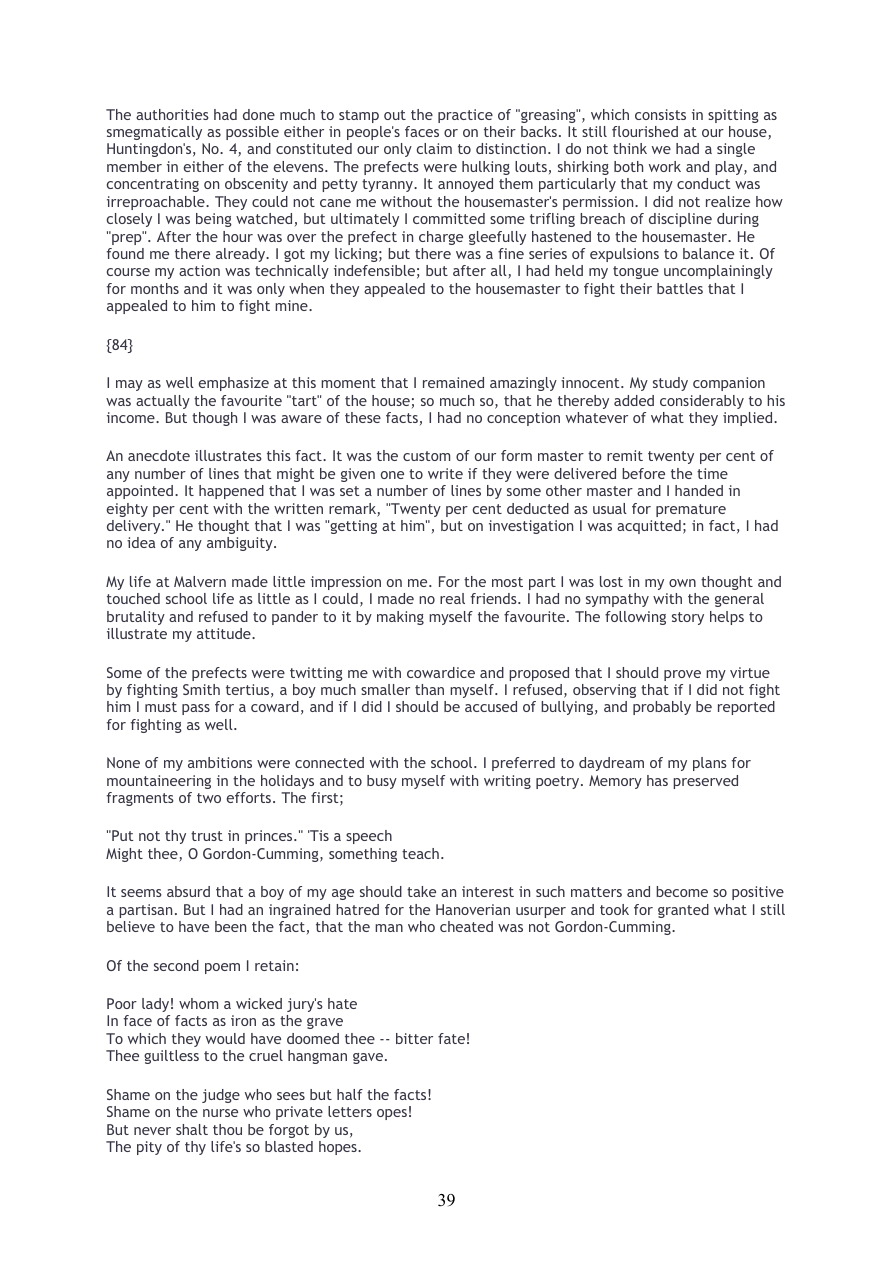
Highlights use the original PDF text layer. OCR-only matches may not be visible on the scan.
Transcription
Download text ↓raw extractionoriginal embedded textReview: unreviewed
39
The authorities had done much to stamp out the practice of "greasing", which consists in spitting as
smegmatically as possible either in people's faces or on their backs. It still flourished at our house,
Huntingdon's, No. 4, and constituted our only claim to distinction. I do not think we had a single
member in either of the elevens. The prefects were hulking louts, shirking both work and play, and
concentrating on obscenity and petty tyranny. It annoyed them particularly that my conduct was
irreproachable. They could not cane me without the housemaster's permission. I did not realize how
closely I was being watched, but ultimately I committed some trifling breach of discipline during
"prep". After the hour was over the prefect in charge gleefully hastened to the housemaster. He
found me there already. I got my licking; but there was a fine series of expulsions to balance it. Of
course my action was technically indefensible; but after all, I had held my tongue uncomplainingly
for months and it was only when they appealed to the housemaster to fight their battles that I
appealed to him to fight mine.
{84}
I may as well emphasize at this moment that I remained amazingly innocent. My study companion
was actually the favourite "tart" of the house; so much so, that he thereby added considerably to his
income. But though I was aware of these facts, I had no conception whatever of what they implied.
An anecdote illustrates this fact. It was the custom of our form master to remit twenty per cent of
any number of lines that might be given one to write if they were delivered before the time
appointed. It happened that I was set a number of lines by some other master and I handed in
eighty per cent with the written remark, "Twenty per cent deducted as usual for premature
delivery." He thought that I was "getting at him", but on investigation I was acquitted; in fact, I had
no idea of any ambiguity.
My life at Malvern made little impression on me. For the most part I was lost in my own thought and
touched school life as little as I could, I made no real friends. I had no sympathy with the general
brutality and refused to pander to it by making myself the favourite. The following story helps to
illustrate my attitude.
Some of the prefects were twitting me with cowardice and proposed that I should prove my virtue
by fighting Smith tertius, a boy much smaller than myself. I refused, observing that if I did not fight
him I must pass for a coward, and if I did I should be accused of bullying, and probably be reported
for fighting as well.
None of my ambitions were connected with the school. I preferred to daydream of my plans for
mountaineering in the holidays and to busy myself with writing poetry. Memory has preserved
fragments of two efforts. The first;
"Put not thy trust in princes." 'Tis a speech
Might thee, O Gordon-Cumming, something teach.
It seems absurd that a boy of my age should take an interest in such matters and become so positive
a partisan. But I had an ingrained hatred for the Hanoverian usurper and took for granted what I still
believe to have been the fact, that the man who cheated was not Gordon-Cumming.
Of the second poem I retain:
Poor lady! whom a wicked jury's hate
In face of facts as iron as the grave
To which they would have doomed thee -- bitter fate!
Thee guiltless to the cruel hangman gave.
Shame on the judge who sees but half the facts!
Shame on the nurse who private letters opes!
But never shalt thou be forgot by us,
The pity of thy life's so blasted hopes.
Page provenance & review flags
Stable page ID: 5ef44b98d8f9c4af5f6f86e1:p00039
Line breaks are preserved. Reading order and OCR accuracy may need review.
Printed page label has not been verified.
- No automated review flags. This does not establish transcription accuracy.