1929 · CLOSE READING
Confessions of Aleister Crowley
Confessions of Aleister Crowley (1929), PDF p. 375
Original page
Enlarge ↗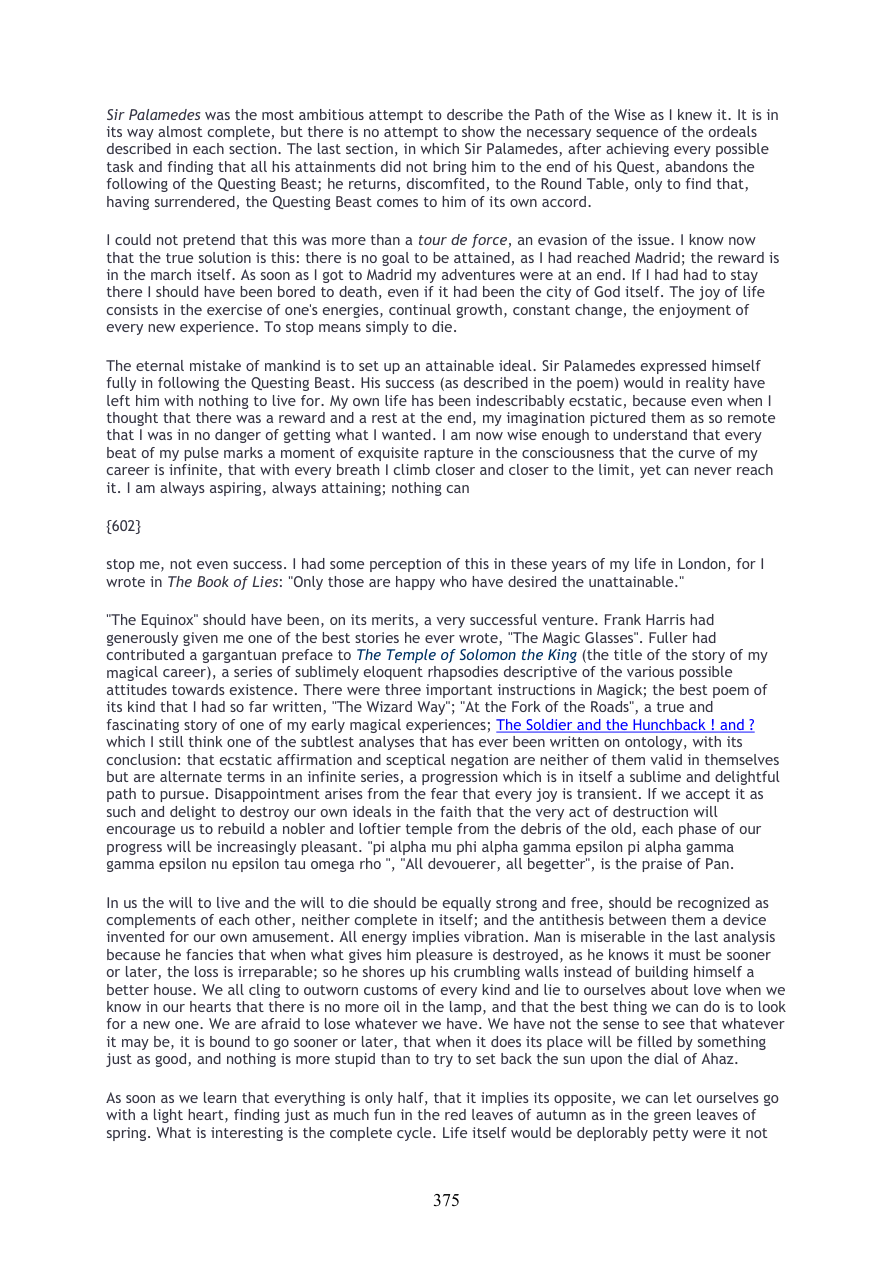
Highlights use the original PDF text layer. OCR-only matches may not be visible on the scan.
Transcription
Download text ↓raw extractionoriginal embedded textReview: unreviewed
375
Sir Palamedes was the most ambitious attempt to describe the Path of the Wise as I knew it. It is in
its way almost complete, but there is no attempt to show the necessary sequence of the ordeals
described in each section. The last section, in which Sir Palamedes, after achieving every possible
task and finding that all his attainments did not bring him to the end of his Quest, abandons the
following of the Questing Beast; he returns, discomfited, to the Round Table, only to find that,
having surrendered, the Questing Beast comes to him of its own accord.
I could not pretend that this was more than a tour de force, an evasion of the issue. I know now
that the true solution is this: there is no goal to be attained, as I had reached Madrid; the reward is
in the march itself. As soon as I got to Madrid my adventures were at an end. If I had had to stay
there I should have been bored to death, even if it had been the city of God itself. The joy of life
consists in the exercise of one's energies, continual growth, constant change, the enjoyment of
every new experience. To stop means simply to die.
The eternal mistake of mankind is to set up an attainable ideal. Sir Palamedes expressed himself
fully in following the Questing Beast. His success (as described in the poem) would in reality have
left him with nothing to live for. My own life has been indescribably ecstatic, because even when I
thought that there was a reward and a rest at the end, my imagination pictured them as so remote
that I was in no danger of getting what I wanted. I am now wise enough to understand that every
beat of my pulse marks a moment of exquisite rapture in the consciousness that the curve of my
career is infinite, that with every breath I climb closer and closer to the limit, yet can never reach
it. I am always aspiring, always attaining; nothing can
{602}
stop me, not even success. I had some perception of this in these years of my life in London, for I
wrote in The Book of Lies: "Only those are happy who have desired the unattainable."
"The Equinox" should have been, on its merits, a very successful venture. Frank Harris had
generously given me one of the best stories he ever wrote, "The Magic Glasses". Fuller had
contributed a gargantuan preface to The Temple of Solomon the King (the title of the story of my
magical career), a series of sublimely eloquent rhapsodies descriptive of the various possible
attitudes towards existence. There were three important instructions in Magick; the best poem of
its kind that I had so far written, "The Wizard Way"; "At the Fork of the Roads", a true and
fascinating story of one of my early magical experiences; The Soldier and the Hunchback ! and ?
which I still think one of the subtlest analyses that has ever been written on ontology, with its
conclusion: that ecstatic affirmation and sceptical negation are neither of them valid in themselves
but are alternate terms in an infinite series, a progression which is in itself a sublime and delightful
path to pursue. Disappointment arises from the fear that every joy is transient. If we accept it as
such and delight to destroy our own ideals in the faith that the very act of destruction will
encourage us to rebuild a nobler and loftier temple from the debris of the old, each phase of our
progress will be increasingly pleasant. "pi alpha mu phi alpha gamma epsilon pi alpha gamma
gamma epsilon nu epsilon tau omega rho ", "All devouerer, all begetter", is the praise of Pan.
In us the will to live and the will to die should be equally strong and free, should be recognized as
complements of each other, neither complete in itself; and the antithesis between them a device
invented for our own amusement. All energy implies vibration. Man is miserable in the last analysis
because he fancies that when what gives him pleasure is destroyed, as he knows it must be sooner
or later, the loss is irreparable; so he shores up his crumbling walls instead of building himself a
better house. We all cling to outworn customs of every kind and lie to ourselves about love when we
know in our hearts that there is no more oil in the lamp, and that the best thing we can do is to look
for a new one. We are afraid to lose whatever we have. We have not the sense to see that whatever
it may be, it is bound to go sooner or later, that when it does its place will be filled by something
just as good, and nothing is more stupid than to try to set back the sun upon the dial of Ahaz.
As soon as we learn that everything is only half, that it implies its opposite, we can let ourselves go
with a light heart, finding just as much fun in the red leaves of autumn as in the green leaves of
spring. What is interesting is the complete cycle. Life itself would be deplorably petty were it not
Page provenance & review flags
Stable page ID: 5ef44b98d8f9c4af5f6f86e1:p00375
Line breaks are preserved. Reading order and OCR accuracy may need review.
Printed page label has not been verified.
- No automated review flags. This does not establish transcription accuracy.