1929 · CLOSE READING
Confessions of Aleister Crowley
Confessions of Aleister Crowley (1929), PDF p. 363
Original page
Enlarge ↗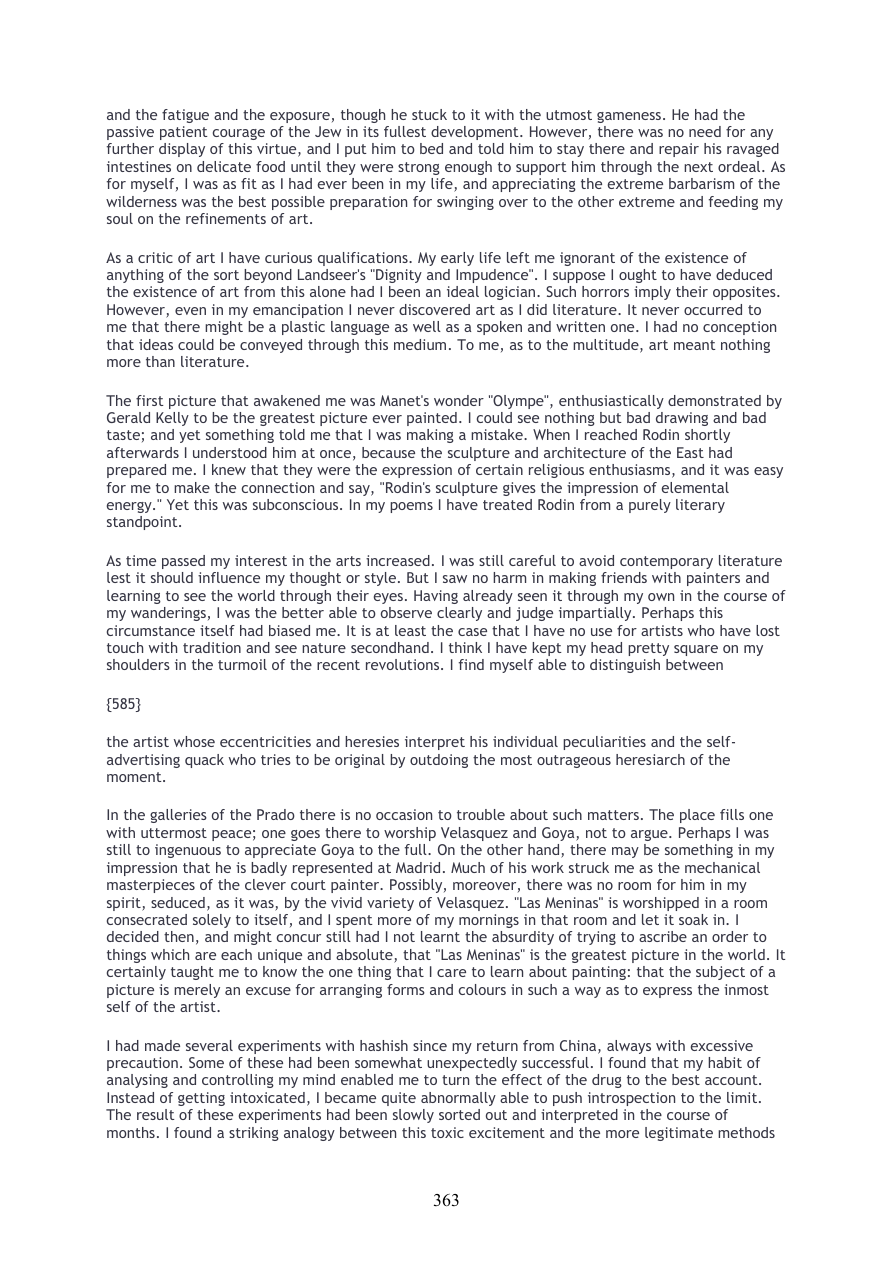
Highlights use the original PDF text layer. OCR-only matches may not be visible on the scan.
Transcription
Download text ↓raw extractionoriginal embedded textReview: unreviewed
363
and the fatigue and the exposure, though he stuck to it with the utmost gameness. He had the
passive patient courage of the Jew in its fullest development. However, there was no need for any
further display of this virtue, and I put him to bed and told him to stay there and repair his ravaged
intestines on delicate food until they were strong enough to support him through the next ordeal. As
for myself, I was as fit as I had ever been in my life, and appreciating the extreme barbarism of the
wilderness was the best possible preparation for swinging over to the other extreme and feeding my
soul on the refinements of art.
As a critic of art I have curious qualifications. My early life left me ignorant of the existence of
anything of the sort beyond Landseer's "Dignity and Impudence". I suppose I ought to have deduced
the existence of art from this alone had I been an ideal logician. Such horrors imply their opposites.
However, even in my emancipation I never discovered art as I did literature. It never occurred to
me that there might be a plastic language as well as a spoken and written one. I had no conception
that ideas could be conveyed through this medium. To me, as to the multitude, art meant nothing
more than literature.
The first picture that awakened me was Manet's wonder "Olympe", enthusiastically demonstrated by
Gerald Kelly to be the greatest picture ever painted. I could see nothing but bad drawing and bad
taste; and yet something told me that I was making a mistake. When I reached Rodin shortly
afterwards I understood him at once, because the sculpture and architecture of the East had
prepared me. I knew that they were the expression of certain religious enthusiasms, and it was easy
for me to make the connection and say, "Rodin's sculpture gives the impression of elemental
energy." Yet this was subconscious. In my poems I have treated Rodin from a purely literary
standpoint.
As time passed my interest in the arts increased. I was still careful to avoid contemporary literature
lest it should influence my thought or style. But I saw no harm in making friends with painters and
learning to see the world through their eyes. Having already seen it through my own in the course of
my wanderings, I was the better able to observe clearly and judge impartially. Perhaps this
circumstance itself had biased me. It is at least the case that I have no use for artists who have lost
touch with tradition and see nature secondhand. I think I have kept my head pretty square on my
shoulders in the turmoil of the recent revolutions. I find myself able to distinguish between
{585}
the artist whose eccentricities and heresies interpret his individual peculiarities and the self-
advertising quack who tries to be original by outdoing the most outrageous heresiarch of the
moment.
In the galleries of the Prado there is no occasion to trouble about such matters. The place fills one
with uttermost peace; one goes there to worship Velasquez and Goya, not to argue. Perhaps I was
still to ingenuous to appreciate Goya to the full. On the other hand, there may be something in my
impression that he is badly represented at Madrid. Much of his work struck me as the mechanical
masterpieces of the clever court painter. Possibly, moreover, there was no room for him in my
spirit, seduced, as it was, by the vivid variety of Velasquez. "Las Meninas" is worshipped in a room
consecrated solely to itself, and I spent more of my mornings in that room and let it soak in. I
decided then, and might concur still had I not learnt the absurdity of trying to ascribe an order to
things which are each unique and absolute, that "Las Meninas" is the greatest picture in the world. It
certainly taught me to know the one thing that I care to learn about painting: that the subject of a
picture is merely an excuse for arranging forms and colours in such a way as to express the inmost
self of the artist.
I had made several experiments with hashish since my return from China, always with excessive
precaution. Some of these had been somewhat unexpectedly successful. I found that my habit of
analysing and controlling my mind enabled me to turn the effect of the drug to the best account.
Instead of getting intoxicated, I became quite abnormally able to push introspection to the limit.
The result of these experiments had been slowly sorted out and interpreted in the course of
months. I found a striking analogy between this toxic excitement and the more legitimate methods
Page provenance & review flags
Stable page ID: 5ef44b98d8f9c4af5f6f86e1:p00363
Line breaks are preserved. Reading order and OCR accuracy may need review.
Printed page label has not been verified.
- No automated review flags. This does not establish transcription accuracy.