1929 · CLOSE READING
Confessions of Aleister Crowley
Confessions of Aleister Crowley (1929), PDF p. 351
Original page
Enlarge ↗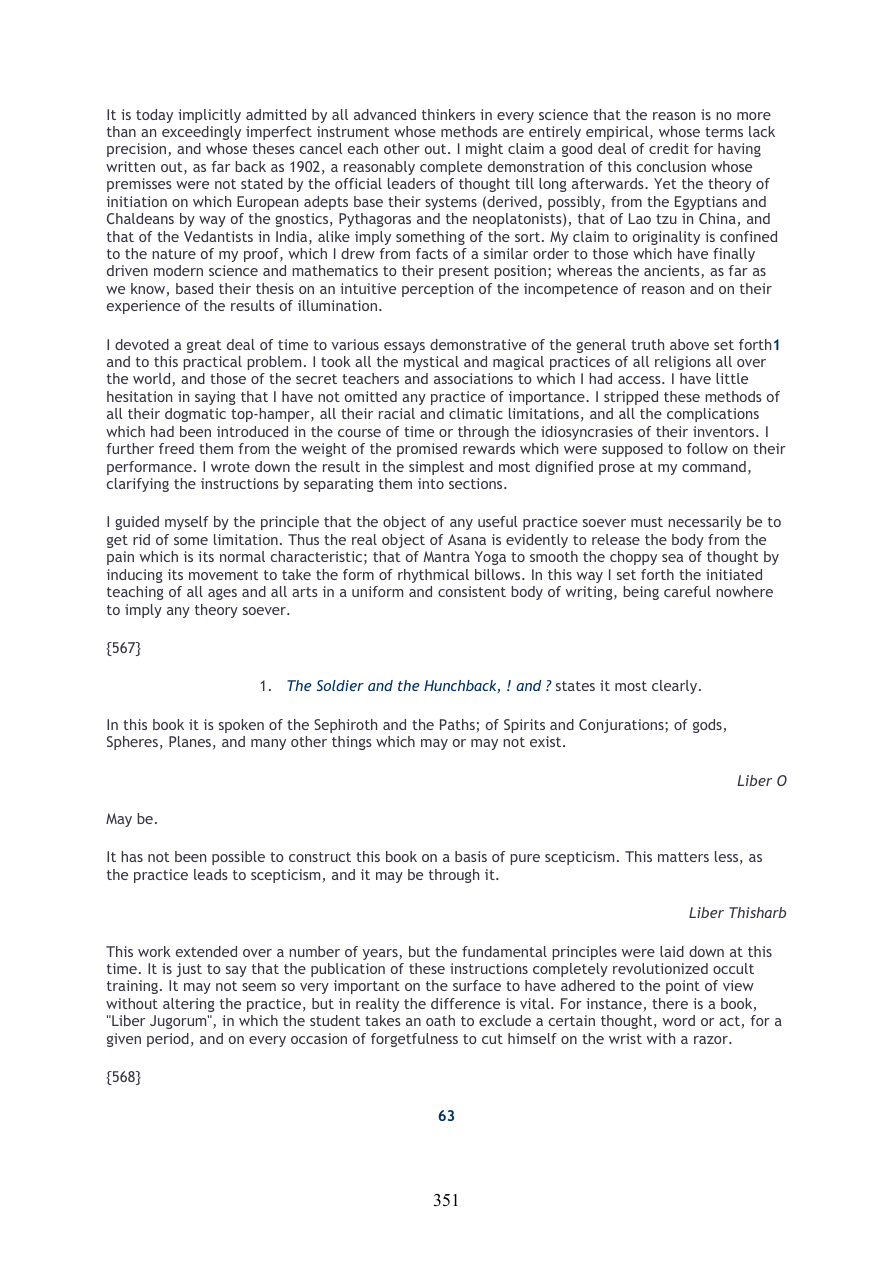
Highlights use the original PDF text layer. OCR-only matches may not be visible on the scan.
Transcription
Download text ↓raw extractionoriginal embedded textReview: unreviewed
351
It is today implicitly admitted by all advanced thinkers in every science that the reason is no more
than an exceedingly imperfect instrument whose methods are entirely empirical, whose terms lack
precision, and whose theses cancel each other out. I might claim a good deal of credit for having
written out, as far back as 1902, a reasonably complete demonstration of this conclusion whose
premisses were not stated by the official leaders of thought till long afterwards. Yet the theory of
initiation on which European adepts base their systems (derived, possibly, from the Egyptians and
Chaldeans by way of the gnostics, Pythagoras and the neoplatonists), that of Lao tzu in China, and
that of the Vedantists in India, alike imply something of the sort. My claim to originality is confined
to the nature of my proof, which I drew from facts of a similar order to those which have finally
driven modern science and mathematics to their present position; whereas the ancients, as far as
we know, based their thesis on an intuitive perception of the incompetence of reason and on their
experience of the results of illumination.
I devoted a great deal of time to various essays demonstrative of the general truth above set forth1
and to this practical problem. I took all the mystical and magical practices of all religions all over
the world, and those of the secret teachers and associations to which I had access. I have little
hesitation in saying that I have not omitted any practice of importance. I stripped these methods of
all their dogmatic top-hamper, all their racial and climatic limitations, and all the complications
which had been introduced in the course of time or through the idiosyncrasies of their inventors. I
further freed them from the weight of the promised rewards which were supposed to follow on their
performance. I wrote down the result in the simplest and most dignified prose at my command,
clarifying the instructions by separating them into sections.
I guided myself by the principle that the object of any useful practice soever must necessarily be to
get rid of some limitation. Thus the real object of Asana is evidently to release the body from the
pain which is its normal characteristic; that of Mantra Yoga to smooth the choppy sea of thought by
inducing its movement to take the form of rhythmical billows. In this way I set forth the initiated
teaching of all ages and all arts in a uniform and consistent body of writing, being careful nowhere
to imply any theory soever.
{567}
1. The Soldier and the Hunchback, ! and ? states it most clearly.
In this book it is spoken of the Sephiroth and the Paths; of Spirits and Conjurations; of gods,
Spheres, Planes, and many other things which may or may not exist.
Liber O
May be.
It has not been possible to construct this book on a basis of pure scepticism. This matters less, as
the practice leads to scepticism, and it may be through it.
Liber Thisharb
This work extended over a number of years, but the fundamental principles were laid down at this
time. It is just to say that the publication of these instructions completely revolutionized occult
training. It may not seem so very important on the surface to have adhered to the point of view
without altering the practice, but in reality the difference is vital. For instance, there is a book,
"Liber Jugorum", in which the student takes an oath to exclude a certain thought, word or act, for a
given period, and on every occasion of forgetfulness to cut himself on the wrist with a razor.
{568}
63
Page provenance & review flags
Stable page ID: 5ef44b98d8f9c4af5f6f86e1:p00351
Line breaks are preserved. Reading order and OCR accuracy may need review.
Printed page label has not been verified.
- No automated review flags. This does not establish transcription accuracy.