1929 · CLOSE READING
Confessions of Aleister Crowley
Confessions of Aleister Crowley (1929), PDF p. 344
Original page
Enlarge ↗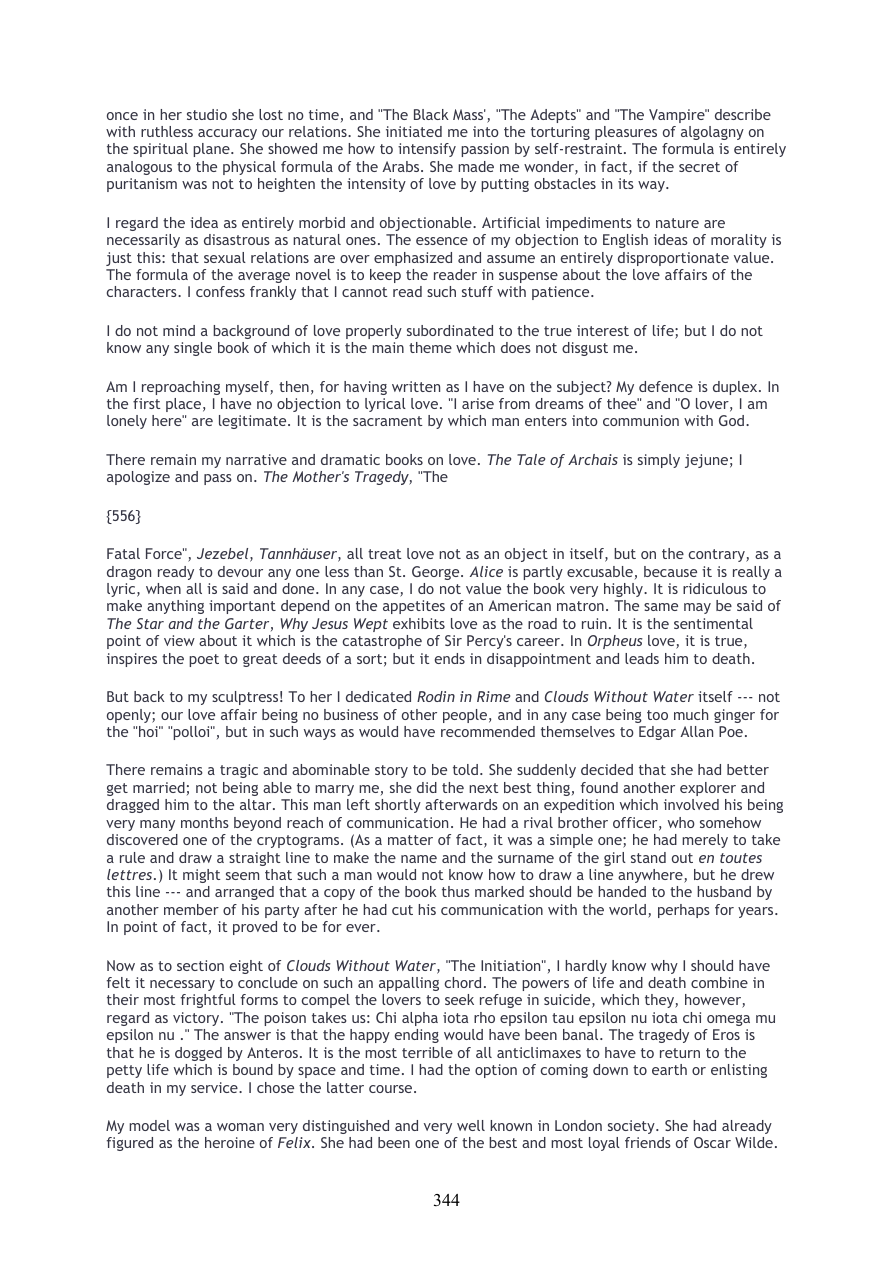
Highlights use the original PDF text layer. OCR-only matches may not be visible on the scan.
Transcription
Download text ↓raw extractionoriginal embedded textReview: unreviewed
344
once in her studio she lost no time, and "The Black Mass', "The Adepts" and "The Vampire" describe
with ruthless accuracy our relations. She initiated me into the torturing pleasures of algolagny on
the spiritual plane. She showed me how to intensify passion by self-restraint. The formula is entirely
analogous to the physical formula of the Arabs. She made me wonder, in fact, if the secret of
puritanism was not to heighten the intensity of love by putting obstacles in its way.
I regard the idea as entirely morbid and objectionable. Artificial impediments to nature are
necessarily as disastrous as natural ones. The essence of my objection to English ideas of morality is
just this: that sexual relations are over emphasized and assume an entirely disproportionate value.
The formula of the average novel is to keep the reader in suspense about the love affairs of the
characters. I confess frankly that I cannot read such stuff with patience.
I do not mind a background of love properly subordinated to the true interest of life; but I do not
know any single book of which it is the main theme which does not disgust me.
Am I reproaching myself, then, for having written as I have on the subject? My defence is duplex. In
the first place, I have no objection to lyrical love. "I arise from dreams of thee" and "O lover, I am
lonely here" are legitimate. It is the sacrament by which man enters into communion with God.
There remain my narrative and dramatic books on love. The Tale of Archais is simply jejune; I
apologize and pass on. The Mother's Tragedy, "The
{556}
Fatal Force", Jezebel, Tannhäuser, all treat love not as an object in itself, but on the contrary, as a
dragon ready to devour any one less than St. George. Alice is partly excusable, because it is really a
lyric, when all is said and done. In any case, I do not value the book very highly. It is ridiculous to
make anything important depend on the appetites of an American matron. The same may be said of
The Star and the Garter, Why Jesus Wept exhibits love as the road to ruin. It is the sentimental
point of view about it which is the catastrophe of Sir Percy's career. In Orpheus love, it is true,
inspires the poet to great deeds of a sort; but it ends in disappointment and leads him to death.
But back to my sculptress! To her I dedicated Rodin in Rime and Clouds Without Water itself --- not
openly; our love affair being no business of other people, and in any case being too much ginger for
the "hoi" "polloi", but in such ways as would have recommended themselves to Edgar Allan Poe.
There remains a tragic and abominable story to be told. She suddenly decided that she had better
get married; not being able to marry me, she did the next best thing, found another explorer and
dragged him to the altar. This man left shortly afterwards on an expedition which involved his being
very many months beyond reach of communication. He had a rival brother officer, who somehow
discovered one of the cryptograms. (As a matter of fact, it was a simple one; he had merely to take
a rule and draw a straight line to make the name and the surname of the girl stand out en toutes
lettres.) It might seem that such a man would not know how to draw a line anywhere, but he drew
this line --- and arranged that a copy of the book thus marked should be handed to the husband by
another member of his party after he had cut his communication with the world, perhaps for years.
In point of fact, it proved to be for ever.
Now as to section eight of Clouds Without Water, "The Initiation", I hardly know why I should have
felt it necessary to conclude on such an appalling chord. The powers of life and death combine in
their most frightful forms to compel the lovers to seek refuge in suicide, which they, however,
regard as victory. "The poison takes us: Chi alpha iota rho epsilon tau epsilon nu iota chi omega mu
epsilon nu ." The answer is that the happy ending would have been banal. The tragedy of Eros is
that he is dogged by Anteros. It is the most terrible of all anticlimaxes to have to return to the
petty life which is bound by space and time. I had the option of coming down to earth or enlisting
death in my service. I chose the latter course.
My model was a woman very distinguished and very well known in London society. She had already
figured as the heroine of Felix. She had been one of the best and most loyal friends of Oscar Wilde.
Page provenance & review flags
Stable page ID: 5ef44b98d8f9c4af5f6f86e1:p00344
Line breaks are preserved. Reading order and OCR accuracy may need review.
Printed page label has not been verified.
- No automated review flags. This does not establish transcription accuracy.