1929 · CLOSE READING
Confessions of Aleister Crowley
Confessions of Aleister Crowley (1929), PDF p. 343
Original page
Enlarge ↗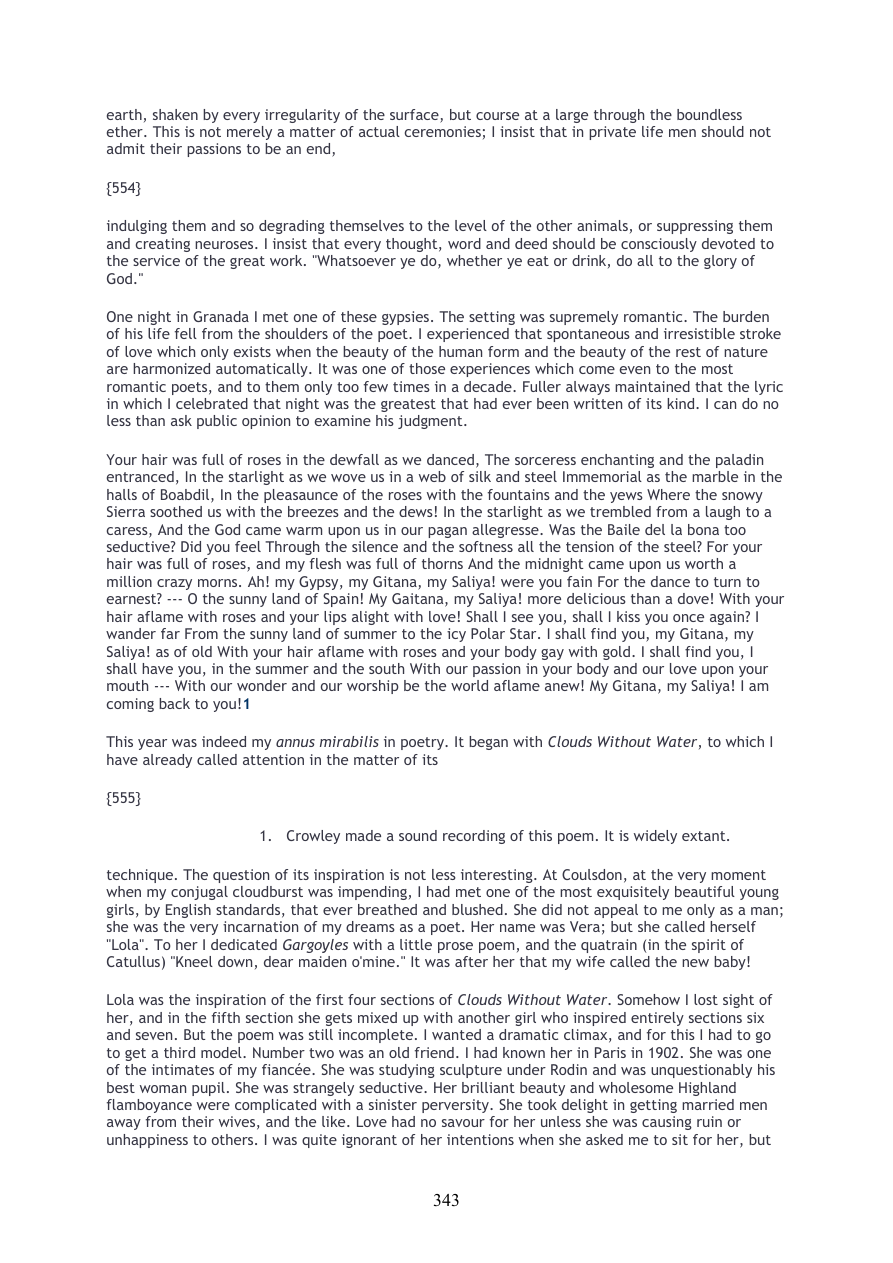
Highlights use the original PDF text layer. OCR-only matches may not be visible on the scan.
Transcription
Download text ↓raw extractionoriginal embedded textReview: unreviewed
343
earth, shaken by every irregularity of the surface, but course at a large through the boundless
ether. This is not merely a matter of actual ceremonies; I insist that in private life men should not
admit their passions to be an end,
{554}
indulging them and so degrading themselves to the level of the other animals, or suppressing them
and creating neuroses. I insist that every thought, word and deed should be consciously devoted to
the service of the great work. "Whatsoever ye do, whether ye eat or drink, do all to the glory of
God."
One night in Granada I met one of these gypsies. The setting was supremely romantic. The burden
of his life fell from the shoulders of the poet. I experienced that spontaneous and irresistible stroke
of love which only exists when the beauty of the human form and the beauty of the rest of nature
are harmonized automatically. It was one of those experiences which come even to the most
romantic poets, and to them only too few times in a decade. Fuller always maintained that the lyric
in which I celebrated that night was the greatest that had ever been written of its kind. I can do no
less than ask public opinion to examine his judgment.
Your hair was full of roses in the dewfall as we danced, The sorceress enchanting and the paladin
entranced, In the starlight as we wove us in a web of silk and steel Immemorial as the marble in the
halls of Boabdil, In the pleasaunce of the roses with the fountains and the yews Where the snowy
Sierra soothed us with the breezes and the dews! In the starlight as we trembled from a laugh to a
caress, And the God came warm upon us in our pagan allegresse. Was the Baile del la bona too
seductive? Did you feel Through the silence and the softness all the tension of the steel? For your
hair was full of roses, and my flesh was full of thorns And the midnight came upon us worth a
million crazy morns. Ah! my Gypsy, my Gitana, my Saliya! were you fain For the dance to turn to
earnest? --- O the sunny land of Spain! My Gaitana, my Saliya! more delicious than a dove! With your
hair aflame with roses and your lips alight with love! Shall I see you, shall I kiss you once again? I
wander far From the sunny land of summer to the icy Polar Star. I shall find you, my Gitana, my
Saliya! as of old With your hair aflame with roses and your body gay with gold. I shall find you, I
shall have you, in the summer and the south With our passion in your body and our love upon your
mouth --- With our wonder and our worship be the world aflame anew! My Gitana, my Saliya! I am
coming back to you!1
This year was indeed my annus mirabilis in poetry. It began with Clouds Without Water, to which I
have already called attention in the matter of its
{555}
1. Crowley made a sound recording of this poem. It is widely extant.
technique. The question of its inspiration is not less interesting. At Coulsdon, at the very moment
when my conjugal cloudburst was impending, I had met one of the most exquisitely beautiful young
girls, by English standards, that ever breathed and blushed. She did not appeal to me only as a man;
she was the very incarnation of my dreams as a poet. Her name was Vera; but she called herself
"Lola". To her I dedicated Gargoyles with a little prose poem, and the quatrain (in the spirit of
Catullus) "Kneel down, dear maiden o'mine." It was after her that my wife called the new baby!
Lola was the inspiration of the first four sections of Clouds Without Water. Somehow I lost sight of
her, and in the fifth section she gets mixed up with another girl who inspired entirely sections six
and seven. But the poem was still incomplete. I wanted a dramatic climax, and for this I had to go
to get a third model. Number two was an old friend. I had known her in Paris in 1902. She was one
of the intimates of my fiancée. She was studying sculpture under Rodin and was unquestionably his
best woman pupil. She was strangely seductive. Her brilliant beauty and wholesome Highland
flamboyance were complicated with a sinister perversity. She took delight in getting married men
away from their wives, and the like. Love had no savour for her unless she was causing ruin or
unhappiness to others. I was quite ignorant of her intentions when she asked me to sit for her, but
Page provenance & review flags
Stable page ID: 5ef44b98d8f9c4af5f6f86e1:p00343
Line breaks are preserved. Reading order and OCR accuracy may need review.
Printed page label has not been verified.
- No automated review flags. This does not establish transcription accuracy.