1929 · CLOSE READING
Confessions of Aleister Crowley
Confessions of Aleister Crowley (1929), PDF p. 341
Original page
Enlarge ↗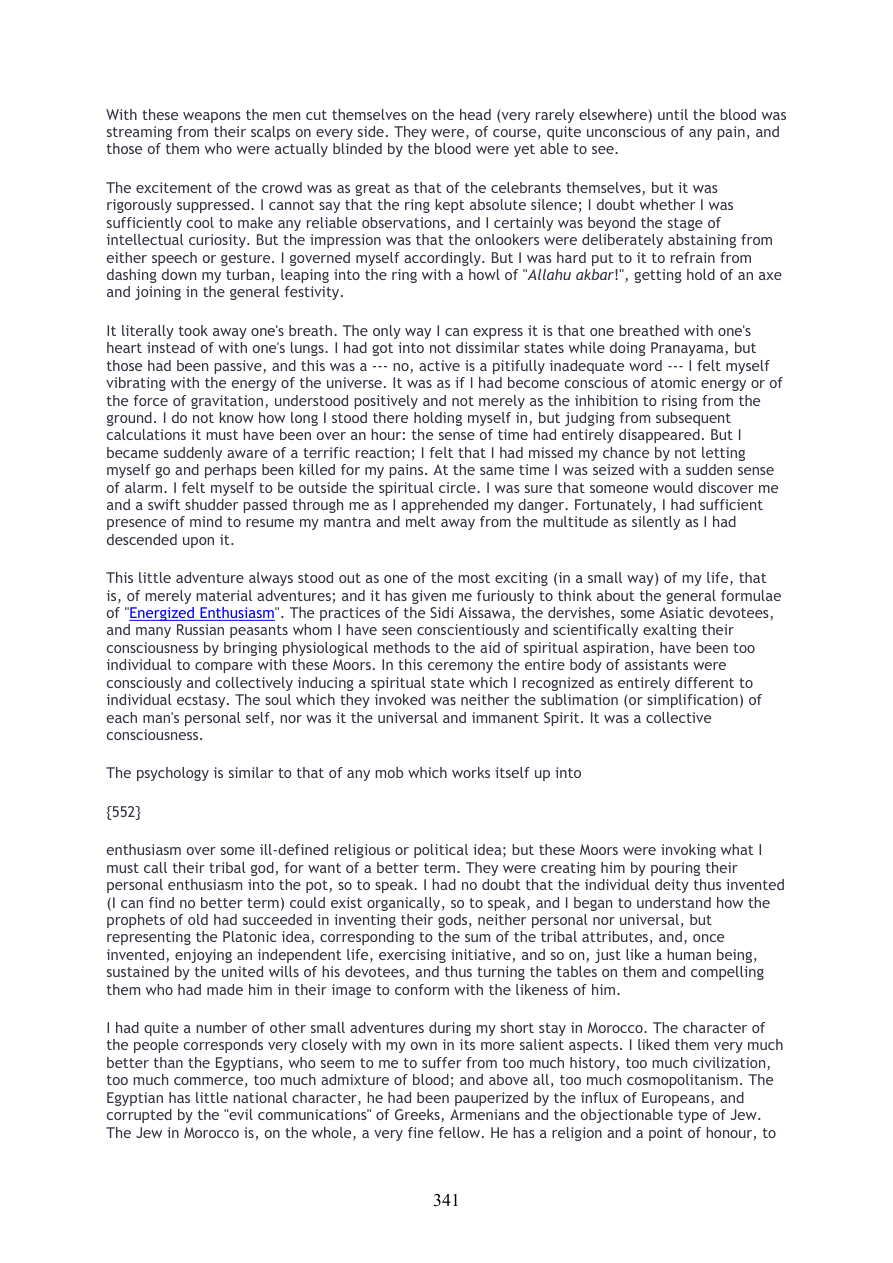
Highlights use the original PDF text layer. OCR-only matches may not be visible on the scan.
Transcription
Download text ↓raw extractionoriginal embedded textReview: unreviewed
341
With these weapons the men cut themselves on the head (very rarely elsewhere) until the blood was
streaming from their scalps on every side. They were, of course, quite unconscious of any pain, and
those of them who were actually blinded by the blood were yet able to see.
The excitement of the crowd was as great as that of the celebrants themselves, but it was
rigorously suppressed. I cannot say that the ring kept absolute silence; I doubt whether I was
sufficiently cool to make any reliable observations, and I certainly was beyond the stage of
intellectual curiosity. But the impression was that the onlookers were deliberately abstaining from
either speech or gesture. I governed myself accordingly. But I was hard put to it to refrain from
dashing down my turban, leaping into the ring with a howl of "Allahu akbar!", getting hold of an axe
and joining in the general festivity.
It literally took away one's breath. The only way I can express it is that one breathed with one's
heart instead of with one's lungs. I had got into not dissimilar states while doing Pranayama, but
those had been passive, and this was a --- no, active is a pitifully inadequate word --- I felt myself
vibrating with the energy of the universe. It was as if I had become conscious of atomic energy or of
the force of gravitation, understood positively and not merely as the inhibition to rising from the
ground. I do not know how long I stood there holding myself in, but judging from subsequent
calculations it must have been over an hour: the sense of time had entirely disappeared. But I
became suddenly aware of a terrific reaction; I felt that I had missed my chance by not letting
myself go and perhaps been killed for my pains. At the same time I was seized with a sudden sense
of alarm. I felt myself to be outside the spiritual circle. I was sure that someone would discover me
and a swift shudder passed through me as I apprehended my danger. Fortunately, I had sufficient
presence of mind to resume my mantra and melt away from the multitude as silently as I had
descended upon it.
This little adventure always stood out as one of the most exciting (in a small way) of my life, that
is, of merely material adventures; and it has given me furiously to think about the general formulae
of "Energized Enthusiasm". The practices of the Sidi Aissawa, the dervishes, some Asiatic devotees,
and many Russian peasants whom I have seen conscientiously and scientifically exalting their
consciousness by bringing physiological methods to the aid of spiritual aspiration, have been too
individual to compare with these Moors. In this ceremony the entire body of assistants were
consciously and collectively inducing a spiritual state which I recognized as entirely different to
individual ecstasy. The soul which they invoked was neither the sublimation (or simplification) of
each man's personal self, nor was it the universal and immanent Spirit. It was a collective
consciousness.
The psychology is similar to that of any mob which works itself up into
{552}
enthusiasm over some ill-defined religious or political idea; but these Moors were invoking what I
must call their tribal god, for want of a better term. They were creating him by pouring their
personal enthusiasm into the pot, so to speak. I had no doubt that the individual deity thus invented
(I can find no better term) could exist organically, so to speak, and I began to understand how the
prophets of old had succeeded in inventing their gods, neither personal nor universal, but
representing the Platonic idea, corresponding to the sum of the tribal attributes, and, once
invented, enjoying an independent life, exercising initiative, and so on, just like a human being,
sustained by the united wills of his devotees, and thus turning the tables on them and compelling
them who had made him in their image to conform with the likeness of him.
I had quite a number of other small adventures during my short stay in Morocco. The character of
the people corresponds very closely with my own in its more salient aspects. I liked them very much
better than the Egyptians, who seem to me to suffer from too much history, too much civilization,
too much commerce, too much admixture of blood; and above all, too much cosmopolitanism. The
Egyptian has little national character, he had been pauperized by the influx of Europeans, and
corrupted by the "evil communications" of Greeks, Armenians and the objectionable type of Jew.
The Jew in Morocco is, on the whole, a very fine fellow. He has a religion and a point of honour, to
Page provenance & review flags
Stable page ID: 5ef44b98d8f9c4af5f6f86e1:p00341
Line breaks are preserved. Reading order and OCR accuracy may need review.
Printed page label has not been verified.
- No automated review flags. This does not establish transcription accuracy.