1929 · CLOSE READING
Confessions of Aleister Crowley
Confessions of Aleister Crowley (1929), PDF p. 33
Original page
Enlarge ↗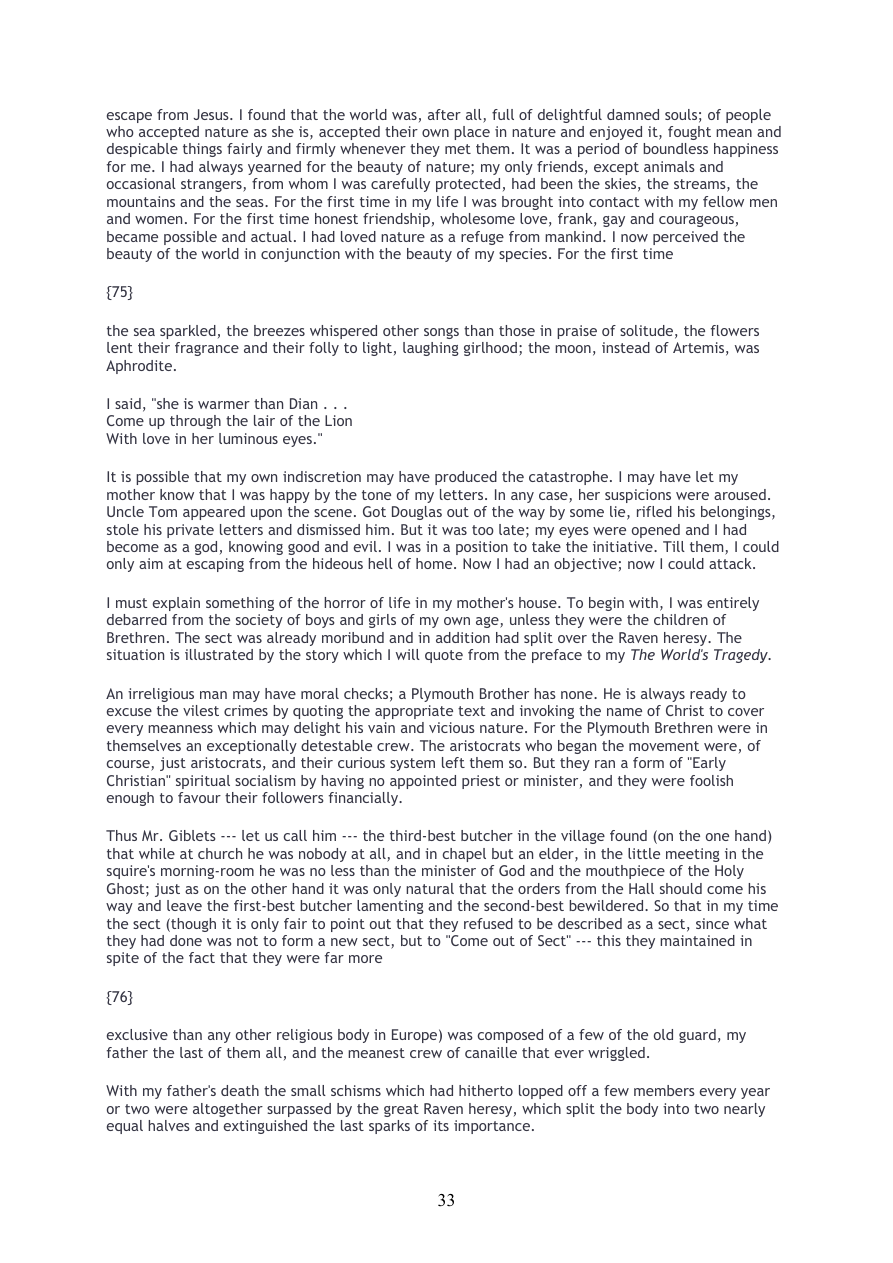
Highlights use the original PDF text layer. OCR-only matches may not be visible on the scan.
Transcription
Download text ↓raw extractionoriginal embedded textReview: unreviewed
33
escape from Jesus. I found that the world was, after all, full of delightful damned souls; of people
who accepted nature as she is, accepted their own place in nature and enjoyed it, fought mean and
despicable things fairly and firmly whenever they met them. It was a period of boundless happiness
for me. I had always yearned for the beauty of nature; my only friends, except animals and
occasional strangers, from whom I was carefully protected, had been the skies, the streams, the
mountains and the seas. For the first time in my life I was brought into contact with my fellow men
and women. For the first time honest friendship, wholesome love, frank, gay and courageous,
became possible and actual. I had loved nature as a refuge from mankind. I now perceived the
beauty of the world in conjunction with the beauty of my species. For the first time
{75}
the sea sparkled, the breezes whispered other songs than those in praise of solitude, the flowers
lent their fragrance and their folly to light, laughing girlhood; the moon, instead of Artemis, was
Aphrodite.
I said, "she is warmer than Dian . . .
Come up through the lair of the Lion
With love in her luminous eyes."
It is possible that my own indiscretion may have produced the catastrophe. I may have let my
mother know that I was happy by the tone of my letters. In any case, her suspicions were aroused.
Uncle Tom appeared upon the scene. Got Douglas out of the way by some lie, rifled his belongings,
stole his private letters and dismissed him. But it was too late; my eyes were opened and I had
become as a god, knowing good and evil. I was in a position to take the initiative. Till them, I could
only aim at escaping from the hideous hell of home. Now I had an objective; now I could attack.
I must explain something of the horror of life in my mother's house. To begin with, I was entirely
debarred from the society of boys and girls of my own age, unless they were the children of
Brethren. The sect was already moribund and in addition had split over the Raven heresy. The
situation is illustrated by the story which I will quote from the preface to my The World's Tragedy.
An irreligious man may have moral checks; a Plymouth Brother has none. He is always ready to
excuse the vilest crimes by quoting the appropriate text and invoking the name of Christ to cover
every meanness which may delight his vain and vicious nature. For the Plymouth Brethren were in
themselves an exceptionally detestable crew. The aristocrats who began the movement were, of
course, just aristocrats, and their curious system left them so. But they ran a form of "Early
Christian" spiritual socialism by having no appointed priest or minister, and they were foolish
enough to favour their followers financially.
Thus Mr. Giblets --- let us call him --- the third-best butcher in the village found (on the one hand)
that while at church he was nobody at all, and in chapel but an elder, in the little meeting in the
squire's morning-room he was no less than the minister of God and the mouthpiece of the Holy
Ghost; just as on the other hand it was only natural that the orders from the Hall should come his
way and leave the first-best butcher lamenting and the second-best bewildered. So that in my time
the sect (though it is only fair to point out that they refused to be described as a sect, since what
they had done was not to form a new sect, but to "Come out of Sect" --- this they maintained in
spite of the fact that they were far more
{76}
exclusive than any other religious body in Europe) was composed of a few of the old guard, my
father the last of them all, and the meanest crew of canaille that ever wriggled.
With my father's death the small schisms which had hitherto lopped off a few members every year
or two were altogether surpassed by the great Raven heresy, which split the body into two nearly
equal halves and extinguished the last sparks of its importance.
Page provenance & review flags
Stable page ID: 5ef44b98d8f9c4af5f6f86e1:p00033
Line breaks are preserved. Reading order and OCR accuracy may need review.
Printed page label has not been verified.
- No automated review flags. This does not establish transcription accuracy.