1929 · CLOSE READING
Confessions of Aleister Crowley
Confessions of Aleister Crowley (1929), PDF p. 337
Original page
Enlarge ↗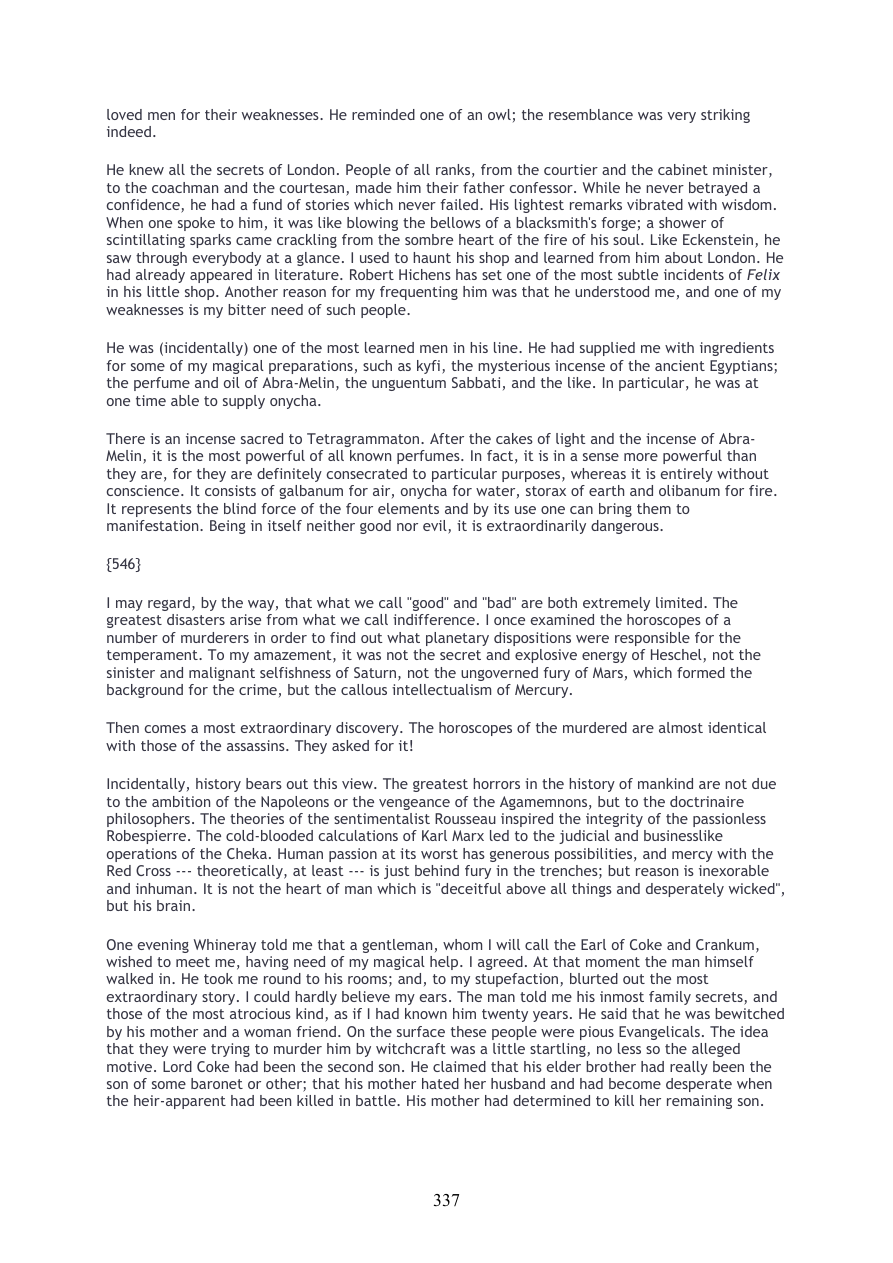
Highlights use the original PDF text layer. OCR-only matches may not be visible on the scan.
Transcription
Download text ↓raw extractionoriginal embedded textReview: unreviewed
337
loved men for their weaknesses. He reminded one of an owl; the resemblance was very striking
indeed.
He knew all the secrets of London. People of all ranks, from the courtier and the cabinet minister,
to the coachman and the courtesan, made him their father confessor. While he never betrayed a
confidence, he had a fund of stories which never failed. His lightest remarks vibrated with wisdom.
When one spoke to him, it was like blowing the bellows of a blacksmith's forge; a shower of
scintillating sparks came crackling from the sombre heart of the fire of his soul. Like Eckenstein, he
saw through everybody at a glance. I used to haunt his shop and learned from him about London. He
had already appeared in literature. Robert Hichens has set one of the most subtle incidents of Felix
in his little shop. Another reason for my frequenting him was that he understood me, and one of my
weaknesses is my bitter need of such people.
He was (incidentally) one of the most learned men in his line. He had supplied me with ingredients
for some of my magical preparations, such as kyfi, the mysterious incense of the ancient Egyptians;
the perfume and oil of Abra-Melin, the unguentum Sabbati, and the like. In particular, he was at
one time able to supply onycha.
There is an incense sacred to Tetragrammaton. After the cakes of light and the incense of Abra-
Melin, it is the most powerful of all known perfumes. In fact, it is in a sense more powerful than
they are, for they are definitely consecrated to particular purposes, whereas it is entirely without
conscience. It consists of galbanum for air, onycha for water, storax of earth and olibanum for fire.
It represents the blind force of the four elements and by its use one can bring them to
manifestation. Being in itself neither good nor evil, it is extraordinarily dangerous.
{546}
I may regard, by the way, that what we call "good" and "bad" are both extremely limited. The
greatest disasters arise from what we call indifference. I once examined the horoscopes of a
number of murderers in order to find out what planetary dispositions were responsible for the
temperament. To my amazement, it was not the secret and explosive energy of Heschel, not the
sinister and malignant selfishness of Saturn, not the ungoverned fury of Mars, which formed the
background for the crime, but the callous intellectualism of Mercury.
Then comes a most extraordinary discovery. The horoscopes of the murdered are almost identical
with those of the assassins. They asked for it!
Incidentally, history bears out this view. The greatest horrors in the history of mankind are not due
to the ambition of the Napoleons or the vengeance of the Agamemnons, but to the doctrinaire
philosophers. The theories of the sentimentalist Rousseau inspired the integrity of the passionless
Robespierre. The cold-blooded calculations of Karl Marx led to the judicial and businesslike
operations of the Cheka. Human passion at its worst has generous possibilities, and mercy with the
Red Cross --- theoretically, at least --- is just behind fury in the trenches; but reason is inexorable
and inhuman. It is not the heart of man which is "deceitful above all things and desperately wicked",
but his brain.
One evening Whineray told me that a gentleman, whom I will call the Earl of Coke and Crankum,
wished to meet me, having need of my magical help. I agreed. At that moment the man himself
walked in. He took me round to his rooms; and, to my stupefaction, blurted out the most
extraordinary story. I could hardly believe my ears. The man told me his inmost family secrets, and
those of the most atrocious kind, as if I had known him twenty years. He said that he was bewitched
by his mother and a woman friend. On the surface these people were pious Evangelicals. The idea
that they were trying to murder him by witchcraft was a little startling, no less so the alleged
motive. Lord Coke had been the second son. He claimed that his elder brother had really been the
son of some baronet or other; that his mother hated her husband and had become desperate when
the heir-apparent had been killed in battle. His mother had determined to kill her remaining son.
Page provenance & review flags
Stable page ID: 5ef44b98d8f9c4af5f6f86e1:p00337
Line breaks are preserved. Reading order and OCR accuracy may need review.
Printed page label has not been verified.
- No automated review flags. This does not establish transcription accuracy.