1929 · CLOSE READING
Confessions of Aleister Crowley
Confessions of Aleister Crowley (1929), PDF p. 336
Original page
Enlarge ↗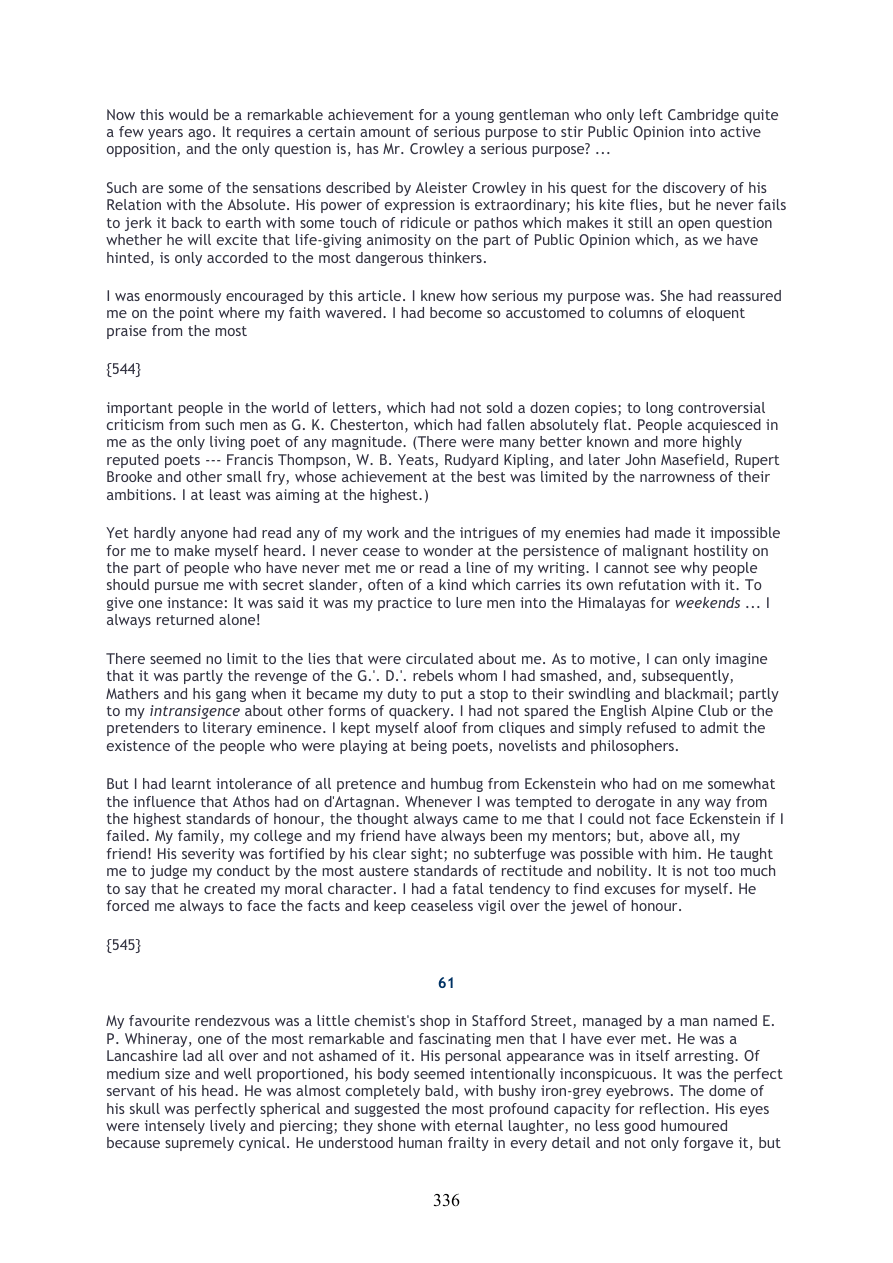
Highlights use the original PDF text layer. OCR-only matches may not be visible on the scan.
Transcription
Download text ↓raw extractionoriginal embedded textReview: unreviewed
336
Now this would be a remarkable achievement for a young gentleman who only left Cambridge quite
a few years ago. It requires a certain amount of serious purpose to stir Public Opinion into active
opposition, and the only question is, has Mr. Crowley a serious purpose? ...
Such are some of the sensations described by Aleister Crowley in his quest for the discovery of his
Relation with the Absolute. His power of expression is extraordinary; his kite flies, but he never fails
to jerk it back to earth with some touch of ridicule or pathos which makes it still an open question
whether he will excite that life-giving animosity on the part of Public Opinion which, as we have
hinted, is only accorded to the most dangerous thinkers.
I was enormously encouraged by this article. I knew how serious my purpose was. She had reassured
me on the point where my faith wavered. I had become so accustomed to columns of eloquent
praise from the most
{544}
important people in the world of letters, which had not sold a dozen copies; to long controversial
criticism from such men as G. K. Chesterton, which had fallen absolutely flat. People acquiesced in
me as the only living poet of any magnitude. (There were many better known and more highly
reputed poets --- Francis Thompson, W. B. Yeats, Rudyard Kipling, and later John Masefield, Rupert
Brooke and other small fry, whose achievement at the best was limited by the narrowness of their
ambitions. I at least was aiming at the highest.)
Yet hardly anyone had read any of my work and the intrigues of my enemies had made it impossible
for me to make myself heard. I never cease to wonder at the persistence of malignant hostility on
the part of people who have never met me or read a line of my writing. I cannot see why people
should pursue me with secret slander, often of a kind which carries its own refutation with it. To
give one instance: It was said it was my practice to lure men into the Himalayas for weekends ... I
always returned alone!
There seemed no limit to the lies that were circulated about me. As to motive, I can only imagine
that it was partly the revenge of the G.'. D.'. rebels whom I had smashed, and, subsequently,
Mathers and his gang when it became my duty to put a stop to their swindling and blackmail; partly
to my intransigence about other forms of quackery. I had not spared the English Alpine Club or the
pretenders to literary eminence. I kept myself aloof from cliques and simply refused to admit the
existence of the people who were playing at being poets, novelists and philosophers.
But I had learnt intolerance of all pretence and humbug from Eckenstein who had on me somewhat
the influence that Athos had on d'Artagnan. Whenever I was tempted to derogate in any way from
the highest standards of honour, the thought always came to me that I could not face Eckenstein if I
failed. My family, my college and my friend have always been my mentors; but, above all, my
friend! His severity was fortified by his clear sight; no subterfuge was possible with him. He taught
me to judge my conduct by the most austere standards of rectitude and nobility. It is not too much
to say that he created my moral character. I had a fatal tendency to find excuses for myself. He
forced me always to face the facts and keep ceaseless vigil over the jewel of honour.
{545}
61
My favourite rendezvous was a little chemist's shop in Stafford Street, managed by a man named E.
P. Whineray, one of the most remarkable and fascinating men that I have ever met. He was a
Lancashire lad all over and not ashamed of it. His personal appearance was in itself arresting. Of
medium size and well proportioned, his body seemed intentionally inconspicuous. It was the perfect
servant of his head. He was almost completely bald, with bushy iron-grey eyebrows. The dome of
his skull was perfectly spherical and suggested the most profound capacity for reflection. His eyes
were intensely lively and piercing; they shone with eternal laughter, no less good humoured
because supremely cynical. He understood human frailty in every detail and not only forgave it, but
Page provenance & review flags
Stable page ID: 5ef44b98d8f9c4af5f6f86e1:p00336
Line breaks are preserved. Reading order and OCR accuracy may need review.
Printed page label has not been verified.
- No automated review flags. This does not establish transcription accuracy.