1929 · CLOSE READING
Confessions of Aleister Crowley
Confessions of Aleister Crowley (1929), PDF p. 333
Original page
Enlarge ↗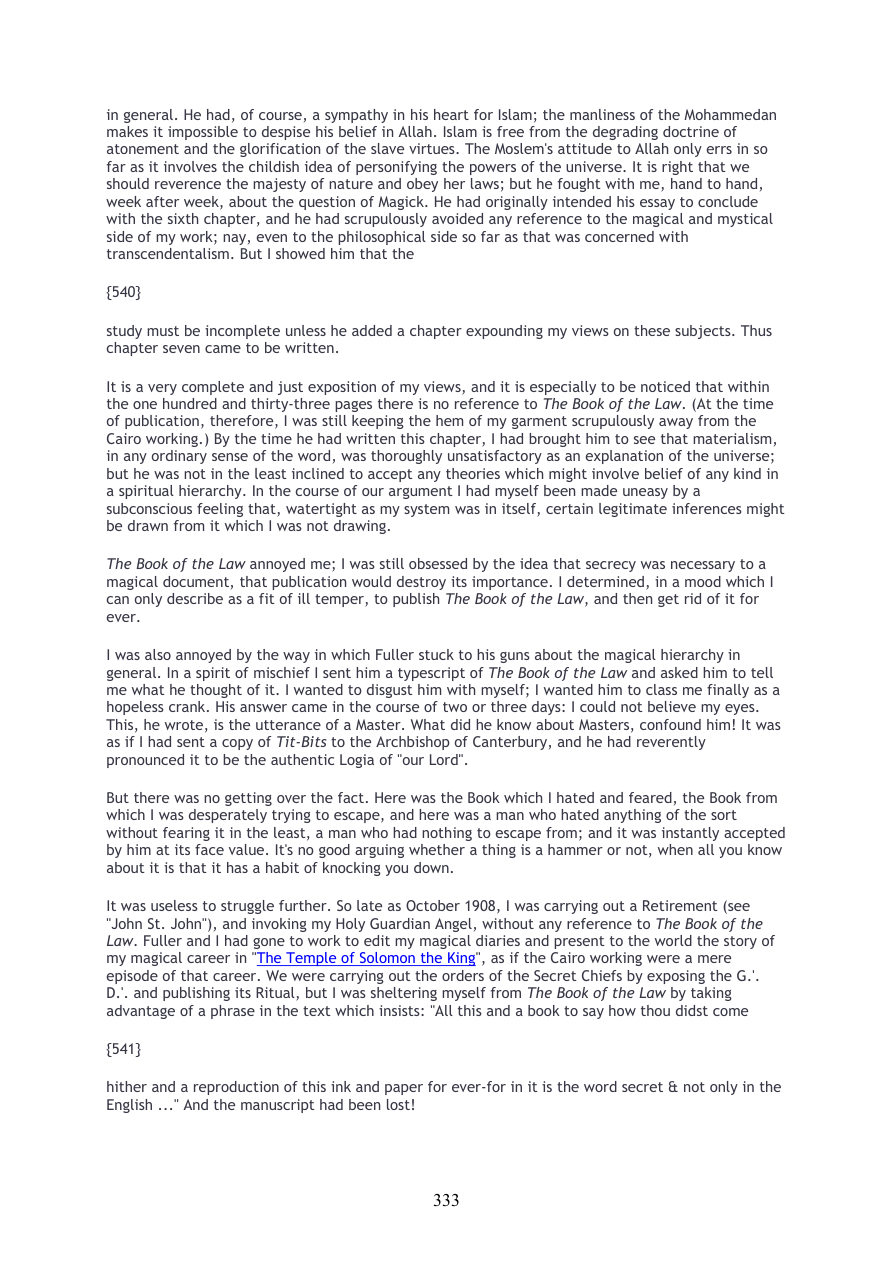
Highlights use the original PDF text layer. OCR-only matches may not be visible on the scan.
Transcription
Download text ↓raw extractionoriginal embedded textReview: unreviewed
333
in general. He had, of course, a sympathy in his heart for Islam; the manliness of the Mohammedan
makes it impossible to despise his belief in Allah. Islam is free from the degrading doctrine of
atonement and the glorification of the slave virtues. The Moslem's attitude to Allah only errs in so
far as it involves the childish idea of personifying the powers of the universe. It is right that we
should reverence the majesty of nature and obey her laws; but he fought with me, hand to hand,
week after week, about the question of Magick. He had originally intended his essay to conclude
with the sixth chapter, and he had scrupulously avoided any reference to the magical and mystical
side of my work; nay, even to the philosophical side so far as that was concerned with
transcendentalism. But I showed him that the
{540}
study must be incomplete unless he added a chapter expounding my views on these subjects. Thus
chapter seven came to be written.
It is a very complete and just exposition of my views, and it is especially to be noticed that within
the one hundred and thirty-three pages there is no reference to The Book of the Law. (At the time
of publication, therefore, I was still keeping the hem of my garment scrupulously away from the
Cairo working.) By the time he had written this chapter, I had brought him to see that materialism,
in any ordinary sense of the word, was thoroughly unsatisfactory as an explanation of the universe;
but he was not in the least inclined to accept any theories which might involve belief of any kind in
a spiritual hierarchy. In the course of our argument I had myself been made uneasy by a
subconscious feeling that, watertight as my system was in itself, certain legitimate inferences might
be drawn from it which I was not drawing.
The Book of the Law annoyed me; I was still obsessed by the idea that secrecy was necessary to a
magical document, that publication would destroy its importance. I determined, in a mood which I
can only describe as a fit of ill temper, to publish The Book of the Law, and then get rid of it for
ever.
I was also annoyed by the way in which Fuller stuck to his guns about the magical hierarchy in
general. In a spirit of mischief I sent him a typescript of The Book of the Law and asked him to tell
me what he thought of it. I wanted to disgust him with myself; I wanted him to class me finally as a
hopeless crank. His answer came in the course of two or three days: I could not believe my eyes.
This, he wrote, is the utterance of a Master. What did he know about Masters, confound him! It was
as if I had sent a copy of Tit-Bits to the Archbishop of Canterbury, and he had reverently
pronounced it to be the authentic Logia of "our Lord".
But there was no getting over the fact. Here was the Book which I hated and feared, the Book from
which I was desperately trying to escape, and here was a man who hated anything of the sort
without fearing it in the least, a man who had nothing to escape from; and it was instantly accepted
by him at its face value. It's no good arguing whether a thing is a hammer or not, when all you know
about it is that it has a habit of knocking you down.
It was useless to struggle further. So late as October 1908, I was carrying out a Retirement (see
"John St. John"), and invoking my Holy Guardian Angel, without any reference to The Book of the
Law. Fuller and I had gone to work to edit my magical diaries and present to the world the story of
my magical career in "The Temple of Solomon the King", as if the Cairo working were a mere
episode of that career. We were carrying out the orders of the Secret Chiefs by exposing the G.'.
D.'. and publishing its Ritual, but I was sheltering myself from The Book of the Law by taking
advantage of a phrase in the text which insists: "All this and a book to say how thou didst come
{541}
hither and a reproduction of this ink and paper for ever-for in it is the word secret & not only in the
English ..." And the manuscript had been lost!
Page provenance & review flags
Stable page ID: 5ef44b98d8f9c4af5f6f86e1:p00333
Line breaks are preserved. Reading order and OCR accuracy may need review.
Printed page label has not been verified.
- No automated review flags. This does not establish transcription accuracy.