1929 · CLOSE READING
Confessions of Aleister Crowley
Confessions of Aleister Crowley (1929), PDF p. 332
Original page
Enlarge ↗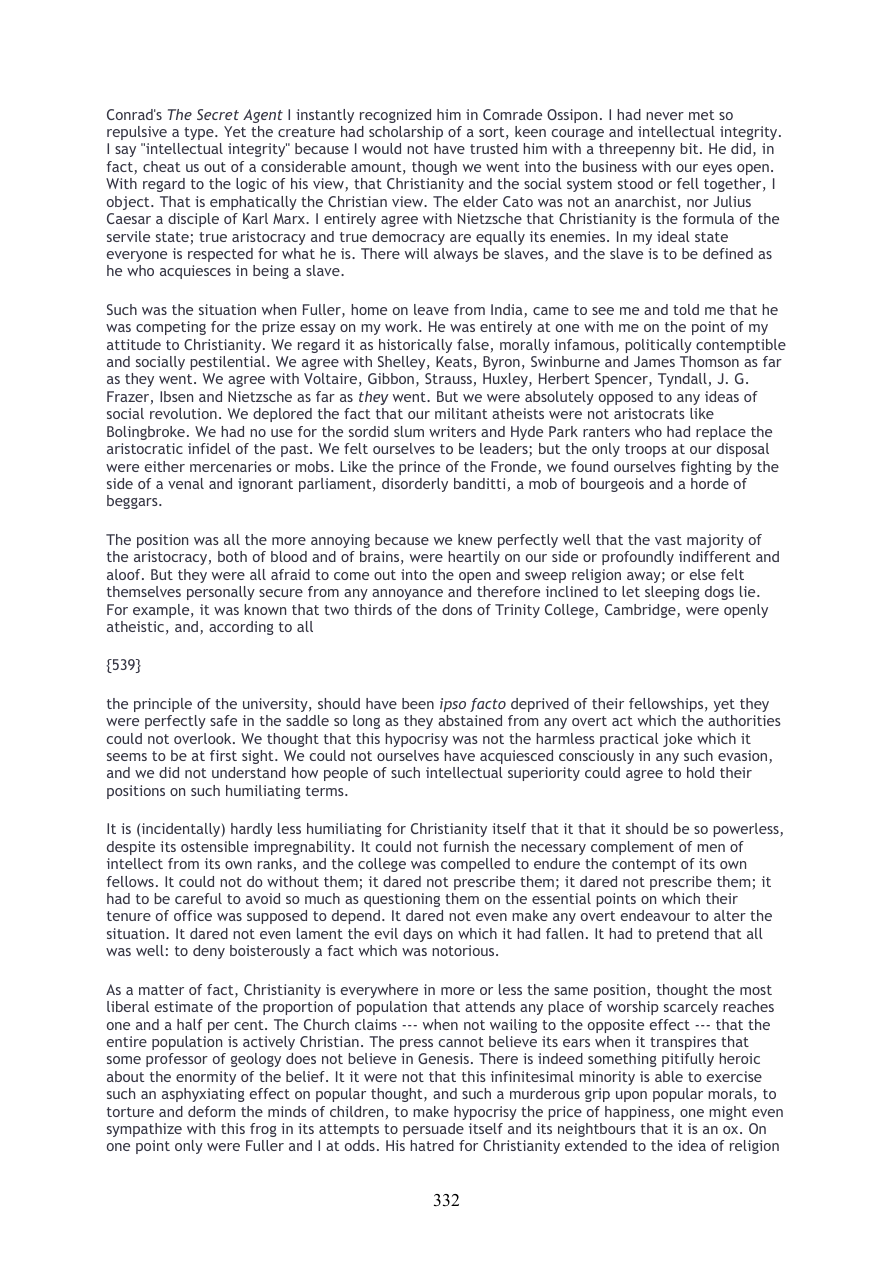
Highlights use the original PDF text layer. OCR-only matches may not be visible on the scan.
Transcription
Download text ↓raw extractionoriginal embedded textReview: unreviewed
332
Conrad's The Secret Agent I instantly recognized him in Comrade Ossipon. I had never met so
repulsive a type. Yet the creature had scholarship of a sort, keen courage and intellectual integrity.
I say "intellectual integrity" because I would not have trusted him with a threepenny bit. He did, in
fact, cheat us out of a considerable amount, though we went into the business with our eyes open.
With regard to the logic of his view, that Christianity and the social system stood or fell together, I
object. That is emphatically the Christian view. The elder Cato was not an anarchist, nor Julius
Caesar a disciple of Karl Marx. I entirely agree with Nietzsche that Christianity is the formula of the
servile state; true aristocracy and true democracy are equally its enemies. In my ideal state
everyone is respected for what he is. There will always be slaves, and the slave is to be defined as
he who acquiesces in being a slave.
Such was the situation when Fuller, home on leave from India, came to see me and told me that he
was competing for the prize essay on my work. He was entirely at one with me on the point of my
attitude to Christianity. We regard it as historically false, morally infamous, politically contemptible
and socially pestilential. We agree with Shelley, Keats, Byron, Swinburne and James Thomson as far
as they went. We agree with Voltaire, Gibbon, Strauss, Huxley, Herbert Spencer, Tyndall, J. G.
Frazer, Ibsen and Nietzsche as far as they went. But we were absolutely opposed to any ideas of
social revolution. We deplored the fact that our militant atheists were not aristocrats like
Bolingbroke. We had no use for the sordid slum writers and Hyde Park ranters who had replace the
aristocratic infidel of the past. We felt ourselves to be leaders; but the only troops at our disposal
were either mercenaries or mobs. Like the prince of the Fronde, we found ourselves fighting by the
side of a venal and ignorant parliament, disorderly banditti, a mob of bourgeois and a horde of
beggars.
The position was all the more annoying because we knew perfectly well that the vast majority of
the aristocracy, both of blood and of brains, were heartily on our side or profoundly indifferent and
aloof. But they were all afraid to come out into the open and sweep religion away; or else felt
themselves personally secure from any annoyance and therefore inclined to let sleeping dogs lie.
For example, it was known that two thirds of the dons of Trinity College, Cambridge, were openly
atheistic, and, according to all
{539}
the principle of the university, should have been ipso facto deprived of their fellowships, yet they
were perfectly safe in the saddle so long as they abstained from any overt act which the authorities
could not overlook. We thought that this hypocrisy was not the harmless practical joke which it
seems to be at first sight. We could not ourselves have acquiesced consciously in any such evasion,
and we did not understand how people of such intellectual superiority could agree to hold their
positions on such humiliating terms.
It is (incidentally) hardly less humiliating for Christianity itself that it that it should be so powerless,
despite its ostensible impregnability. It could not furnish the necessary complement of men of
intellect from its own ranks, and the college was compelled to endure the contempt of its own
fellows. It could not do without them; it dared not prescribe them; it dared not prescribe them; it
had to be careful to avoid so much as questioning them on the essential points on which their
tenure of office was supposed to depend. It dared not even make any overt endeavour to alter the
situation. It dared not even lament the evil days on which it had fallen. It had to pretend that all
was well: to deny boisterously a fact which was notorious.
As a matter of fact, Christianity is everywhere in more or less the same position, thought the most
liberal estimate of the proportion of population that attends any place of worship scarcely reaches
one and a half per cent. The Church claims --- when not wailing to the opposite effect --- that the
entire population is actively Christian. The press cannot believe its ears when it transpires that
some professor of geology does not believe in Genesis. There is indeed something pitifully heroic
about the enormity of the belief. It it were not that this infinitesimal minority is able to exercise
such an asphyxiating effect on popular thought, and such a murderous grip upon popular morals, to
torture and deform the minds of children, to make hypocrisy the price of happiness, one might even
sympathize with this frog in its attempts to persuade itself and its neightbours that it is an ox. On
one point only were Fuller and I at odds. His hatred for Christianity extended to the idea of religion
Page provenance & review flags
Stable page ID: 5ef44b98d8f9c4af5f6f86e1:p00332
Line breaks are preserved. Reading order and OCR accuracy may need review.
Printed page label has not been verified.
- No automated review flags. This does not establish transcription accuracy.