1929 · CLOSE READING
Confessions of Aleister Crowley
Confessions of Aleister Crowley (1929), PDF p. 331
Original page
Enlarge ↗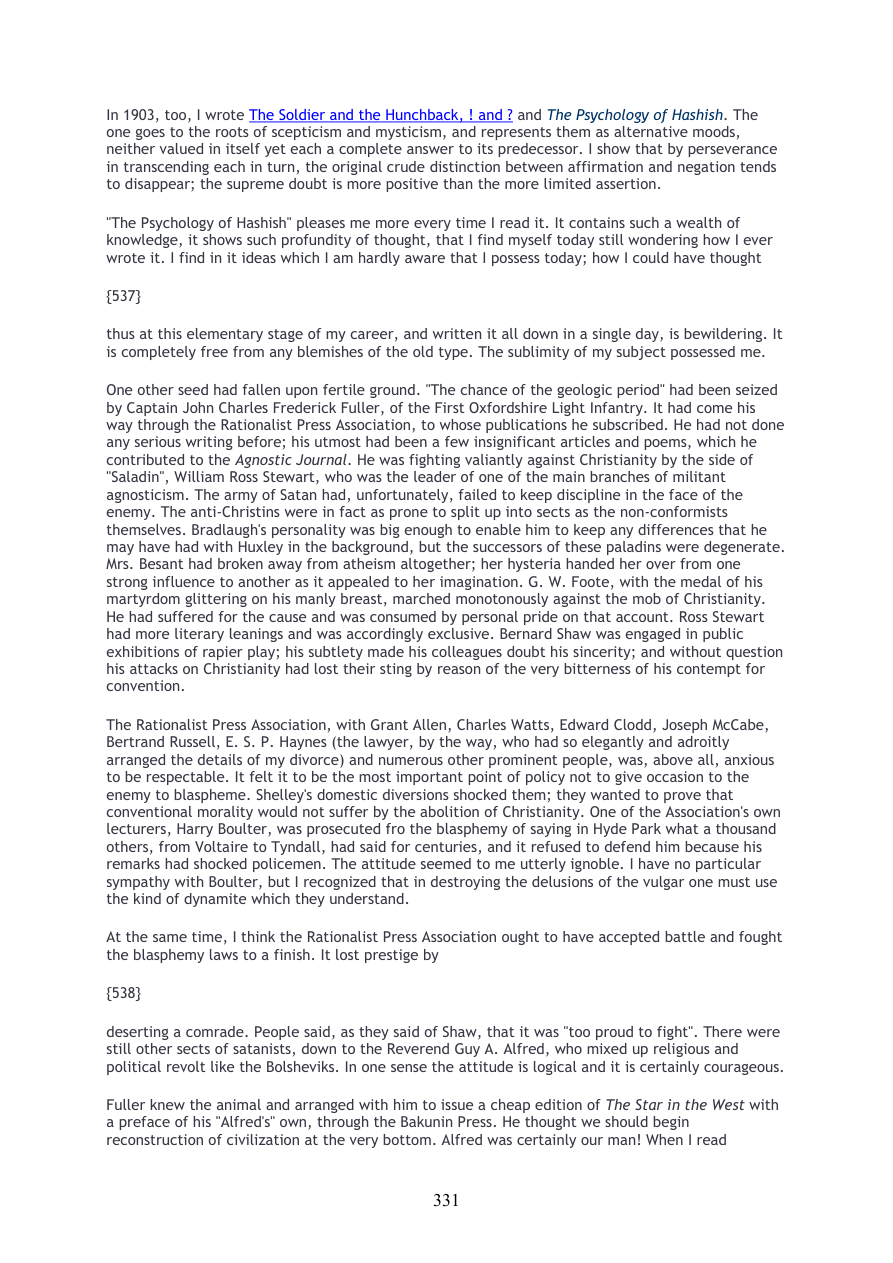
Highlights use the original PDF text layer. OCR-only matches may not be visible on the scan.
Transcription
Download text ↓raw extractionoriginal embedded textReview: unreviewed
331
In 1903, too, I wrote The Soldier and the Hunchback, ! and ? and The Psychology of Hashish. The
one goes to the roots of scepticism and mysticism, and represents them as alternative moods,
neither valued in itself yet each a complete answer to its predecessor. I show that by perseverance
in transcending each in turn, the original crude distinction between affirmation and negation tends
to disappear; the supreme doubt is more positive than the more limited assertion.
"The Psychology of Hashish" pleases me more every time I read it. It contains such a wealth of
knowledge, it shows such profundity of thought, that I find myself today still wondering how I ever
wrote it. I find in it ideas which I am hardly aware that I possess today; how I could have thought
{537}
thus at this elementary stage of my career, and written it all down in a single day, is bewildering. It
is completely free from any blemishes of the old type. The sublimity of my subject possessed me.
One other seed had fallen upon fertile ground. "The chance of the geologic period" had been seized
by Captain John Charles Frederick Fuller, of the First Oxfordshire Light Infantry. It had come his
way through the Rationalist Press Association, to whose publications he subscribed. He had not done
any serious writing before; his utmost had been a few insignificant articles and poems, which he
contributed to the Agnostic Journal. He was fighting valiantly against Christianity by the side of
"Saladin", William Ross Stewart, who was the leader of one of the main branches of militant
agnosticism. The army of Satan had, unfortunately, failed to keep discipline in the face of the
enemy. The anti-Christins were in fact as prone to split up into sects as the non-conformists
themselves. Bradlaugh's personality was big enough to enable him to keep any differences that he
may have had with Huxley in the background, but the successors of these paladins were degenerate.
Mrs. Besant had broken away from atheism altogether; her hysteria handed her over from one
strong influence to another as it appealed to her imagination. G. W. Foote, with the medal of his
martyrdom glittering on his manly breast, marched monotonously against the mob of Christianity.
He had suffered for the cause and was consumed by personal pride on that account. Ross Stewart
had more literary leanings and was accordingly exclusive. Bernard Shaw was engaged in public
exhibitions of rapier play; his subtlety made his colleagues doubt his sincerity; and without question
his attacks on Christianity had lost their sting by reason of the very bitterness of his contempt for
convention.
The Rationalist Press Association, with Grant Allen, Charles Watts, Edward Clodd, Joseph McCabe,
Bertrand Russell, E. S. P. Haynes (the lawyer, by the way, who had so elegantly and adroitly
arranged the details of my divorce) and numerous other prominent people, was, above all, anxious
to be respectable. It felt it to be the most important point of policy not to give occasion to the
enemy to blaspheme. Shelley's domestic diversions shocked them; they wanted to prove that
conventional morality would not suffer by the abolition of Christianity. One of the Association's own
lecturers, Harry Boulter, was prosecuted fro the blasphemy of saying in Hyde Park what a thousand
others, from Voltaire to Tyndall, had said for centuries, and it refused to defend him because his
remarks had shocked policemen. The attitude seemed to me utterly ignoble. I have no particular
sympathy with Boulter, but I recognized that in destroying the delusions of the vulgar one must use
the kind of dynamite which they understand.
At the same time, I think the Rationalist Press Association ought to have accepted battle and fought
the blasphemy laws to a finish. It lost prestige by
{538}
deserting a comrade. People said, as they said of Shaw, that it was "too proud to fight". There were
still other sects of satanists, down to the Reverend Guy A. Alfred, who mixed up religious and
political revolt like the Bolsheviks. In one sense the attitude is logical and it is certainly courageous.
Fuller knew the animal and arranged with him to issue a cheap edition of The Star in the West with
a preface of his "Alfred's" own, through the Bakunin Press. He thought we should begin
reconstruction of civilization at the very bottom. Alfred was certainly our man! When I read
Page provenance & review flags
Stable page ID: 5ef44b98d8f9c4af5f6f86e1:p00331
Line breaks are preserved. Reading order and OCR accuracy may need review.
Printed page label has not been verified.
- No automated review flags. This does not establish transcription accuracy.