1929 · CLOSE READING
Confessions of Aleister Crowley
Confessions of Aleister Crowley (1929), PDF p. 29
Original page
Enlarge ↗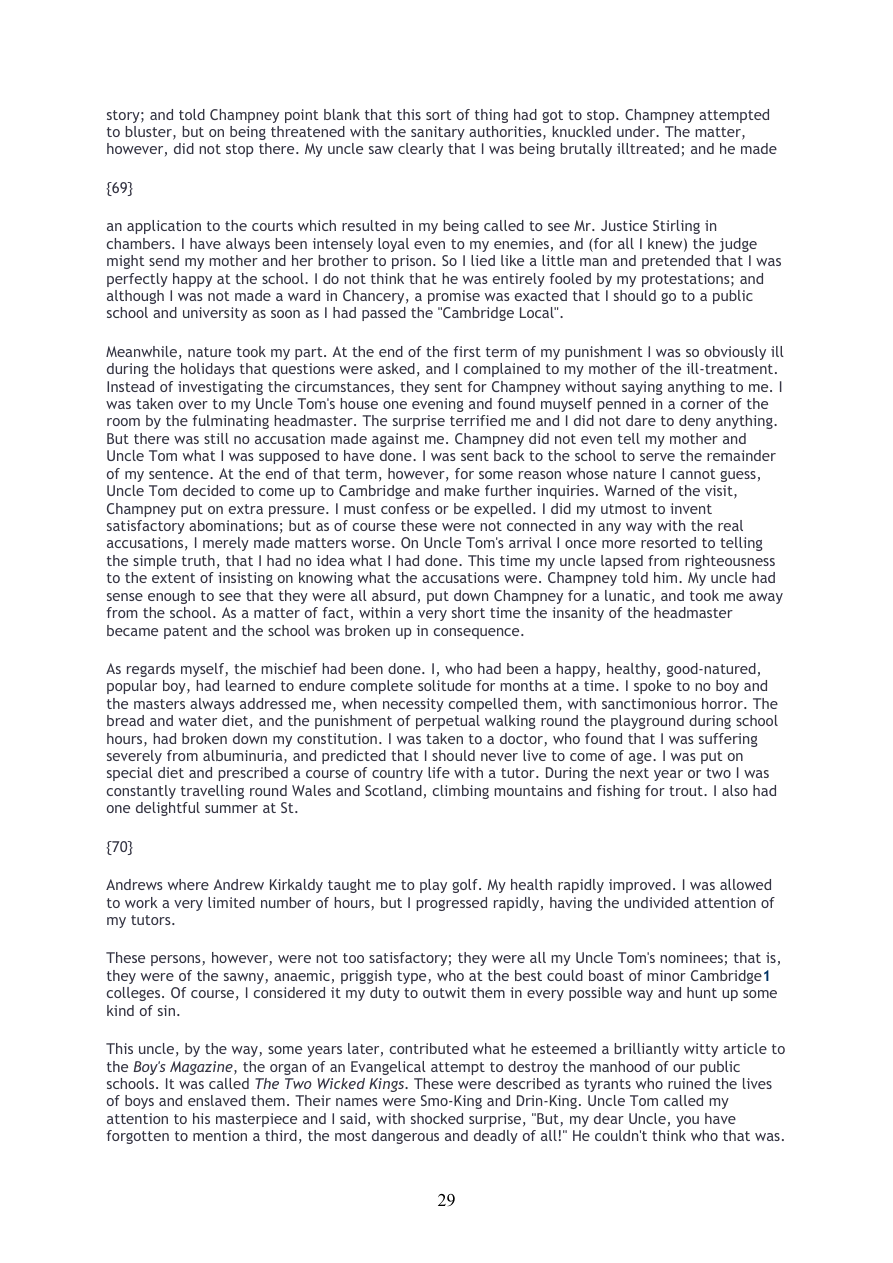
Highlights use the original PDF text layer. OCR-only matches may not be visible on the scan.
Transcription
Download text ↓raw extractionoriginal embedded textReview: unreviewed
29
story; and told Champney point blank that this sort of thing had got to stop. Champney attempted
to bluster, but on being threatened with the sanitary authorities, knuckled under. The matter,
however, did not stop there. My uncle saw clearly that I was being brutally illtreated; and he made
{69}
an application to the courts which resulted in my being called to see Mr. Justice Stirling in
chambers. I have always been intensely loyal even to my enemies, and (for all I knew) the judge
might send my mother and her brother to prison. So I lied like a little man and pretended that I was
perfectly happy at the school. I do not think that he was entirely fooled by my protestations; and
although I was not made a ward in Chancery, a promise was exacted that I should go to a public
school and university as soon as I had passed the "Cambridge Local".
Meanwhile, nature took my part. At the end of the first term of my punishment I was so obviously ill
during the holidays that questions were asked, and I complained to my mother of the ill-treatment.
Instead of investigating the circumstances, they sent for Champney without saying anything to me. I
was taken over to my Uncle Tom's house one evening and found muyself penned in a corner of the
room by the fulminating headmaster. The surprise terrified me and I did not dare to deny anything.
But there was still no accusation made against me. Champney did not even tell my mother and
Uncle Tom what I was supposed to have done. I was sent back to the school to serve the remainder
of my sentence. At the end of that term, however, for some reason whose nature I cannot guess,
Uncle Tom decided to come up to Cambridge and make further inquiries. Warned of the visit,
Champney put on extra pressure. I must confess or be expelled. I did my utmost to invent
satisfactory abominations; but as of course these were not connected in any way with the real
accusations, I merely made matters worse. On Uncle Tom's arrival I once more resorted to telling
the simple truth, that I had no idea what I had done. This time my uncle lapsed from righteousness
to the extent of insisting on knowing what the accusations were. Champney told him. My uncle had
sense enough to see that they were all absurd, put down Champney for a lunatic, and took me away
from the school. As a matter of fact, within a very short time the insanity of the headmaster
became patent and the school was broken up in consequence.
As regards myself, the mischief had been done. I, who had been a happy, healthy, good-natured,
popular boy, had learned to endure complete solitude for months at a time. I spoke to no boy and
the masters always addressed me, when necessity compelled them, with sanctimonious horror. The
bread and water diet, and the punishment of perpetual walking round the playground during school
hours, had broken down my constitution. I was taken to a doctor, who found that I was suffering
severely from albuminuria, and predicted that I should never live to come of age. I was put on
special diet and prescribed a course of country life with a tutor. During the next year or two I was
constantly travelling round Wales and Scotland, climbing mountains and fishing for trout. I also had
one delightful summer at St.
{70}
Andrews where Andrew Kirkaldy taught me to play golf. My health rapidly improved. I was allowed
to work a very limited number of hours, but I progressed rapidly, having the undivided attention of
my tutors.
These persons, however, were not too satisfactory; they were all my Uncle Tom's nominees; that is,
they were of the sawny, anaemic, priggish type, who at the best could boast of minor Cambridge1
colleges. Of course, I considered it my duty to outwit them in every possible way and hunt up some
kind of sin.
This uncle, by the way, some years later, contributed what he esteemed a brilliantly witty article to
the Boy's Magazine, the organ of an Evangelical attempt to destroy the manhood of our public
schools. It was called The Two Wicked Kings. These were described as tyrants who ruined the lives
of boys and enslaved them. Their names were Smo-King and Drin-King. Uncle Tom called my
attention to his masterpiece and I said, with shocked surprise, "But, my dear Uncle, you have
forgotten to mention a third, the most dangerous and deadly of all!" He couldn't think who that was.
Page provenance & review flags
Stable page ID: 5ef44b98d8f9c4af5f6f86e1:p00029
Line breaks are preserved. Reading order and OCR accuracy may need review.
Printed page label has not been verified.
- No automated review flags. This does not establish transcription accuracy.