1929 · CLOSE READING
Confessions of Aleister Crowley
Confessions of Aleister Crowley (1929), PDF p. 287
Original page
Enlarge ↗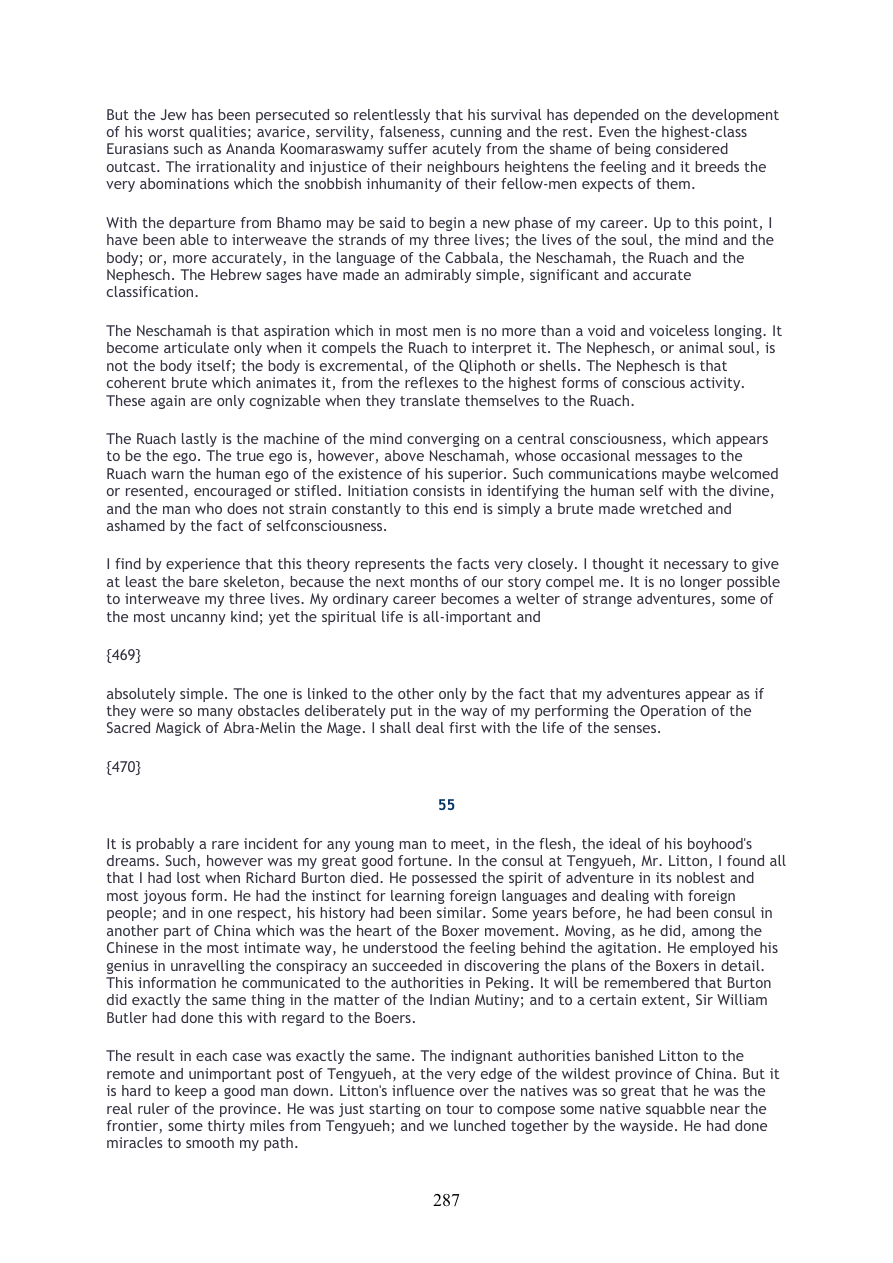
Highlights use the original PDF text layer. OCR-only matches may not be visible on the scan.
Transcription
Download text ↓raw extractionoriginal embedded textReview: unreviewed
287
But the Jew has been persecuted so relentlessly that his survival has depended on the development
of his worst qualities; avarice, servility, falseness, cunning and the rest. Even the highest-class
Eurasians such as Ananda Koomaraswamy suffer acutely from the shame of being considered
outcast. The irrationality and injustice of their neighbours heightens the feeling and it breeds the
very abominations which the snobbish inhumanity of their fellow-men expects of them.
With the departure from Bhamo may be said to begin a new phase of my career. Up to this point, I
have been able to interweave the strands of my three lives; the lives of the soul, the mind and the
body; or, more accurately, in the language of the Cabbala, the Neschamah, the Ruach and the
Nephesch. The Hebrew sages have made an admirably simple, significant and accurate
classification.
The Neschamah is that aspiration which in most men is no more than a void and voiceless longing. It
become articulate only when it compels the Ruach to interpret it. The Nephesch, or animal soul, is
not the body itself; the body is excremental, of the Qliphoth or shells. The Nephesch is that
coherent brute which animates it, from the reflexes to the highest forms of conscious activity.
These again are only cognizable when they translate themselves to the Ruach.
The Ruach lastly is the machine of the mind converging on a central consciousness, which appears
to be the ego. The true ego is, however, above Neschamah, whose occasional messages to the
Ruach warn the human ego of the existence of his superior. Such communications maybe welcomed
or resented, encouraged or stifled. Initiation consists in identifying the human self with the divine,
and the man who does not strain constantly to this end is simply a brute made wretched and
ashamed by the fact of selfconsciousness.
I find by experience that this theory represents the facts very closely. I thought it necessary to give
at least the bare skeleton, because the next months of our story compel me. It is no longer possible
to interweave my three lives. My ordinary career becomes a welter of strange adventures, some of
the most uncanny kind; yet the spiritual life is all-important and
{469}
absolutely simple. The one is linked to the other only by the fact that my adventures appear as if
they were so many obstacles deliberately put in the way of my performing the Operation of the
Sacred Magick of Abra-Melin the Mage. I shall deal first with the life of the senses.
{470}
55
It is probably a rare incident for any young man to meet, in the flesh, the ideal of his boyhood's
dreams. Such, however was my great good fortune. In the consul at Tengyueh, Mr. Litton, I found all
that I had lost when Richard Burton died. He possessed the spirit of adventure in its noblest and
most joyous form. He had the instinct for learning foreign languages and dealing with foreign
people; and in one respect, his history had been similar. Some years before, he had been consul in
another part of China which was the heart of the Boxer movement. Moving, as he did, among the
Chinese in the most intimate way, he understood the feeling behind the agitation. He employed his
genius in unravelling the conspiracy an succeeded in discovering the plans of the Boxers in detail.
This information he communicated to the authorities in Peking. It will be remembered that Burton
did exactly the same thing in the matter of the Indian Mutiny; and to a certain extent, Sir William
Butler had done this with regard to the Boers.
The result in each case was exactly the same. The indignant authorities banished Litton to the
remote and unimportant post of Tengyueh, at the very edge of the wildest province of China. But it
is hard to keep a good man down. Litton's influence over the natives was so great that he was the
real ruler of the province. He was just starting on tour to compose some native squabble near the
frontier, some thirty miles from Tengyueh; and we lunched together by the wayside. He had done
miracles to smooth my path.
Page provenance & review flags
Stable page ID: 5ef44b98d8f9c4af5f6f86e1:p00287
Line breaks are preserved. Reading order and OCR accuracy may need review.
Printed page label has not been verified.
- No automated review flags. This does not establish transcription accuracy.