1929 · CLOSE READING
Confessions of Aleister Crowley
Confessions of Aleister Crowley (1929), PDF p. 282
Original page
Enlarge ↗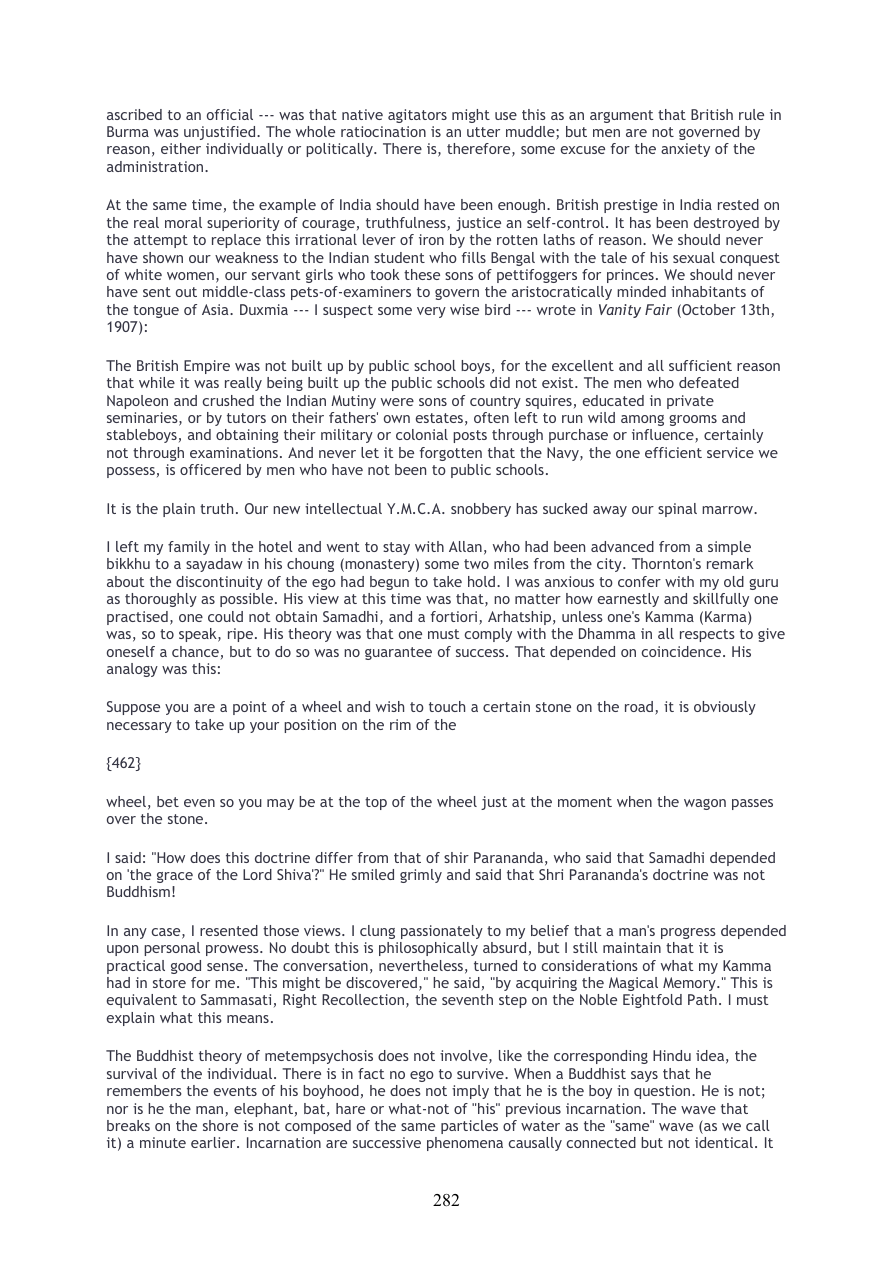
Highlights use the original PDF text layer. OCR-only matches may not be visible on the scan.
Transcription
Download text ↓raw extractionoriginal embedded textReview: unreviewed
282
ascribed to an official --- was that native agitators might use this as an argument that British rule in
Burma was unjustified. The whole ratiocination is an utter muddle; but men are not governed by
reason, either individually or politically. There is, therefore, some excuse for the anxiety of the
administration.
At the same time, the example of India should have been enough. British prestige in India rested on
the real moral superiority of courage, truthfulness, justice an self-control. It has been destroyed by
the attempt to replace this irrational lever of iron by the rotten laths of reason. We should never
have shown our weakness to the Indian student who fills Bengal with the tale of his sexual conquest
of white women, our servant girls who took these sons of pettifoggers for princes. We should never
have sent out middle-class pets-of-examiners to govern the aristocratically minded inhabitants of
the tongue of Asia. Duxmia --- I suspect some very wise bird --- wrote in Vanity Fair (October 13th,
1907):
The British Empire was not built up by public school boys, for the excellent and all sufficient reason
that while it was really being built up the public schools did not exist. The men who defeated
Napoleon and crushed the Indian Mutiny were sons of country squires, educated in private
seminaries, or by tutors on their fathers' own estates, often left to run wild among grooms and
stableboys, and obtaining their military or colonial posts through purchase or influence, certainly
not through examinations. And never let it be forgotten that the Navy, the one efficient service we
possess, is officered by men who have not been to public schools.
It is the plain truth. Our new intellectual Y.M.C.A. snobbery has sucked away our spinal marrow.
I left my family in the hotel and went to stay with Allan, who had been advanced from a simple
bikkhu to a sayadaw in his choung (monastery) some two miles from the city. Thornton's remark
about the discontinuity of the ego had begun to take hold. I was anxious to confer with my old guru
as thoroughly as possible. His view at this time was that, no matter how earnestly and skillfully one
practised, one could not obtain Samadhi, and a fortiori, Arhatship, unless one's Kamma (Karma)
was, so to speak, ripe. His theory was that one must comply with the Dhamma in all respects to give
oneself a chance, but to do so was no guarantee of success. That depended on coincidence. His
analogy was this:
Suppose you are a point of a wheel and wish to touch a certain stone on the road, it is obviously
necessary to take up your position on the rim of the
{462}
wheel, bet even so you may be at the top of the wheel just at the moment when the wagon passes
over the stone.
I said: "How does this doctrine differ from that of shir Parananda, who said that Samadhi depended
on 'the grace of the Lord Shiva'?" He smiled grimly and said that Shri Parananda's doctrine was not
Buddhism!
In any case, I resented those views. I clung passionately to my belief that a man's progress depended
upon personal prowess. No doubt this is philosophically absurd, but I still maintain that it is
practical good sense. The conversation, nevertheless, turned to considerations of what my Kamma
had in store for me. "This might be discovered," he said, "by acquiring the Magical Memory." This is
equivalent to Sammasati, Right Recollection, the seventh step on the Noble Eightfold Path. I must
explain what this means.
The Buddhist theory of metempsychosis does not involve, like the corresponding Hindu idea, the
survival of the individual. There is in fact no ego to survive. When a Buddhist says that he
remembers the events of his boyhood, he does not imply that he is the boy in question. He is not;
nor is he the man, elephant, bat, hare or what-not of "his" previous incarnation. The wave that
breaks on the shore is not composed of the same particles of water as the "same" wave (as we call
it) a minute earlier. Incarnation are successive phenomena causally connected but not identical. It
Page provenance & review flags
Stable page ID: 5ef44b98d8f9c4af5f6f86e1:p00282
Line breaks are preserved. Reading order and OCR accuracy may need review.
Printed page label has not been verified.
- No automated review flags. This does not establish transcription accuracy.