1929 · CLOSE READING
Confessions of Aleister Crowley
Confessions of Aleister Crowley (1929), PDF p. 274
Original page
Enlarge ↗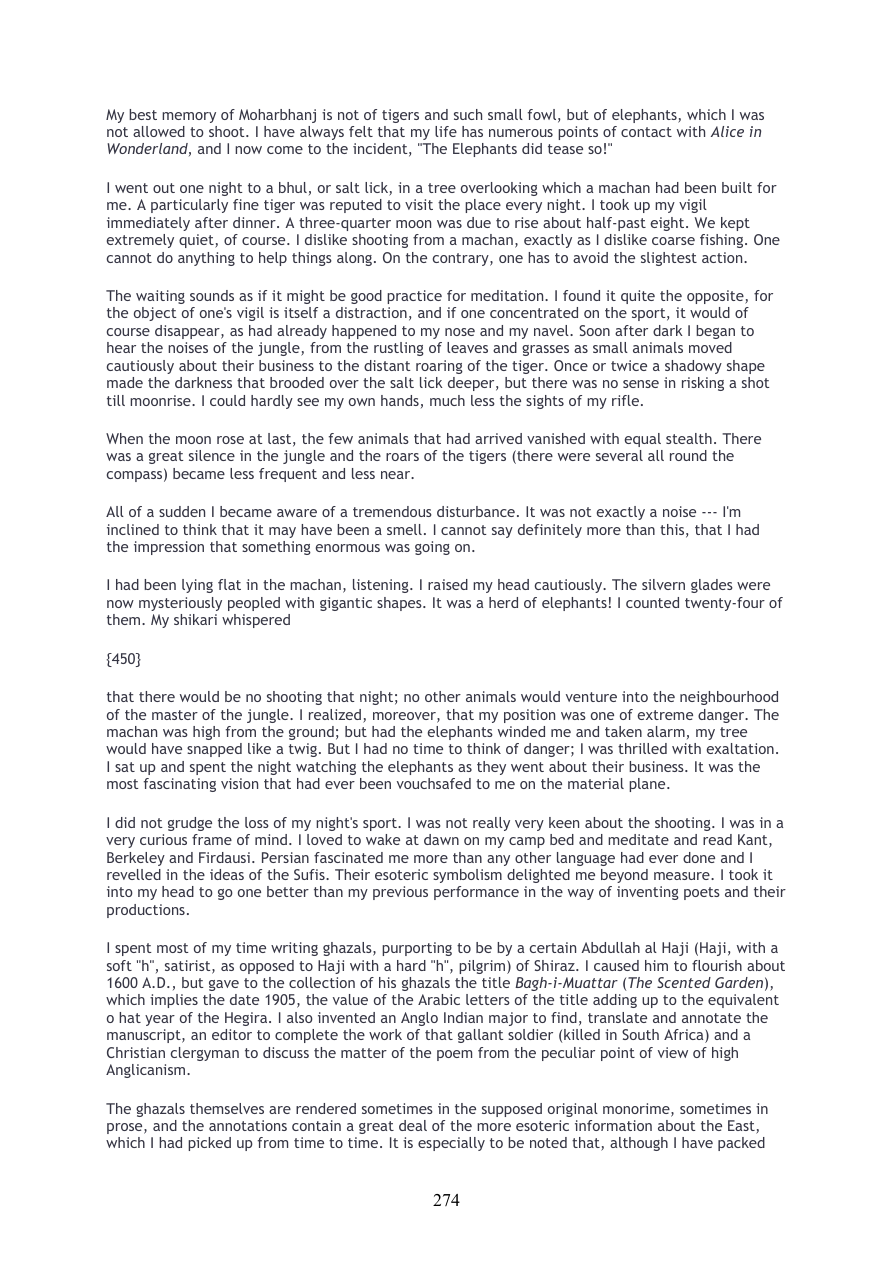
Highlights use the original PDF text layer. OCR-only matches may not be visible on the scan.
Transcription
Download text ↓raw extractionoriginal embedded textReview: unreviewed
274
My best memory of Moharbhanj is not of tigers and such small fowl, but of elephants, which I was
not allowed to shoot. I have always felt that my life has numerous points of contact with Alice in
Wonderland, and I now come to the incident, "The Elephants did tease so!"
I went out one night to a bhul, or salt lick, in a tree overlooking which a machan had been built for
me. A particularly fine tiger was reputed to visit the place every night. I took up my vigil
immediately after dinner. A three-quarter moon was due to rise about half-past eight. We kept
extremely quiet, of course. I dislike shooting from a machan, exactly as I dislike coarse fishing. One
cannot do anything to help things along. On the contrary, one has to avoid the slightest action.
The waiting sounds as if it might be good practice for meditation. I found it quite the opposite, for
the object of one's vigil is itself a distraction, and if one concentrated on the sport, it would of
course disappear, as had already happened to my nose and my navel. Soon after dark I began to
hear the noises of the jungle, from the rustling of leaves and grasses as small animals moved
cautiously about their business to the distant roaring of the tiger. Once or twice a shadowy shape
made the darkness that brooded over the salt lick deeper, but there was no sense in risking a shot
till moonrise. I could hardly see my own hands, much less the sights of my rifle.
When the moon rose at last, the few animals that had arrived vanished with equal stealth. There
was a great silence in the jungle and the roars of the tigers (there were several all round the
compass) became less frequent and less near.
All of a sudden I became aware of a tremendous disturbance. It was not exactly a noise --- I'm
inclined to think that it may have been a smell. I cannot say definitely more than this, that I had
the impression that something enormous was going on.
I had been lying flat in the machan, listening. I raised my head cautiously. The silvern glades were
now mysteriously peopled with gigantic shapes. It was a herd of elephants! I counted twenty-four of
them. My shikari whispered
{450}
that there would be no shooting that night; no other animals would venture into the neighbourhood
of the master of the jungle. I realized, moreover, that my position was one of extreme danger. The
machan was high from the ground; but had the elephants winded me and taken alarm, my tree
would have snapped like a twig. But I had no time to think of danger; I was thrilled with exaltation.
I sat up and spent the night watching the elephants as they went about their business. It was the
most fascinating vision that had ever been vouchsafed to me on the material plane.
I did not grudge the loss of my night's sport. I was not really very keen about the shooting. I was in a
very curious frame of mind. I loved to wake at dawn on my camp bed and meditate and read Kant,
Berkeley and Firdausi. Persian fascinated me more than any other language had ever done and I
revelled in the ideas of the Sufis. Their esoteric symbolism delighted me beyond measure. I took it
into my head to go one better than my previous performance in the way of inventing poets and their
productions.
I spent most of my time writing ghazals, purporting to be by a certain Abdullah al Haji (Haji, with a
soft "h", satirist, as opposed to Haji with a hard "h", pilgrim) of Shiraz. I caused him to flourish about
1600 A.D., but gave to the collection of his ghazals the title Bagh-i-Muattar (The Scented Garden),
which implies the date 1905, the value of the Arabic letters of the title adding up to the equivalent
o hat year of the Hegira. I also invented an Anglo Indian major to find, translate and annotate the
manuscript, an editor to complete the work of that gallant soldier (killed in South Africa) and a
Christian clergyman to discuss the matter of the poem from the peculiar point of view of high
Anglicanism.
The ghazals themselves are rendered sometimes in the supposed original monorime, sometimes in
prose, and the annotations contain a great deal of the more esoteric information about the East,
which I had picked up from time to time. It is especially to be noted that, although I have packed
Page provenance & review flags
Stable page ID: 5ef44b98d8f9c4af5f6f86e1:p00274
Line breaks are preserved. Reading order and OCR accuracy may need review.
Printed page label has not been verified.
- No automated review flags. This does not establish transcription accuracy.