1929 · CLOSE READING
Confessions of Aleister Crowley
Confessions of Aleister Crowley (1929), PDF p. 256
Original page
Enlarge ↗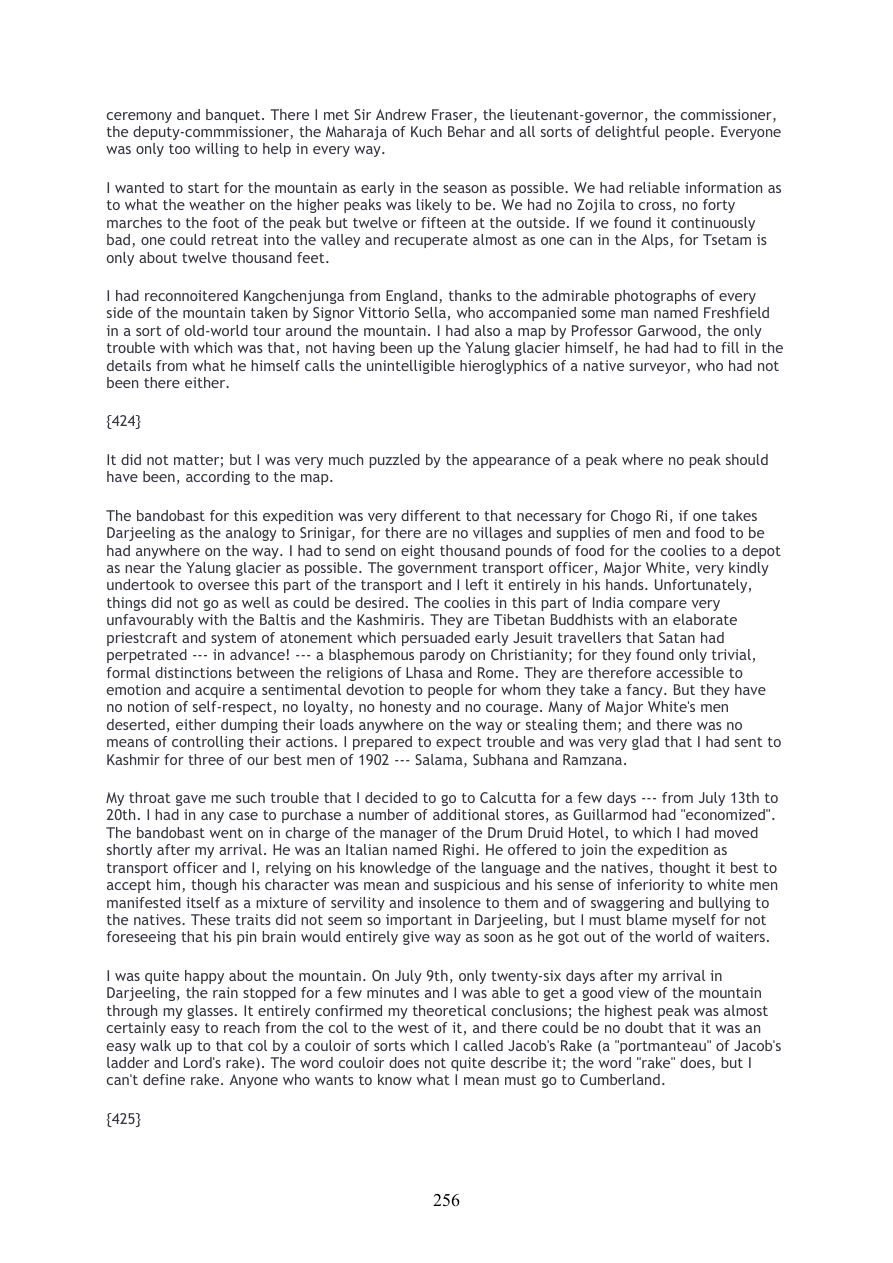
Highlights use the original PDF text layer. OCR-only matches may not be visible on the scan.
Transcription
Download text ↓raw extractionoriginal embedded textReview: unreviewed
256
ceremony and banquet. There I met Sir Andrew Fraser, the lieutenant-governor, the commissioner,
the deputy-commmissioner, the Maharaja of Kuch Behar and all sorts of delightful people. Everyone
was only too willing to help in every way.
I wanted to start for the mountain as early in the season as possible. We had reliable information as
to what the weather on the higher peaks was likely to be. We had no Zojila to cross, no forty
marches to the foot of the peak but twelve or fifteen at the outside. If we found it continuously
bad, one could retreat into the valley and recuperate almost as one can in the Alps, for Tsetam is
only about twelve thousand feet.
I had reconnoitered Kangchenjunga from England, thanks to the admirable photographs of every
side of the mountain taken by Signor Vittorio Sella, who accompanied some man named Freshfield
in a sort of old-world tour around the mountain. I had also a map by Professor Garwood, the only
trouble with which was that, not having been up the Yalung glacier himself, he had had to fill in the
details from what he himself calls the unintelligible hieroglyphics of a native surveyor, who had not
been there either.
{424}
It did not matter; but I was very much puzzled by the appearance of a peak where no peak should
have been, according to the map.
The bandobast for this expedition was very different to that necessary for Chogo Ri, if one takes
Darjeeling as the analogy to Srinigar, for there are no villages and supplies of men and food to be
had anywhere on the way. I had to send on eight thousand pounds of food for the coolies to a depot
as near the Yalung glacier as possible. The government transport officer, Major White, very kindly
undertook to oversee this part of the transport and I left it entirely in his hands. Unfortunately,
things did not go as well as could be desired. The coolies in this part of India compare very
unfavourably with the Baltis and the Kashmiris. They are Tibetan Buddhists with an elaborate
priestcraft and system of atonement which persuaded early Jesuit travellers that Satan had
perpetrated --- in advance! --- a blasphemous parody on Christianity; for they found only trivial,
formal distinctions between the religions of Lhasa and Rome. They are therefore accessible to
emotion and acquire a sentimental devotion to people for whom they take a fancy. But they have
no notion of self-respect, no loyalty, no honesty and no courage. Many of Major White's men
deserted, either dumping their loads anywhere on the way or stealing them; and there was no
means of controlling their actions. I prepared to expect trouble and was very glad that I had sent to
Kashmir for three of our best men of 1902 --- Salama, Subhana and Ramzana.
My throat gave me such trouble that I decided to go to Calcutta for a few days --- from July 13th to
20th. I had in any case to purchase a number of additional stores, as Guillarmod had "economized".
The bandobast went on in charge of the manager of the Drum Druid Hotel, to which I had moved
shortly after my arrival. He was an Italian named Righi. He offered to join the expedition as
transport officer and I, relying on his knowledge of the language and the natives, thought it best to
accept him, though his character was mean and suspicious and his sense of inferiority to white men
manifested itself as a mixture of servility and insolence to them and of swaggering and bullying to
the natives. These traits did not seem so important in Darjeeling, but I must blame myself for not
foreseeing that his pin brain would entirely give way as soon as he got out of the world of waiters.
I was quite happy about the mountain. On July 9th, only twenty-six days after my arrival in
Darjeeling, the rain stopped for a few minutes and I was able to get a good view of the mountain
through my glasses. It entirely confirmed my theoretical conclusions; the highest peak was almost
certainly easy to reach from the col to the west of it, and there could be no doubt that it was an
easy walk up to that col by a couloir of sorts which I called Jacob's Rake (a "portmanteau" of Jacob's
ladder and Lord's rake). The word couloir does not quite describe it; the word "rake" does, but I
can't define rake. Anyone who wants to know what I mean must go to Cumberland.
{425}
Page provenance & review flags
Stable page ID: 5ef44b98d8f9c4af5f6f86e1:p00256
Line breaks are preserved. Reading order and OCR accuracy may need review.
Printed page label has not been verified.
- No automated review flags. This does not establish transcription accuracy.