1929 · CLOSE READING
Confessions of Aleister Crowley
Confessions of Aleister Crowley (1929), PDF p. 248
Original page
Enlarge ↗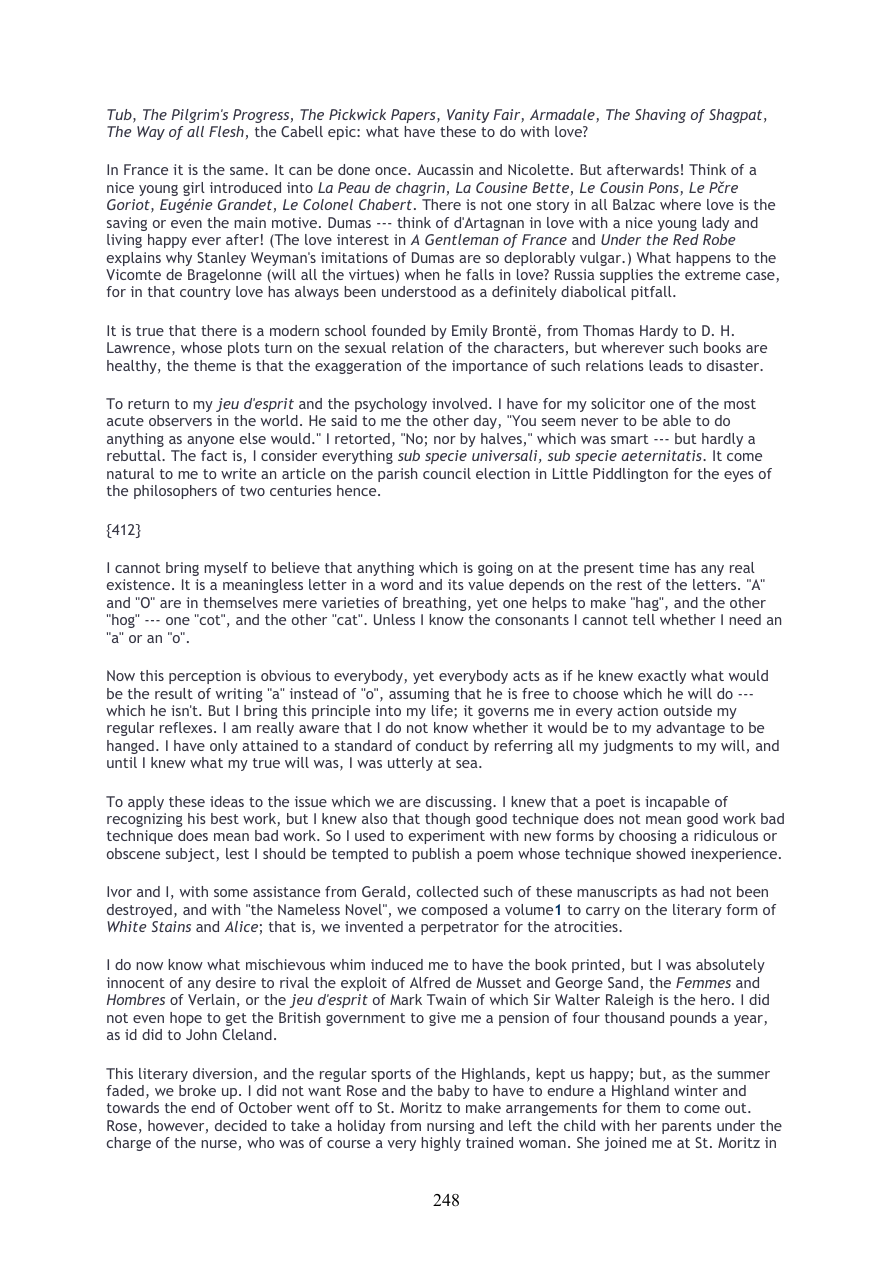
Highlights use the original PDF text layer. OCR-only matches may not be visible on the scan.
Transcription
Download text ↓raw extractionoriginal embedded textReview: unreviewed
248
Tub, The Pilgrim's Progress, The Pickwick Papers, Vanity Fair, Armadale, The Shaving of Shagpat,
The Way of all Flesh, the Cabell epic: what have these to do with love?
In France it is the same. It can be done once. Aucassin and Nicolette. But afterwards! Think of a
nice young girl introduced into La Peau de chagrin, La Cousine Bette, Le Cousin Pons, Le Pčre
Goriot, Eugénie Grandet, Le Colonel Chabert. There is not one story in all Balzac where love is the
saving or even the main motive. Dumas --- think of d'Artagnan in love with a nice young lady and
living happy ever after! (The love interest in A Gentleman of France and Under the Red Robe
explains why Stanley Weyman's imitations of Dumas are so deplorably vulgar.) What happens to the
Vicomte de Bragelonne (will all the virtues) when he falls in love? Russia supplies the extreme case,
for in that country love has always been understood as a definitely diabolical pitfall.
It is true that there is a modern school founded by Emily Brontë, from Thomas Hardy to D. H.
Lawrence, whose plots turn on the sexual relation of the characters, but wherever such books are
healthy, the theme is that the exaggeration of the importance of such relations leads to disaster.
To return to my jeu d'esprit and the psychology involved. I have for my solicitor one of the most
acute observers in the world. He said to me the other day, "You seem never to be able to do
anything as anyone else would." I retorted, "No; nor by halves," which was smart --- but hardly a
rebuttal. The fact is, I consider everything sub specie universali, sub specie aeternitatis. It come
natural to me to write an article on the parish council election in Little Piddlington for the eyes of
the philosophers of two centuries hence.
{412}
I cannot bring myself to believe that anything which is going on at the present time has any real
existence. It is a meaningless letter in a word and its value depends on the rest of the letters. "A"
and "O" are in themselves mere varieties of breathing, yet one helps to make "hag", and the other
"hog" --- one "cot", and the other "cat". Unless I know the consonants I cannot tell whether I need an
"a" or an "o".
Now this perception is obvious to everybody, yet everybody acts as if he knew exactly what would
be the result of writing "a" instead of "o", assuming that he is free to choose which he will do ---
which he isn't. But I bring this principle into my life; it governs me in every action outside my
regular reflexes. I am really aware that I do not know whether it would be to my advantage to be
hanged. I have only attained to a standard of conduct by referring all my judgments to my will, and
until I knew what my true will was, I was utterly at sea.
To apply these ideas to the issue which we are discussing. I knew that a poet is incapable of
recognizing his best work, but I knew also that though good technique does not mean good work bad
technique does mean bad work. So I used to experiment with new forms by choosing a ridiculous or
obscene subject, lest I should be tempted to publish a poem whose technique showed inexperience.
Ivor and I, with some assistance from Gerald, collected such of these manuscripts as had not been
destroyed, and with "the Nameless Novel", we composed a volume1 to carry on the literary form of
White Stains and Alice; that is, we invented a perpetrator for the atrocities.
I do now know what mischievous whim induced me to have the book printed, but I was absolutely
innocent of any desire to rival the exploit of Alfred de Musset and George Sand, the Femmes and
Hombres of Verlain, or the jeu d'esprit of Mark Twain of which Sir Walter Raleigh is the hero. I did
not even hope to get the British government to give me a pension of four thousand pounds a year,
as id did to John Cleland.
This literary diversion, and the regular sports of the Highlands, kept us happy; but, as the summer
faded, we broke up. I did not want Rose and the baby to have to endure a Highland winter and
towards the end of October went off to St. Moritz to make arrangements for them to come out.
Rose, however, decided to take a holiday from nursing and left the child with her parents under the
charge of the nurse, who was of course a very highly trained woman. She joined me at St. Moritz in
Page provenance & review flags
Stable page ID: 5ef44b98d8f9c4af5f6f86e1:p00248
Line breaks are preserved. Reading order and OCR accuracy may need review.
Printed page label has not been verified.
- No automated review flags. This does not establish transcription accuracy.