1929 · CLOSE READING
Confessions of Aleister Crowley
Confessions of Aleister Crowley (1929), PDF p. 247
Original page
Enlarge ↗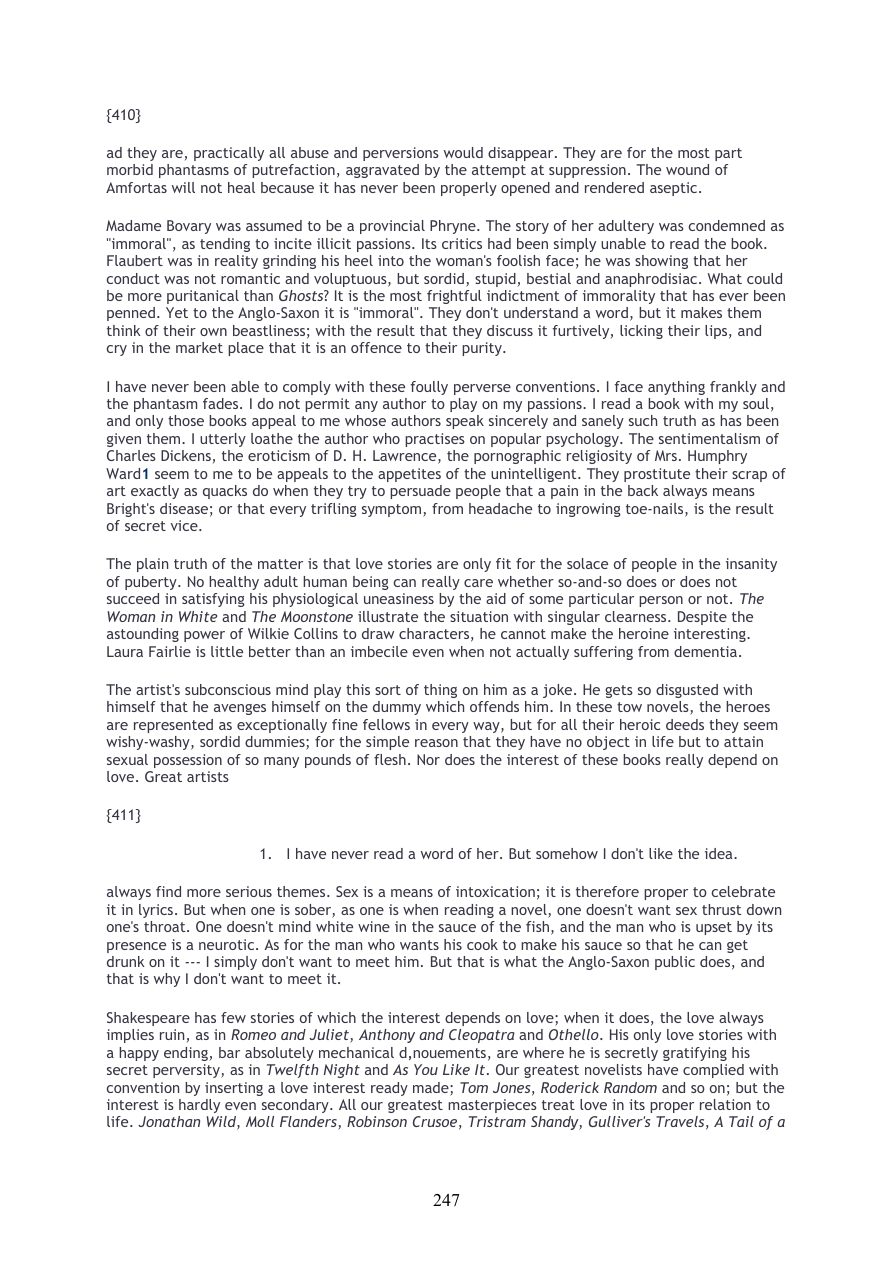
Highlights use the original PDF text layer. OCR-only matches may not be visible on the scan.
Transcription
Download text ↓raw extractionoriginal embedded textReview: unreviewed
247
{410}
ad they are, practically all abuse and perversions would disappear. They are for the most part
morbid phantasms of putrefaction, aggravated by the attempt at suppression. The wound of
Amfortas will not heal because it has never been properly opened and rendered aseptic.
Madame Bovary was assumed to be a provincial Phryne. The story of her adultery was condemned as
"immoral", as tending to incite illicit passions. Its critics had been simply unable to read the book.
Flaubert was in reality grinding his heel into the woman's foolish face; he was showing that her
conduct was not romantic and voluptuous, but sordid, stupid, bestial and anaphrodisiac. What could
be more puritanical than Ghosts? It is the most frightful indictment of immorality that has ever been
penned. Yet to the Anglo-Saxon it is "immoral". They don't understand a word, but it makes them
think of their own beastliness; with the result that they discuss it furtively, licking their lips, and
cry in the market place that it is an offence to their purity.
I have never been able to comply with these foully perverse conventions. I face anything frankly and
the phantasm fades. I do not permit any author to play on my passions. I read a book with my soul,
and only those books appeal to me whose authors speak sincerely and sanely such truth as has been
given them. I utterly loathe the author who practises on popular psychology. The sentimentalism of
Charles Dickens, the eroticism of D. H. Lawrence, the pornographic religiosity of Mrs. Humphry
Ward1 seem to me to be appeals to the appetites of the unintelligent. They prostitute their scrap of
art exactly as quacks do when they try to persuade people that a pain in the back always means
Bright's disease; or that every trifling symptom, from headache to ingrowing toe-nails, is the result
of secret vice.
The plain truth of the matter is that love stories are only fit for the solace of people in the insanity
of puberty. No healthy adult human being can really care whether so-and-so does or does not
succeed in satisfying his physiological uneasiness by the aid of some particular person or not. The
Woman in White and The Moonstone illustrate the situation with singular clearness. Despite the
astounding power of Wilkie Collins to draw characters, he cannot make the heroine interesting.
Laura Fairlie is little better than an imbecile even when not actually suffering from dementia.
The artist's subconscious mind play this sort of thing on him as a joke. He gets so disgusted with
himself that he avenges himself on the dummy which offends him. In these tow novels, the heroes
are represented as exceptionally fine fellows in every way, but for all their heroic deeds they seem
wishy-washy, sordid dummies; for the simple reason that they have no object in life but to attain
sexual possession of so many pounds of flesh. Nor does the interest of these books really depend on
love. Great artists
{411}
1. I have never read a word of her. But somehow I don't like the idea.
always find more serious themes. Sex is a means of intoxication; it is therefore proper to celebrate
it in lyrics. But when one is sober, as one is when reading a novel, one doesn't want sex thrust down
one's throat. One doesn't mind white wine in the sauce of the fish, and the man who is upset by its
presence is a neurotic. As for the man who wants his cook to make his sauce so that he can get
drunk on it --- I simply don't want to meet him. But that is what the Anglo-Saxon public does, and
that is why I don't want to meet it.
Shakespeare has few stories of which the interest depends on love; when it does, the love always
implies ruin, as in Romeo and Juliet, Anthony and Cleopatra and Othello. His only love stories with
a happy ending, bar absolutely mechanical dnouements, are where he is secretly gratifying his
secret perversity, as in Twelfth Night and As You Like It. Our greatest novelists have complied with
convention by inserting a love interest ready made; Tom Jones, Roderick Random and so on; but the
interest is hardly even secondary. All our greatest masterpieces treat love in its proper relation to
life. Jonathan Wild, Moll Flanders, Robinson Crusoe, Tristram Shandy, Gulliver's Travels, A Tail of a
Page provenance & review flags
Stable page ID: 5ef44b98d8f9c4af5f6f86e1:p00247
Line breaks are preserved. Reading order and OCR accuracy may need review.
Printed page label has not been verified.
- No automated review flags. This does not establish transcription accuracy.