1929 · CLOSE READING
Confessions of Aleister Crowley
Confessions of Aleister Crowley (1929), PDF p. 240
Original page
Enlarge ↗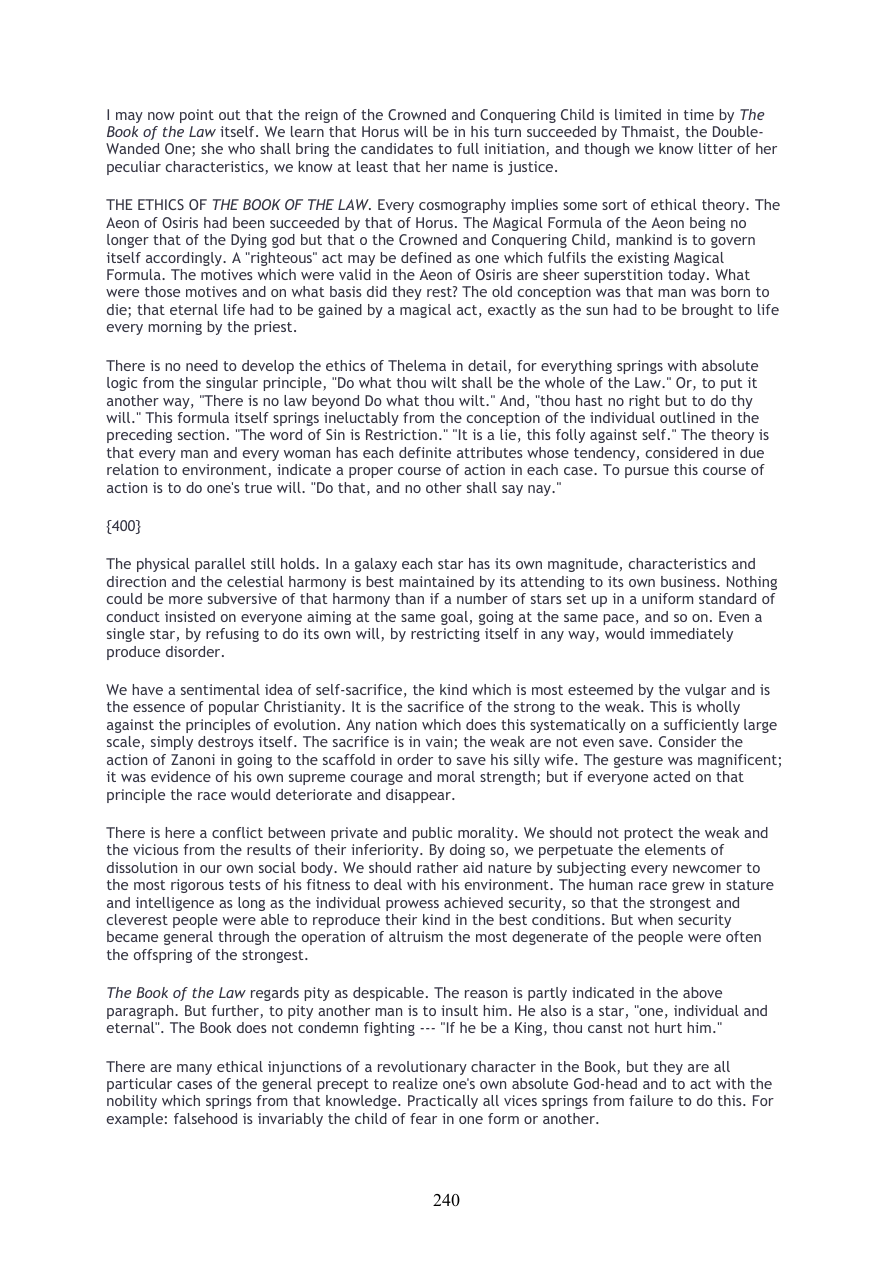
Highlights use the original PDF text layer. OCR-only matches may not be visible on the scan.
Transcription
Download text ↓raw extractionoriginal embedded textReview: unreviewed
240
I may now point out that the reign of the Crowned and Conquering Child is limited in time by The
Book of the Law itself. We learn that Horus will be in his turn succeeded by Thmaist, the Double-
Wanded One; she who shall bring the candidates to full initiation, and though we know litter of her
peculiar characteristics, we know at least that her name is justice.
THE ETHICS OF THE BOOK OF THE LAW. Every cosmography implies some sort of ethical theory. The
Aeon of Osiris had been succeeded by that of Horus. The Magical Formula of the Aeon being no
longer that of the Dying god but that o the Crowned and Conquering Child, mankind is to govern
itself accordingly. A "righteous" act may be defined as one which fulfils the existing Magical
Formula. The motives which were valid in the Aeon of Osiris are sheer superstition today. What
were those motives and on what basis did they rest? The old conception was that man was born to
die; that eternal life had to be gained by a magical act, exactly as the sun had to be brought to life
every morning by the priest.
There is no need to develop the ethics of Thelema in detail, for everything springs with absolute
logic from the singular principle, "Do what thou wilt shall be the whole of the Law." Or, to put it
another way, "There is no law beyond Do what thou wilt." And, "thou hast no right but to do thy
will." This formula itself springs ineluctably from the conception of the individual outlined in the
preceding section. "The word of Sin is Restriction." "It is a lie, this folly against self." The theory is
that every man and every woman has each definite attributes whose tendency, considered in due
relation to environment, indicate a proper course of action in each case. To pursue this course of
action is to do one's true will. "Do that, and no other shall say nay."
{400}
The physical parallel still holds. In a galaxy each star has its own magnitude, characteristics and
direction and the celestial harmony is best maintained by its attending to its own business. Nothing
could be more subversive of that harmony than if a number of stars set up in a uniform standard of
conduct insisted on everyone aiming at the same goal, going at the same pace, and so on. Even a
single star, by refusing to do its own will, by restricting itself in any way, would immediately
produce disorder.
We have a sentimental idea of self-sacrifice, the kind which is most esteemed by the vulgar and is
the essence of popular Christianity. It is the sacrifice of the strong to the weak. This is wholly
against the principles of evolution. Any nation which does this systematically on a sufficiently large
scale, simply destroys itself. The sacrifice is in vain; the weak are not even save. Consider the
action of Zanoni in going to the scaffold in order to save his silly wife. The gesture was magnificent;
it was evidence of his own supreme courage and moral strength; but if everyone acted on that
principle the race would deteriorate and disappear.
There is here a conflict between private and public morality. We should not protect the weak and
the vicious from the results of their inferiority. By doing so, we perpetuate the elements of
dissolution in our own social body. We should rather aid nature by subjecting every newcomer to
the most rigorous tests of his fitness to deal with his environment. The human race grew in stature
and intelligence as long as the individual prowess achieved security, so that the strongest and
cleverest people were able to reproduce their kind in the best conditions. But when security
became general through the operation of altruism the most degenerate of the people were often
the offspring of the strongest.
The Book of the Law regards pity as despicable. The reason is partly indicated in the above
paragraph. But further, to pity another man is to insult him. He also is a star, "one, individual and
eternal". The Book does not condemn fighting --- "If he be a King, thou canst not hurt him."
There are many ethical injunctions of a revolutionary character in the Book, but they are all
particular cases of the general precept to realize one's own absolute God-head and to act with the
nobility which springs from that knowledge. Practically all vices springs from failure to do this. For
example: falsehood is invariably the child of fear in one form or another.
Page provenance & review flags
Stable page ID: 5ef44b98d8f9c4af5f6f86e1:p00240
Line breaks are preserved. Reading order and OCR accuracy may need review.
Printed page label has not been verified.
- No automated review flags. This does not establish transcription accuracy.