1929 · CLOSE READING
Confessions of Aleister Crowley
Confessions of Aleister Crowley (1929), PDF p. 236
Original page
Enlarge ↗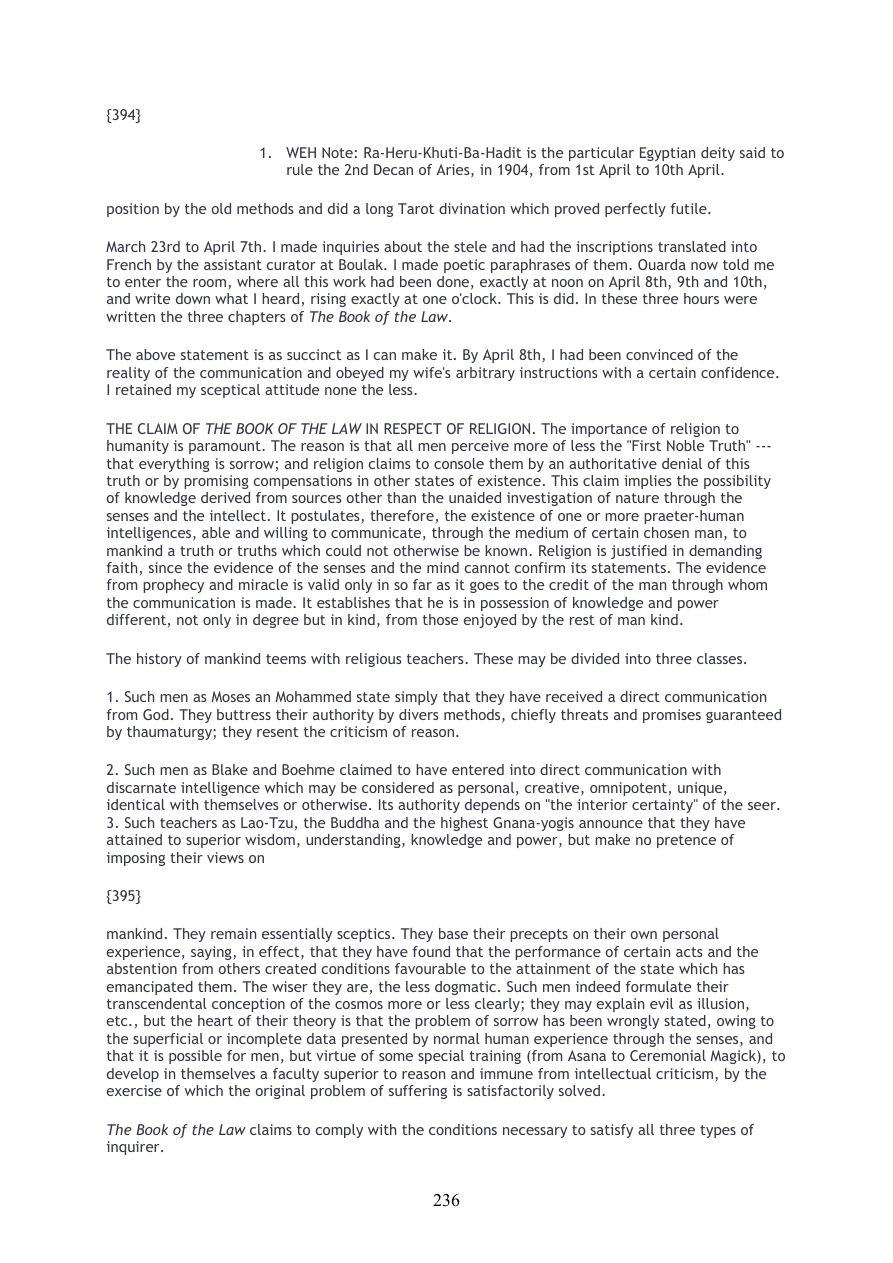
Highlights use the original PDF text layer. OCR-only matches may not be visible on the scan.
Transcription
Download text ↓raw extractionoriginal embedded textReview: unreviewed
236
{394}
1. WEH Note: Ra-Heru-Khuti-Ba-Hadit is the particular Egyptian deity said to
rule the 2nd Decan of Aries, in 1904, from 1st April to 10th April.
position by the old methods and did a long Tarot divination which proved perfectly futile.
March 23rd to April 7th. I made inquiries about the stele and had the inscriptions translated into
French by the assistant curator at Boulak. I made poetic paraphrases of them. Ouarda now told me
to enter the room, where all this work had been done, exactly at noon on April 8th, 9th and 10th,
and write down what I heard, rising exactly at one o'clock. This is did. In these three hours were
written the three chapters of The Book of the Law.
The above statement is as succinct as I can make it. By April 8th, I had been convinced of the
reality of the communication and obeyed my wife's arbitrary instructions with a certain confidence.
I retained my sceptical attitude none the less.
THE CLAIM OF THE BOOK OF THE LAW IN RESPECT OF RELIGION. The importance of religion to
humanity is paramount. The reason is that all men perceive more of less the "First Noble Truth" ---
that everything is sorrow; and religion claims to console them by an authoritative denial of this
truth or by promising compensations in other states of existence. This claim implies the possibility
of knowledge derived from sources other than the unaided investigation of nature through the
senses and the intellect. It postulates, therefore, the existence of one or more praeter-human
intelligences, able and willing to communicate, through the medium of certain chosen man, to
mankind a truth or truths which could not otherwise be known. Religion is justified in demanding
faith, since the evidence of the senses and the mind cannot confirm its statements. The evidence
from prophecy and miracle is valid only in so far as it goes to the credit of the man through whom
the communication is made. It establishes that he is in possession of knowledge and power
different, not only in degree but in kind, from those enjoyed by the rest of man kind.
The history of mankind teems with religious teachers. These may be divided into three classes.
1. Such men as Moses an Mohammed state simply that they have received a direct communication
from God. They buttress their authority by divers methods, chiefly threats and promises guaranteed
by thaumaturgy; they resent the criticism of reason.
2. Such men as Blake and Boehme claimed to have entered into direct communication with
discarnate intelligence which may be considered as personal, creative, omnipotent, unique,
identical with themselves or otherwise. Its authority depends on "the interior certainty" of the seer.
3. Such teachers as Lao-Tzu, the Buddha and the highest Gnana-yogis announce that they have
attained to superior wisdom, understanding, knowledge and power, but make no pretence of
imposing their views on
{395}
mankind. They remain essentially sceptics. They base their precepts on their own personal
experience, saying, in effect, that they have found that the performance of certain acts and the
abstention from others created conditions favourable to the attainment of the state which has
emancipated them. The wiser they are, the less dogmatic. Such men indeed formulate their
transcendental conception of the cosmos more or less clearly; they may explain evil as illusion,
etc., but the heart of their theory is that the problem of sorrow has been wrongly stated, owing to
the superficial or incomplete data presented by normal human experience through the senses, and
that it is possible for men, but virtue of some special training (from Asana to Ceremonial Magick), to
develop in themselves a faculty superior to reason and immune from intellectual criticism, by the
exercise of which the original problem of suffering is satisfactorily solved.
The Book of the Law claims to comply with the conditions necessary to satisfy all three types of
inquirer.
Page provenance & review flags
Stable page ID: 5ef44b98d8f9c4af5f6f86e1:p00236
Line breaks are preserved. Reading order and OCR accuracy may need review.
Printed page label has not been verified.
- No automated review flags. This does not establish transcription accuracy.