1929 · CLOSE READING
Confessions of Aleister Crowley
Confessions of Aleister Crowley (1929), PDF p. 230
Original page
Enlarge ↗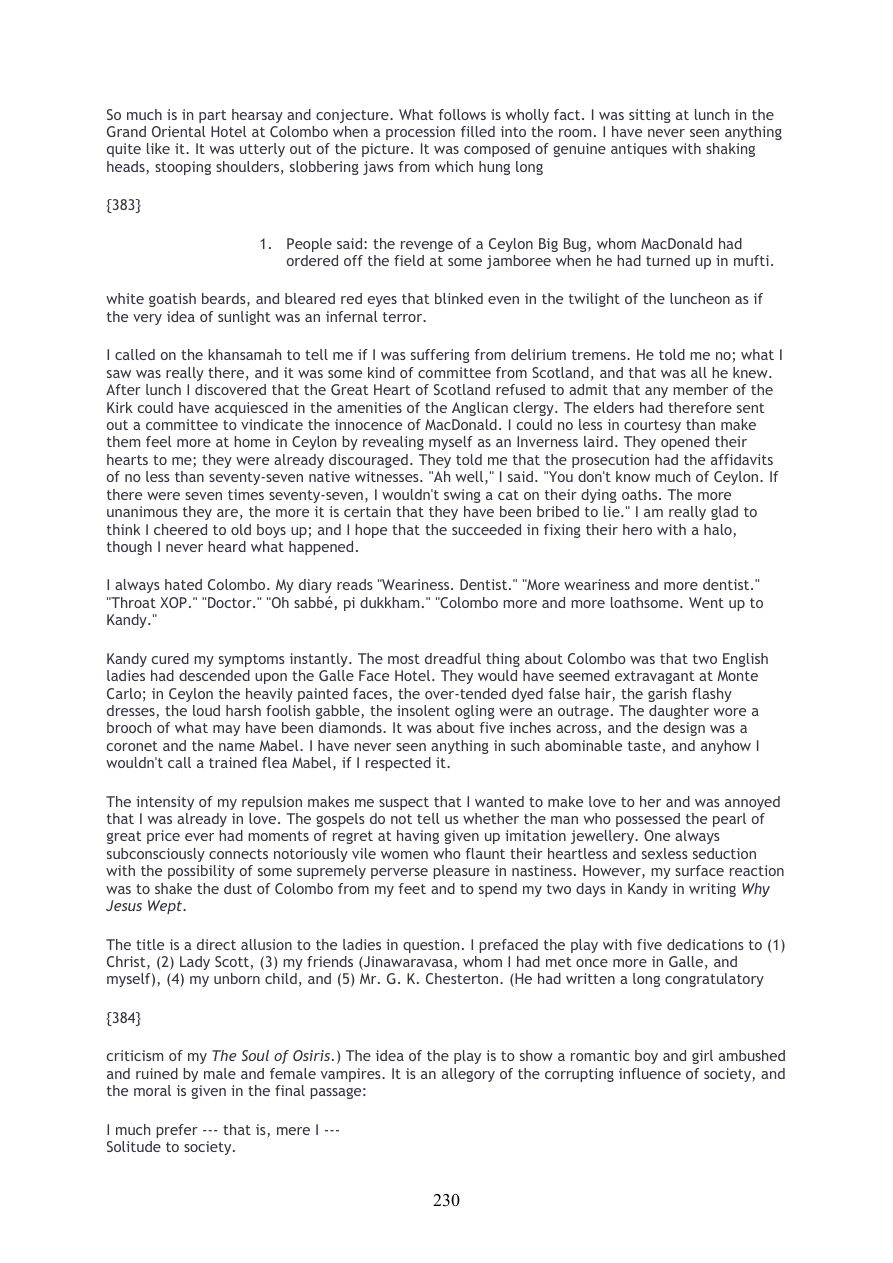
Highlights use the original PDF text layer. OCR-only matches may not be visible on the scan.
Transcription
Download text ↓raw extractionoriginal embedded textReview: unreviewed
230
So much is in part hearsay and conjecture. What follows is wholly fact. I was sitting at lunch in the
Grand Oriental Hotel at Colombo when a procession filled into the room. I have never seen anything
quite like it. It was utterly out of the picture. It was composed of genuine antiques with shaking
heads, stooping shoulders, slobbering jaws from which hung long
{383}
1. People said: the revenge of a Ceylon Big Bug, whom MacDonald had
ordered off the field at some jamboree when he had turned up in mufti.
white goatish beards, and bleared red eyes that blinked even in the twilight of the luncheon as if
the very idea of sunlight was an infernal terror.
I called on the khansamah to tell me if I was suffering from delirium tremens. He told me no; what I
saw was really there, and it was some kind of committee from Scotland, and that was all he knew.
After lunch I discovered that the Great Heart of Scotland refused to admit that any member of the
Kirk could have acquiesced in the amenities of the Anglican clergy. The elders had therefore sent
out a committee to vindicate the innocence of MacDonald. I could no less in courtesy than make
them feel more at home in Ceylon by revealing myself as an Inverness laird. They opened their
hearts to me; they were already discouraged. They told me that the prosecution had the affidavits
of no less than seventy-seven native witnesses. "Ah well," I said. "You don't know much of Ceylon. If
there were seven times seventy-seven, I wouldn't swing a cat on their dying oaths. The more
unanimous they are, the more it is certain that they have been bribed to lie." I am really glad to
think I cheered to old boys up; and I hope that the succeeded in fixing their hero with a halo,
though I never heard what happened.
I always hated Colombo. My diary reads "Weariness. Dentist." "More weariness and more dentist."
"Throat XOP." "Doctor." "Oh sabbé pi dukkham." "Colombo more and more loathsome. Went up to
Kandy."
Kandy cured my symptoms instantly. The most dreadful thing about Colombo was that two English
ladies had descended upon the Galle Face Hotel. They would have seemed extravagant at Monte
Carlo; in Ceylon the heavily painted faces, the over-tended dyed false hair, the garish flashy
dresses, the loud harsh foolish gabble, the insolent ogling were an outrage. The daughter wore a
brooch of what may have been diamonds. It was about five inches across, and the design was a
coronet and the name Mabel. I have never seen anything in such abominable taste, and anyhow I
wouldn't call a trained flea Mabel, if I respected it.
The intensity of my repulsion makes me suspect that I wanted to make love to her and was annoyed
that I was already in love. The gospels do not tell us whether the man who possessed the pearl of
great price ever had moments of regret at having given up imitation jewellery. One always
subconsciously connects notoriously vile women who flaunt their heartless and sexless seduction
with the possibility of some supremely perverse pleasure in nastiness. However, my surface reaction
was to shake the dust of Colombo from my feet and to spend my two days in Kandy in writing Why
Jesus Wept.
The title is a direct allusion to the ladies in question. I prefaced the play with five dedications to (1)
Christ, (2) Lady Scott, (3) my friends (Jinawaravasa, whom I had met once more in Galle, and
myself), (4) my unborn child, and (5) Mr. G. K. Chesterton. (He had written a long congratulatory
{384}
criticism of my The Soul of Osiris.) The idea of the play is to show a romantic boy and girl ambushed
and ruined by male and female vampires. It is an allegory of the corrupting influence of society, and
the moral is given in the final passage:
I much prefer --- that is, mere I ---
Solitude to society.
Page provenance & review flags
Stable page ID: 5ef44b98d8f9c4af5f6f86e1:p00230
Line breaks are preserved. Reading order and OCR accuracy may need review.
Printed page label has not been verified.
- No automated review flags. This does not establish transcription accuracy.