1929 · CLOSE READING
Confessions of Aleister Crowley
Confessions of Aleister Crowley (1929), PDF p. 225
Original page
Enlarge ↗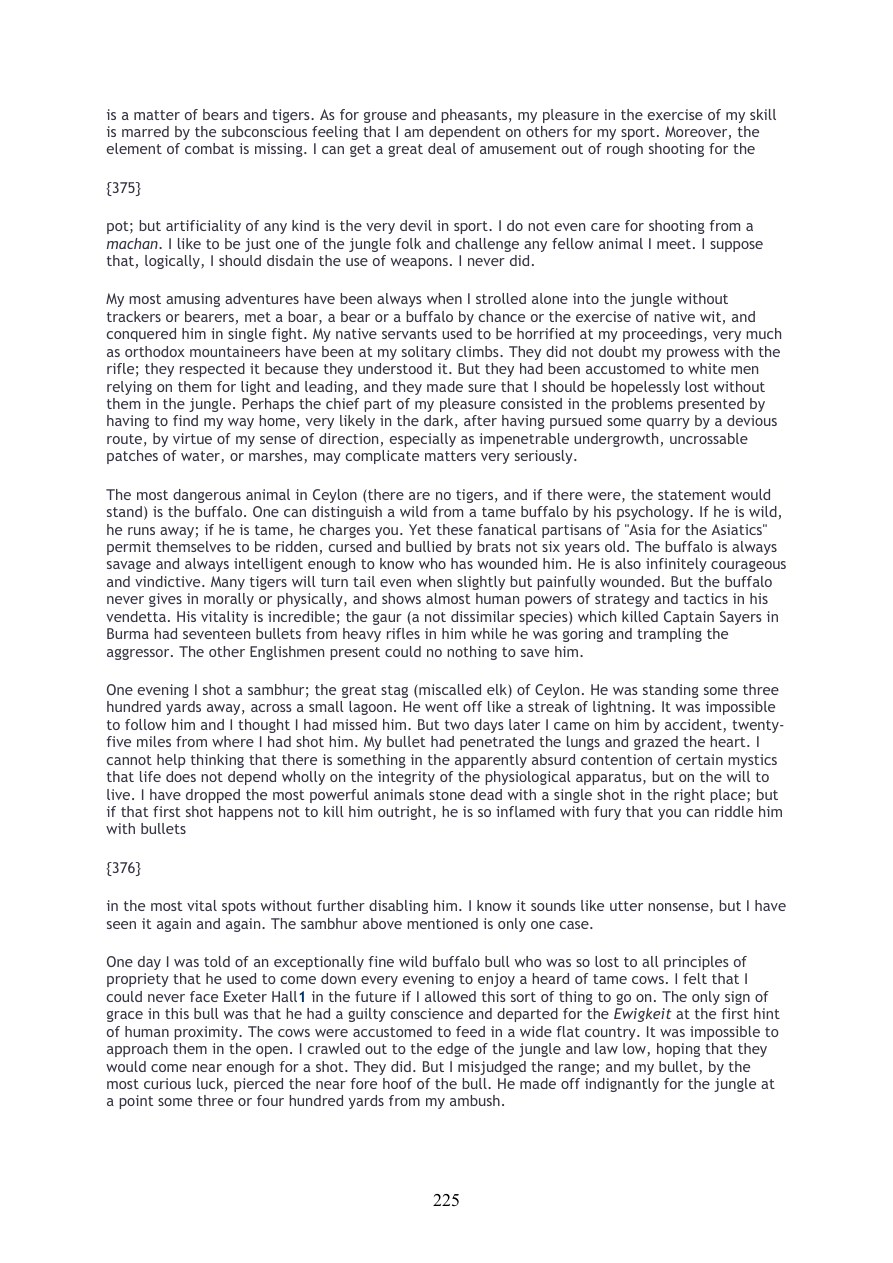
Highlights use the original PDF text layer. OCR-only matches may not be visible on the scan.
Transcription
Download text ↓raw extractionoriginal embedded textReview: unreviewed
225
is a matter of bears and tigers. As for grouse and pheasants, my pleasure in the exercise of my skill
is marred by the subconscious feeling that I am dependent on others for my sport. Moreover, the
element of combat is missing. I can get a great deal of amusement out of rough shooting for the
{375}
pot; but artificiality of any kind is the very devil in sport. I do not even care for shooting from a
machan. I like to be just one of the jungle folk and challenge any fellow animal I meet. I suppose
that, logically, I should disdain the use of weapons. I never did.
My most amusing adventures have been always when I strolled alone into the jungle without
trackers or bearers, met a boar, a bear or a buffalo by chance or the exercise of native wit, and
conquered him in single fight. My native servants used to be horrified at my proceedings, very much
as orthodox mountaineers have been at my solitary climbs. They did not doubt my prowess with the
rifle; they respected it because they understood it. But they had been accustomed to white men
relying on them for light and leading, and they made sure that I should be hopelessly lost without
them in the jungle. Perhaps the chief part of my pleasure consisted in the problems presented by
having to find my way home, very likely in the dark, after having pursued some quarry by a devious
route, by virtue of my sense of direction, especially as impenetrable undergrowth, uncrossable
patches of water, or marshes, may complicate matters very seriously.
The most dangerous animal in Ceylon (there are no tigers, and if there were, the statement would
stand) is the buffalo. One can distinguish a wild from a tame buffalo by his psychology. If he is wild,
he runs away; if he is tame, he charges you. Yet these fanatical partisans of "Asia for the Asiatics"
permit themselves to be ridden, cursed and bullied by brats not six years old. The buffalo is always
savage and always intelligent enough to know who has wounded him. He is also infinitely courageous
and vindictive. Many tigers will turn tail even when slightly but painfully wounded. But the buffalo
never gives in morally or physically, and shows almost human powers of strategy and tactics in his
vendetta. His vitality is incredible; the gaur (a not dissimilar species) which killed Captain Sayers in
Burma had seventeen bullets from heavy rifles in him while he was goring and trampling the
aggressor. The other Englishmen present could no nothing to save him.
One evening I shot a sambhur; the great stag (miscalled elk) of Ceylon. He was standing some three
hundred yards away, across a small lagoon. He went off like a streak of lightning. It was impossible
to follow him and I thought I had missed him. But two days later I came on him by accident, twenty-
five miles from where I had shot him. My bullet had penetrated the lungs and grazed the heart. I
cannot help thinking that there is something in the apparently absurd contention of certain mystics
that life does not depend wholly on the integrity of the physiological apparatus, but on the will to
live. I have dropped the most powerful animals stone dead with a single shot in the right place; but
if that first shot happens not to kill him outright, he is so inflamed with fury that you can riddle him
with bullets
{376}
in the most vital spots without further disabling him. I know it sounds like utter nonsense, but I have
seen it again and again. The sambhur above mentioned is only one case.
One day I was told of an exceptionally fine wild buffalo bull who was so lost to all principles of
propriety that he used to come down every evening to enjoy a heard of tame cows. I felt that I
could never face Exeter Hall1 in the future if I allowed this sort of thing to go on. The only sign of
grace in this bull was that he had a guilty conscience and departed for the Ewigkeit at the first hint
of human proximity. The cows were accustomed to feed in a wide flat country. It was impossible to
approach them in the open. I crawled out to the edge of the jungle and law low, hoping that they
would come near enough for a shot. They did. But I misjudged the range; and my bullet, by the
most curious luck, pierced the near fore hoof of the bull. He made off indignantly for the jungle at
a point some three or four hundred yards from my ambush.
Page provenance & review flags
Stable page ID: 5ef44b98d8f9c4af5f6f86e1:p00225
Line breaks are preserved. Reading order and OCR accuracy may need review.
Printed page label has not been verified.
- No automated review flags. This does not establish transcription accuracy.