1929 · CLOSE READING
Confessions of Aleister Crowley
Confessions of Aleister Crowley (1929), PDF p. 22
Original page
Enlarge ↗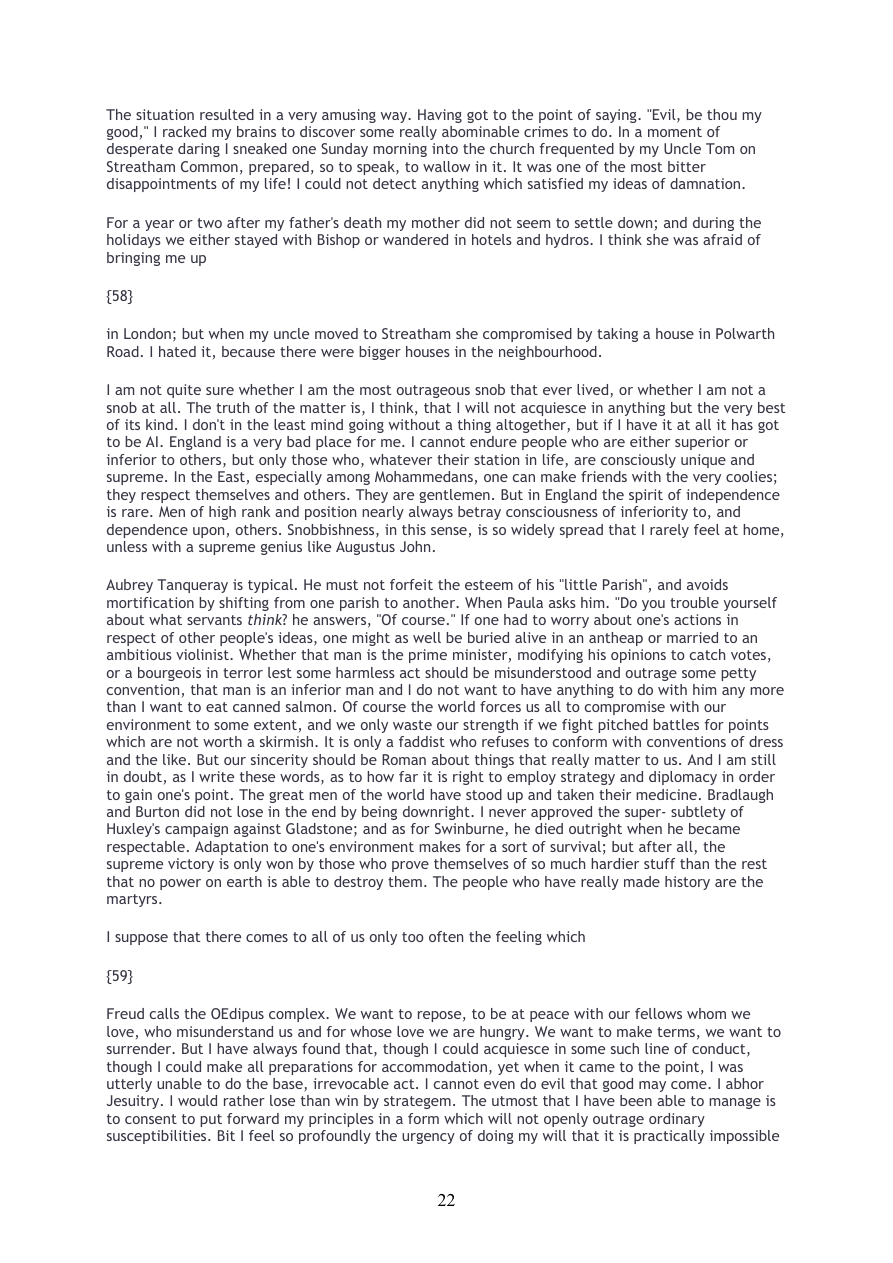
Highlights use the original PDF text layer. OCR-only matches may not be visible on the scan.
Transcription
Download text ↓raw extractionoriginal embedded textReview: unreviewed
22
The situation resulted in a very amusing way. Having got to the point of saying. "Evil, be thou my
good," I racked my brains to discover some really abominable crimes to do. In a moment of
desperate daring I sneaked one Sunday morning into the church frequented by my Uncle Tom on
Streatham Common, prepared, so to speak, to wallow in it. It was one of the most bitter
disappointments of my life! I could not detect anything which satisfied my ideas of damnation.
For a year or two after my father's death my mother did not seem to settle down; and during the
holidays we either stayed with Bishop or wandered in hotels and hydros. I think she was afraid of
bringing me up
{58}
in London; but when my uncle moved to Streatham she compromised by taking a house in Polwarth
Road. I hated it, because there were bigger houses in the neighbourhood.
I am not quite sure whether I am the most outrageous snob that ever lived, or whether I am not a
snob at all. The truth of the matter is, I think, that I will not acquiesce in anything but the very best
of its kind. I don't in the least mind going without a thing altogether, but if I have it at all it has got
to be AI. England is a very bad place for me. I cannot endure people who are either superior or
inferior to others, but only those who, whatever their station in life, are consciously unique and
supreme. In the East, especially among Mohammedans, one can make friends with the very coolies;
they respect themselves and others. They are gentlemen. But in England the spirit of independence
is rare. Men of high rank and position nearly always betray consciousness of inferiority to, and
dependence upon, others. Snobbishness, in this sense, is so widely spread that I rarely feel at home,
unless with a supreme genius like Augustus John.
Aubrey Tanqueray is typical. He must not forfeit the esteem of his "little Parish", and avoids
mortification by shifting from one parish to another. When Paula asks him. "Do you trouble yourself
about what servants think? he answers, "Of course." If one had to worry about one's actions in
respect of other people's ideas, one might as well be buried alive in an antheap or married to an
ambitious violinist. Whether that man is the prime minister, modifying his opinions to catch votes,
or a bourgeois in terror lest some harmless act should be misunderstood and outrage some petty
convention, that man is an inferior man and I do not want to have anything to do with him any more
than I want to eat canned salmon. Of course the world forces us all to compromise with our
environment to some extent, and we only waste our strength if we fight pitched battles for points
which are not worth a skirmish. It is only a faddist who refuses to conform with conventions of dress
and the like. But our sincerity should be Roman about things that really matter to us. And I am still
in doubt, as I write these words, as to how far it is right to employ strategy and diplomacy in order
to gain one's point. The great men of the world have stood up and taken their medicine. Bradlaugh
and Burton did not lose in the end by being downright. I never approved the super- subtlety of
Huxley's campaign against Gladstone; and as for Swinburne, he died outright when he became
respectable. Adaptation to one's environment makes for a sort of survival; but after all, the
supreme victory is only won by those who prove themselves of so much hardier stuff than the rest
that no power on earth is able to destroy them. The people who have really made history are the
martyrs.
I suppose that there comes to all of us only too often the feeling which
{59}
Freud calls the OEdipus complex. We want to repose, to be at peace with our fellows whom we
love, who misunderstand us and for whose love we are hungry. We want to make terms, we want to
surrender. But I have always found that, though I could acquiesce in some such line of conduct,
though I could make all preparations for accommodation, yet when it came to the point, I was
utterly unable to do the base, irrevocable act. I cannot even do evil that good may come. I abhor
Jesuitry. I would rather lose than win by strategem. The utmost that I have been able to manage is
to consent to put forward my principles in a form which will not openly outrage ordinary
susceptibilities. Bit I feel so profoundly the urgency of doing my will that it is practically impossible
Page provenance & review flags
Stable page ID: 5ef44b98d8f9c4af5f6f86e1:p00022
Line breaks are preserved. Reading order and OCR accuracy may need review.
Printed page label has not been verified.
- No automated review flags. This does not establish transcription accuracy.