1929 · CLOSE READING
Confessions of Aleister Crowley
Confessions of Aleister Crowley (1929), PDF p. 21
Original page
Enlarge ↗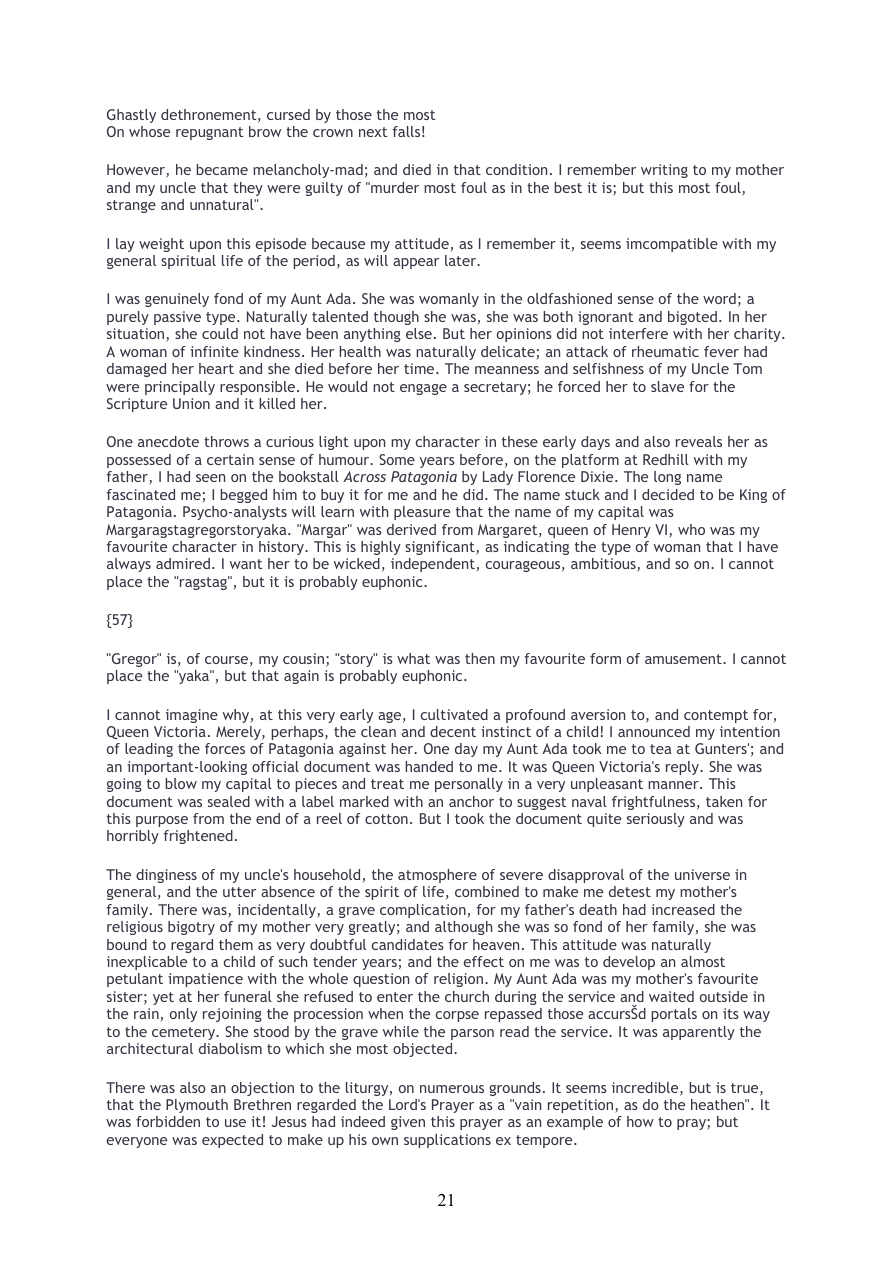
Highlights use the original PDF text layer. OCR-only matches may not be visible on the scan.
Transcription
Download text ↓raw extractionoriginal embedded textReview: unreviewed
21
Ghastly dethronement, cursed by those the most
On whose repugnant brow the crown next falls!
However, he became melancholy-mad; and died in that condition. I remember writing to my mother
and my uncle that they were guilty of "murder most foul as in the best it is; but this most foul,
strange and unnatural".
I lay weight upon this episode because my attitude, as I remember it, seems imcompatible with my
general spiritual life of the period, as will appear later.
I was genuinely fond of my Aunt Ada. She was womanly in the oldfashioned sense of the word; a
purely passive type. Naturally talented though she was, she was both ignorant and bigoted. In her
situation, she could not have been anything else. But her opinions did not interfere with her charity.
A woman of infinite kindness. Her health was naturally delicate; an attack of rheumatic fever had
damaged her heart and she died before her time. The meanness and selfishness of my Uncle Tom
were principally responsible. He would not engage a secretary; he forced her to slave for the
Scripture Union and it killed her.
One anecdote throws a curious light upon my character in these early days and also reveals her as
possessed of a certain sense of humour. Some years before, on the platform at Redhill with my
father, I had seen on the bookstall Across Patagonia by Lady Florence Dixie. The long name
fascinated me; I begged him to buy it for me and he did. The name stuck and I decided to be King of
Patagonia. Psycho-analysts will learn with pleasure that the name of my capital was
Margaragstagregorstoryaka. "Margar" was derived from Margaret, queen of Henry VI, who was my
favourite character in history. This is highly significant, as indicating the type of woman that I have
always admired. I want her to be wicked, independent, courageous, ambitious, and so on. I cannot
place the "ragstag", but it is probably euphonic.
{57}
"Gregor" is, of course, my cousin; "story" is what was then my favourite form of amusement. I cannot
place the "yaka", but that again is probably euphonic.
I cannot imagine why, at this very early age, I cultivated a profound aversion to, and contempt for,
Queen Victoria. Merely, perhaps, the clean and decent instinct of a child! I announced my intention
of leading the forces of Patagonia against her. One day my Aunt Ada took me to tea at Gunters'; and
an important-looking official document was handed to me. It was Queen Victoria's reply. She was
going to blow my capital to pieces and treat me personally in a very unpleasant manner. This
document was sealed with a label marked with an anchor to suggest naval frightfulness, taken for
this purpose from the end of a reel of cotton. But I took the document quite seriously and was
horribly frightened.
The dinginess of my uncle's household, the atmosphere of severe disapproval of the universe in
general, and the utter absence of the spirit of life, combined to make me detest my mother's
family. There was, incidentally, a grave complication, for my father's death had increased the
religious bigotry of my mother very greatly; and although she was so fond of her family, she was
bound to regard them as very doubtful candidates for heaven. This attitude was naturally
inexplicable to a child of such tender years; and the effect on me was to develop an almost
petulant impatience with the whole question of religion. My Aunt Ada was my mother's favourite
sister; yet at her funeral she refused to enter the church during the service and waited outside in
the rain, only rejoining the procession when the corpse repassed those accursd portals on its way
to the cemetery. She stood by the grave while the parson read the service. It was apparently the
architectural diabolism to which she most objected.
There was also an objection to the liturgy, on numerous grounds. It seems incredible, but is true,
that the Plymouth Brethren regarded the Lord's Prayer as a "vain repetition, as do the heathen". It
was forbidden to use it! Jesus had indeed given this prayer as an example of how to pray; but
everyone was expected to make up his own supplications ex tempore.
Page provenance & review flags
Stable page ID: 5ef44b98d8f9c4af5f6f86e1:p00021
Line breaks are preserved. Reading order and OCR accuracy may need review.
Printed page label has not been verified.
- No automated review flags. This does not establish transcription accuracy.