1929 · CLOSE READING
Confessions of Aleister Crowley
Confessions of Aleister Crowley (1929), PDF p. 211
Original page
Enlarge ↗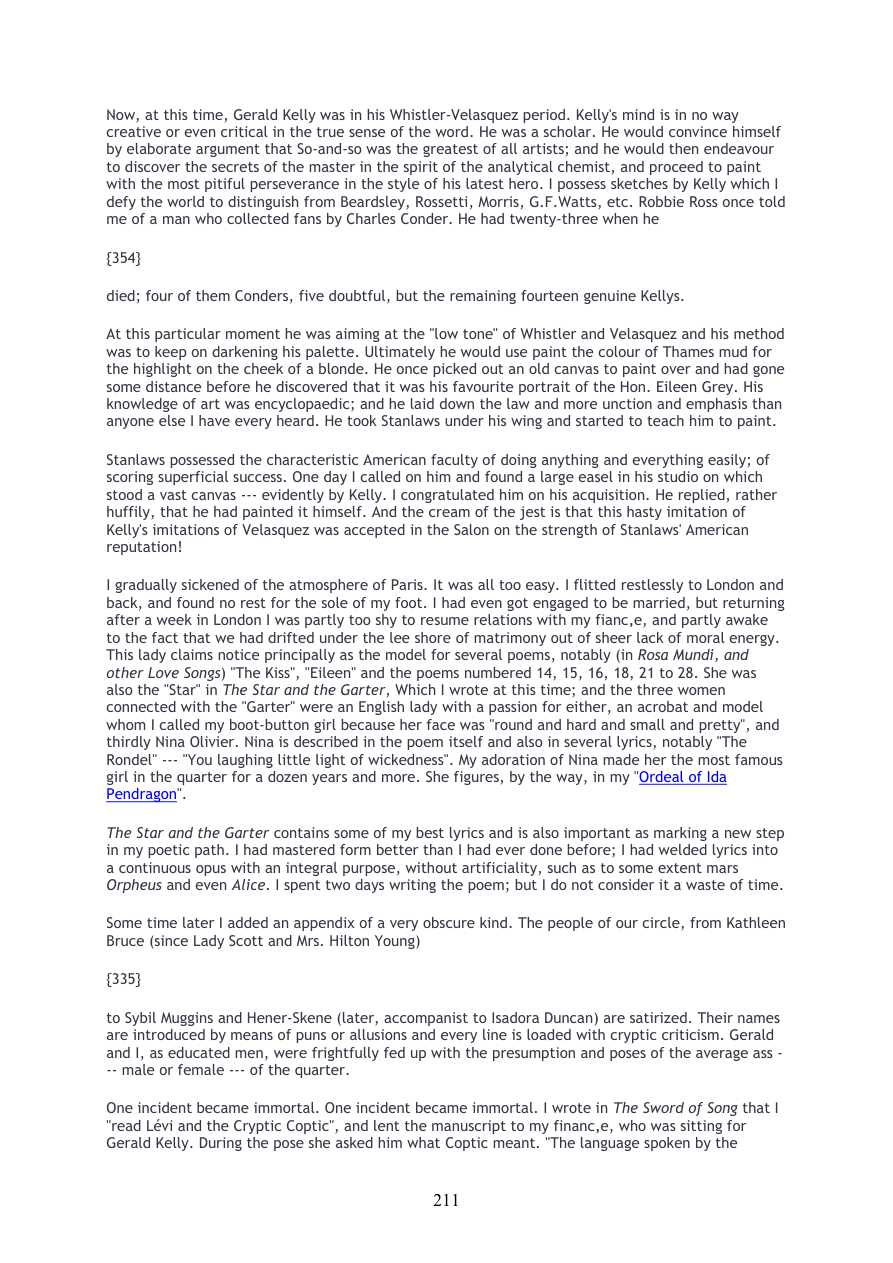
Highlights use the original PDF text layer. OCR-only matches may not be visible on the scan.
Transcription
Download text ↓raw extractionoriginal embedded textReview: unreviewed
211
Now, at this time, Gerald Kelly was in his Whistler-Velasquez period. Kelly's mind is in no way
creative or even critical in the true sense of the word. He was a scholar. He would convince himself
by elaborate argument that So-and-so was the greatest of all artists; and he would then endeavour
to discover the secrets of the master in the spirit of the analytical chemist, and proceed to paint
with the most pitiful perseverance in the style of his latest hero. I possess sketches by Kelly which I
defy the world to distinguish from Beardsley, Rossetti, Morris, G.F.Watts, etc. Robbie Ross once told
me of a man who collected fans by Charles Conder. He had twenty-three when he
{354}
died; four of them Conders, five doubtful, but the remaining fourteen genuine Kellys.
At this particular moment he was aiming at the "low tone" of Whistler and Velasquez and his method
was to keep on darkening his palette. Ultimately he would use paint the colour of Thames mud for
the highlight on the cheek of a blonde. He once picked out an old canvas to paint over and had gone
some distance before he discovered that it was his favourite portrait of the Hon. Eileen Grey. His
knowledge of art was encyclopaedic; and he laid down the law and more unction and emphasis than
anyone else I have every heard. He took Stanlaws under his wing and started to teach him to paint.
Stanlaws possessed the characteristic American faculty of doing anything and everything easily; of
scoring superficial success. One day I called on him and found a large easel in his studio on which
stood a vast canvas --- evidently by Kelly. I congratulated him on his acquisition. He replied, rather
huffily, that he had painted it himself. And the cream of the jest is that this hasty imitation of
Kelly's imitations of Velasquez was accepted in the Salon on the strength of Stanlaws' American
reputation!
I gradually sickened of the atmosphere of Paris. It was all too easy. I flitted restlessly to London and
back, and found no rest for the sole of my foot. I had even got engaged to be married, but returning
after a week in London I was partly too shy to resume relations with my fiance, and partly awake
to the fact that we had drifted under the lee shore of matrimony out of sheer lack of moral energy.
This lady claims notice principally as the model for several poems, notably (in Rosa Mundi, and
other Love Songs) "The Kiss", "Eileen" and the poems numbered 14, 15, 16, 18, 21 to 28. She was
also the "Star" in The Star and the Garter, Which I wrote at this time; and the three women
connected with the "Garter" were an English lady with a passion for either, an acrobat and model
whom I called my boot-button girl because her face was "round and hard and small and pretty", and
thirdly Nina Olivier. Nina is described in the poem itself and also in several lyrics, notably "The
Rondel" --- "You laughing little light of wickedness". My adoration of Nina made her the most famous
girl in the quarter for a dozen years and more. She figures, by the way, in my "Ordeal of Ida
Pendragon".
The Star and the Garter contains some of my best lyrics and is also important as marking a new step
in my poetic path. I had mastered form better than I had ever done before; I had welded lyrics into
a continuous opus with an integral purpose, without artificiality, such as to some extent mars
Orpheus and even Alice. I spent two days writing the poem; but I do not consider it a waste of time.
Some time later I added an appendix of a very obscure kind. The people of our circle, from Kathleen
Bruce (since Lady Scott and Mrs. Hilton Young)
{335}
to Sybil Muggins and Hener-Skene (later, accompanist to Isadora Duncan) are satirized. Their names
are introduced by means of puns or allusions and every line is loaded with cryptic criticism. Gerald
and I, as educated men, were frightfully fed up with the presumption and poses of the average ass -
-- male or female --- of the quarter.
One incident became immortal. One incident became immortal. I wrote in The Sword of Song that I
"read Lévi and the Cryptic Coptic", and lent the manuscript to my finance, who was sitting for
Gerald Kelly. During the pose she asked him what Coptic meant. "The language spoken by the
Page provenance & review flags
Stable page ID: 5ef44b98d8f9c4af5f6f86e1:p00211
Line breaks are preserved. Reading order and OCR accuracy may need review.
Printed page label has not been verified.
- No automated review flags. This does not establish transcription accuracy.