1929 · CLOSE READING
Confessions of Aleister Crowley
Confessions of Aleister Crowley (1929), PDF p. 205
Original page
Enlarge ↗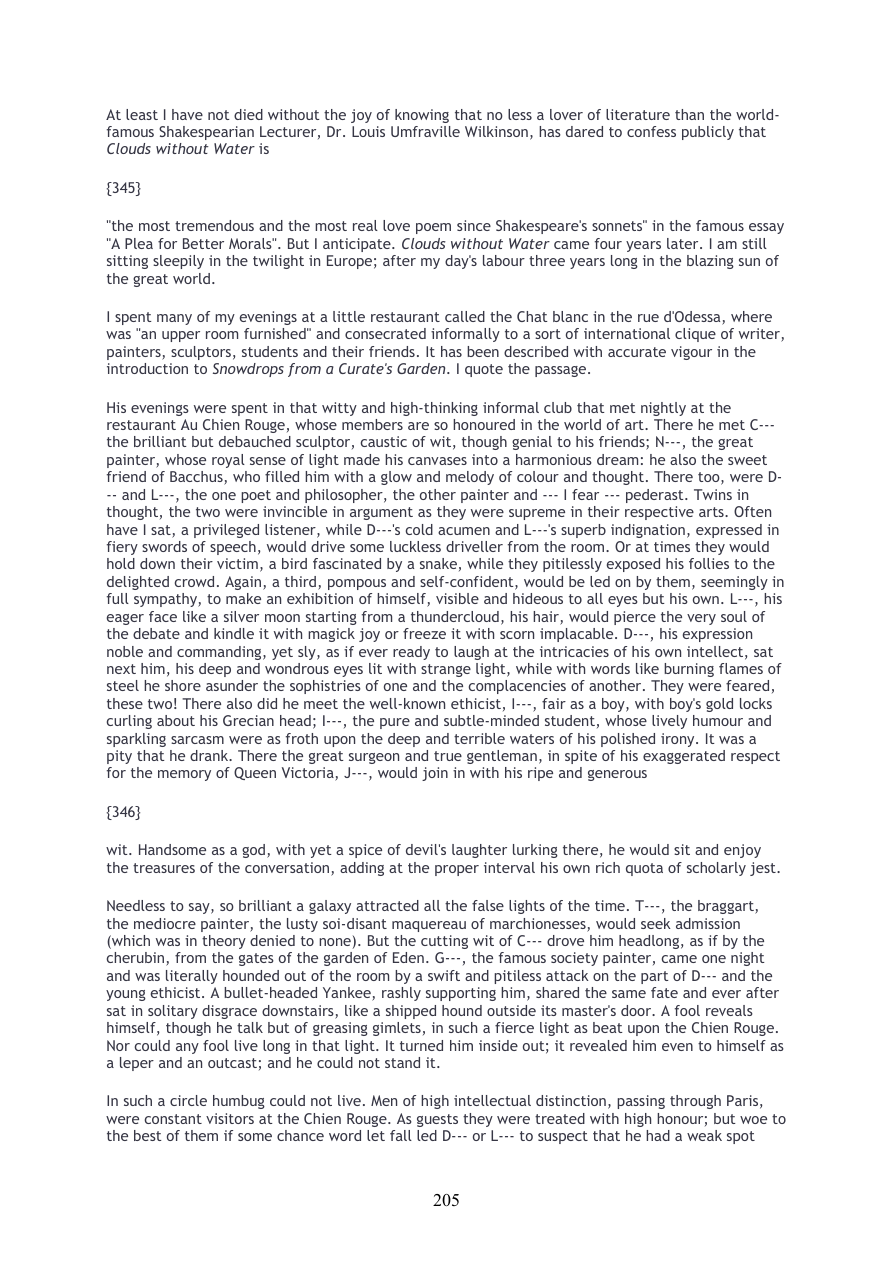
Highlights use the original PDF text layer. OCR-only matches may not be visible on the scan.
Transcription
Download text ↓raw extractionoriginal embedded textReview: unreviewed
205
At least I have not died without the joy of knowing that no less a lover of literature than the world-
famous Shakespearian Lecturer, Dr. Louis Umfraville Wilkinson, has dared to confess publicly that
Clouds without Water is
{345}
"the most tremendous and the most real love poem since Shakespeare's sonnets" in the famous essay
"A Plea for Better Morals". But I anticipate. Clouds without Water came four years later. I am still
sitting sleepily in the twilight in Europe; after my day's labour three years long in the blazing sun of
the great world.
I spent many of my evenings at a little restaurant called the Chat blanc in the rue d'Odessa, where
was "an upper room furnished" and consecrated informally to a sort of international clique of writer,
painters, sculptors, students and their friends. It has been described with accurate vigour in the
introduction to Snowdrops from a Curate's Garden. I quote the passage.
His evenings were spent in that witty and high-thinking informal club that met nightly at the
restaurant Au Chien Rouge, whose members are so honoured in the world of art. There he met C---
the brilliant but debauched sculptor, caustic of wit, though genial to his friends; N---, the great
painter, whose royal sense of light made his canvases into a harmonious dream: he also the sweet
friend of Bacchus, who filled him with a glow and melody of colour and thought. There too, were D-
-- and L---, the one poet and philosopher, the other painter and --- I fear --- pederast. Twins in
thought, the two were invincible in argument as they were supreme in their respective arts. Often
have I sat, a privileged listener, while D---'s cold acumen and L---'s superb indignation, expressed in
fiery swords of speech, would drive some luckless driveller from the room. Or at times they would
hold down their victim, a bird fascinated by a snake, while they pitilessly exposed his follies to the
delighted crowd. Again, a third, pompous and self-confident, would be led on by them, seemingly in
full sympathy, to make an exhibition of himself, visible and hideous to all eyes but his own. L---, his
eager face like a silver moon starting from a thundercloud, his hair, would pierce the very soul of
the debate and kindle it with magick joy or freeze it with scorn implacable. D---, his expression
noble and commanding, yet sly, as if ever ready to laugh at the intricacies of his own intellect, sat
next him, his deep and wondrous eyes lit with strange light, while with words like burning flames of
steel he shore asunder the sophistries of one and the complacencies of another. They were feared,
these two! There also did he meet the well-known ethicist, I---, fair as a boy, with boy's gold locks
curling about his Grecian head; I---, the pure and subtle-minded student, whose lively humour and
sparkling sarcasm were as froth upon the deep and terrible waters of his polished irony. It was a
pity that he drank. There the great surgeon and true gentleman, in spite of his exaggerated respect
for the memory of Queen Victoria, J---, would join in with his ripe and generous
{346}
wit. Handsome as a god, with yet a spice of devil's laughter lurking there, he would sit and enjoy
the treasures of the conversation, adding at the proper interval his own rich quota of scholarly jest.
Needless to say, so brilliant a galaxy attracted all the false lights of the time. T---, the braggart,
the mediocre painter, the lusty soi-disant maquereau of marchionesses, would seek admission
(which was in theory denied to none). But the cutting wit of C--- drove him headlong, as if by the
cherubin, from the gates of the garden of Eden. G---, the famous society painter, came one night
and was literally hounded out of the room by a swift and pitiless attack on the part of D--- and the
young ethicist. A bullet-headed Yankee, rashly supporting him, shared the same fate and ever after
sat in solitary disgrace downstairs, like a shipped hound outside its master's door. A fool reveals
himself, though he talk but of greasing gimlets, in such a fierce light as beat upon the Chien Rouge.
Nor could any fool live long in that light. It turned him inside out; it revealed him even to himself as
a leper and an outcast; and he could not stand it.
In such a circle humbug could not live. Men of high intellectual distinction, passing through Paris,
were constant visitors at the Chien Rouge. As guests they were treated with high honour; but woe to
the best of them if some chance word let fall led D--- or L--- to suspect that he had a weak spot
Page provenance & review flags
Stable page ID: 5ef44b98d8f9c4af5f6f86e1:p00205
Line breaks are preserved. Reading order and OCR accuracy may need review.
Printed page label has not been verified.
- No automated review flags. This does not establish transcription accuracy.