1929 · CLOSE READING
Confessions of Aleister Crowley
Confessions of Aleister Crowley (1929), PDF p. 200
Original page
Enlarge ↗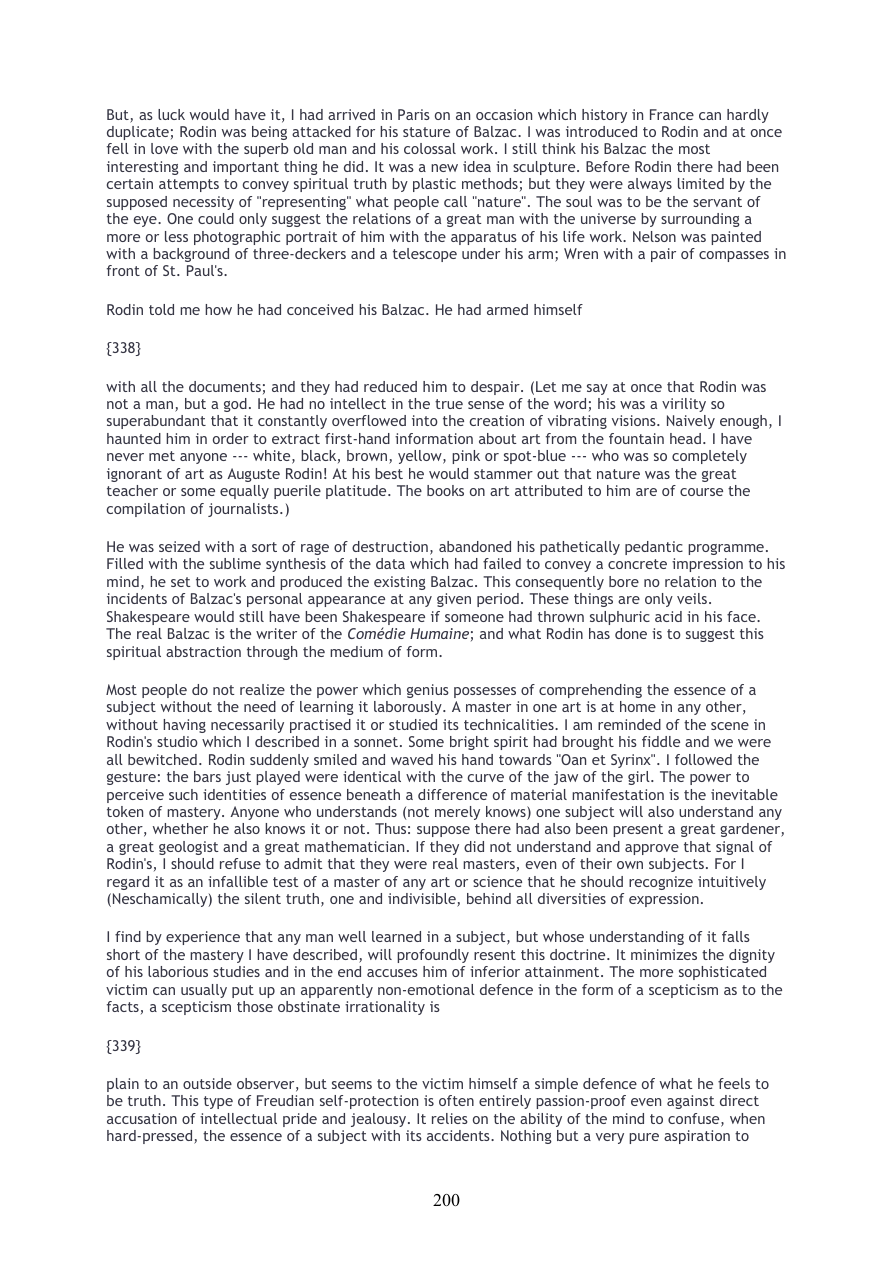
Highlights use the original PDF text layer. OCR-only matches may not be visible on the scan.
Transcription
Download text ↓raw extractionoriginal embedded textReview: unreviewed
200
But, as luck would have it, I had arrived in Paris on an occasion which history in France can hardly
duplicate; Rodin was being attacked for his stature of Balzac. I was introduced to Rodin and at once
fell in love with the superb old man and his colossal work. I still think his Balzac the most
interesting and important thing he did. It was a new idea in sculpture. Before Rodin there had been
certain attempts to convey spiritual truth by plastic methods; but they were always limited by the
supposed necessity of "representing" what people call "nature". The soul was to be the servant of
the eye. One could only suggest the relations of a great man with the universe by surrounding a
more or less photographic portrait of him with the apparatus of his life work. Nelson was painted
with a background of three-deckers and a telescope under his arm; Wren with a pair of compasses in
front of St. Paul's.
Rodin told me how he had conceived his Balzac. He had armed himself
{338}
with all the documents; and they had reduced him to despair. (Let me say at once that Rodin was
not a man, but a god. He had no intellect in the true sense of the word; his was a virility so
superabundant that it constantly overflowed into the creation of vibrating visions. Naively enough, I
haunted him in order to extract first-hand information about art from the fountain head. I have
never met anyone --- white, black, brown, yellow, pink or spot-blue --- who was so completely
ignorant of art as Auguste Rodin! At his best he would stammer out that nature was the great
teacher or some equally puerile platitude. The books on art attributed to him are of course the
compilation of journalists.)
He was seized with a sort of rage of destruction, abandoned his pathetically pedantic programme.
Filled with the sublime synthesis of the data which had failed to convey a concrete impression to his
mind, he set to work and produced the existing Balzac. This consequently bore no relation to the
incidents of Balzac's personal appearance at any given period. These things are only veils.
Shakespeare would still have been Shakespeare if someone had thrown sulphuric acid in his face.
The real Balzac is the writer of the Comédie Humaine; and what Rodin has done is to suggest this
spiritual abstraction through the medium of form.
Most people do not realize the power which genius possesses of comprehending the essence of a
subject without the need of learning it laborously. A master in one art is at home in any other,
without having necessarily practised it or studied its technicalities. I am reminded of the scene in
Rodin's studio which I described in a sonnet. Some bright spirit had brought his fiddle and we were
all bewitched. Rodin suddenly smiled and waved his hand towards "Oan et Syrinx". I followed the
gesture: the bars just played were identical with the curve of the jaw of the girl. The power to
perceive such identities of essence beneath a difference of material manifestation is the inevitable
token of mastery. Anyone who understands (not merely knows) one subject will also understand any
other, whether he also knows it or not. Thus: suppose there had also been present a great gardener,
a great geologist and a great mathematician. If they did not understand and approve that signal of
Rodin's, I should refuse to admit that they were real masters, even of their own subjects. For I
regard it as an infallible test of a master of any art or science that he should recognize intuitively
(Neschamically) the silent truth, one and indivisible, behind all diversities of expression.
I find by experience that any man well learned in a subject, but whose understanding of it falls
short of the mastery I have described, will profoundly resent this doctrine. It minimizes the dignity
of his laborious studies and in the end accuses him of inferior attainment. The more sophisticated
victim can usually put up an apparently non-emotional defence in the form of a scepticism as to the
facts, a scepticism those obstinate irrationality is
{339}
plain to an outside observer, but seems to the victim himself a simple defence of what he feels to
be truth. This type of Freudian self-protection is often entirely passion-proof even against direct
accusation of intellectual pride and jealousy. It relies on the ability of the mind to confuse, when
hard-pressed, the essence of a subject with its accidents. Nothing but a very pure aspiration to
Page provenance & review flags
Stable page ID: 5ef44b98d8f9c4af5f6f86e1:p00200
Line breaks are preserved. Reading order and OCR accuracy may need review.
Printed page label has not been verified.
- No automated review flags. This does not establish transcription accuracy.