1929 · CLOSE READING
Confessions of Aleister Crowley
Confessions of Aleister Crowley (1929), PDF p. 19
Original page
Enlarge ↗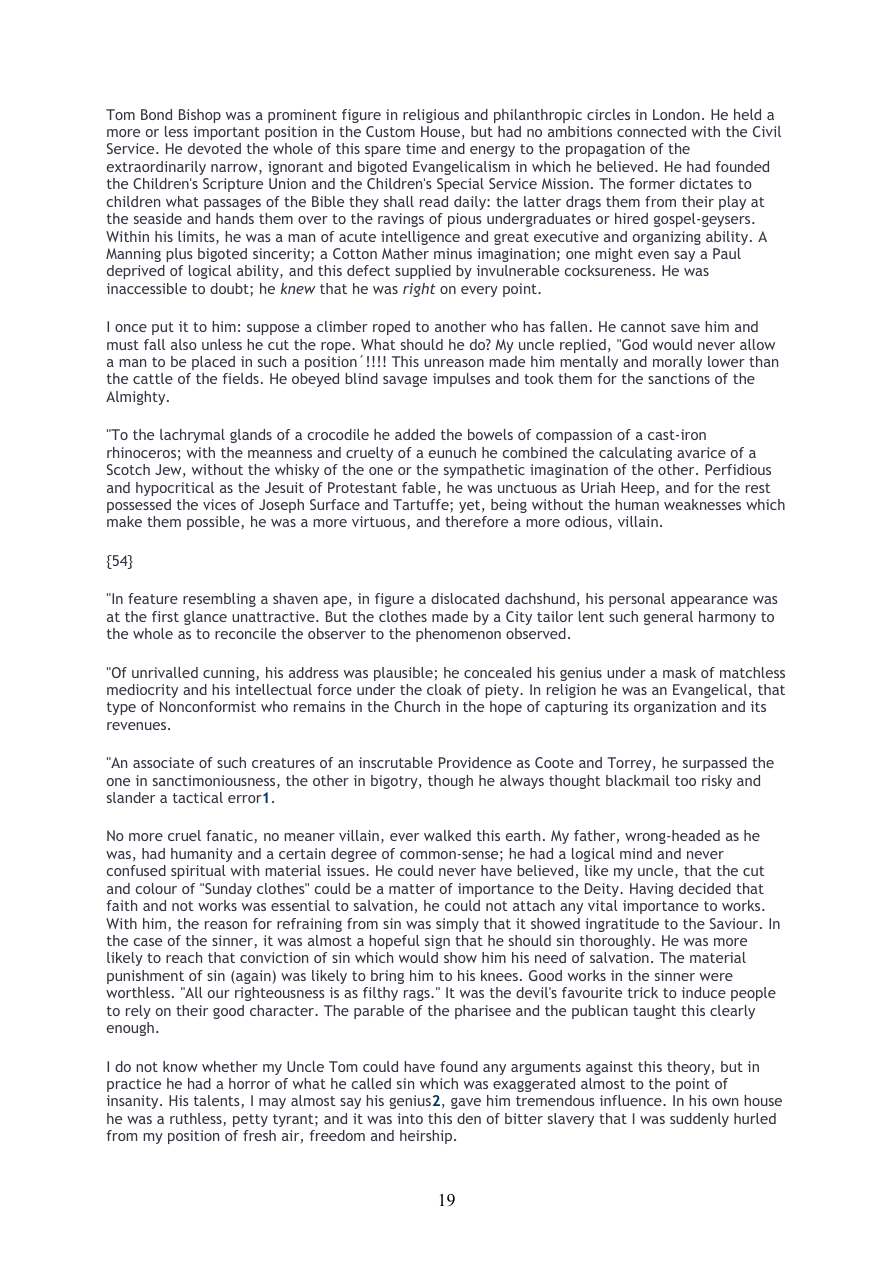
Highlights use the original PDF text layer. OCR-only matches may not be visible on the scan.
Transcription
Download text ↓raw extractionoriginal embedded textReview: unreviewed
19
Tom Bond Bishop was a prominent figure in religious and philanthropic circles in London. He held a
more or less important position in the Custom House, but had no ambitions connected with the Civil
Service. He devoted the whole of this spare time and energy to the propagation of the
extraordinarily narrow, ignorant and bigoted Evangelicalism in which he believed. He had founded
the Children's Scripture Union and the Children's Special Service Mission. The former dictates to
children what passages of the Bible they shall read daily: the latter drags them from their play at
the seaside and hands them over to the ravings of pious undergraduates or hired gospel-geysers.
Within his limits, he was a man of acute intelligence and great executive and organizing ability. A
Manning plus bigoted sincerity; a Cotton Mather minus imagination; one might even say a Paul
deprived of logical ability, and this defect supplied by invulnerable cocksureness. He was
inaccessible to doubt; he knew that he was right on every point.
I once put it to him: suppose a climber roped to another who has fallen. He cannot save him and
must fall also unless he cut the rope. What should he do? My uncle replied, "God would never allow
a man to be placed in such a position´!!!! This unreason made him mentally and morally lower than
the cattle of the fields. He obeyed blind savage impulses and took them for the sanctions of the
Almighty.
"To the lachrymal glands of a crocodile he added the bowels of compassion of a cast-iron
rhinoceros; with the meanness and cruelty of a eunuch he combined the calculating avarice of a
Scotch Jew, without the whisky of the one or the sympathetic imagination of the other. Perfidious
and hypocritical as the Jesuit of Protestant fable, he was unctuous as Uriah Heep, and for the rest
possessed the vices of Joseph Surface and Tartuffe; yet, being without the human weaknesses which
make them possible, he was a more virtuous, and therefore a more odious, villain.
{54}
"In feature resembling a shaven ape, in figure a dislocated dachshund, his personal appearance was
at the first glance unattractive. But the clothes made by a City tailor lent such general harmony to
the whole as to reconcile the observer to the phenomenon observed.
"Of unrivalled cunning, his address was plausible; he concealed his genius under a mask of matchless
mediocrity and his intellectual force under the cloak of piety. In religion he was an Evangelical, that
type of Nonconformist who remains in the Church in the hope of capturing its organization and its
revenues.
"An associate of such creatures of an inscrutable Providence as Coote and Torrey, he surpassed the
one in sanctimoniousness, the other in bigotry, though he always thought blackmail too risky and
slander a tactical error1.
No more cruel fanatic, no meaner villain, ever walked this earth. My father, wrong-headed as he
was, had humanity and a certain degree of common-sense; he had a logical mind and never
confused spiritual with material issues. He could never have believed, like my uncle, that the cut
and colour of "Sunday clothes" could be a matter of importance to the Deity. Having decided that
faith and not works was essential to salvation, he could not attach any vital importance to works.
With him, the reason for refraining from sin was simply that it showed ingratitude to the Saviour. In
the case of the sinner, it was almost a hopeful sign that he should sin thoroughly. He was more
likely to reach that conviction of sin which would show him his need of salvation. The material
punishment of sin (again) was likely to bring him to his knees. Good works in the sinner were
worthless. "All our righteousness is as filthy rags." It was the devil's favourite trick to induce people
to rely on their good character. The parable of the pharisee and the publican taught this clearly
enough.
I do not know whether my Uncle Tom could have found any arguments against this theory, but in
practice he had a horror of what he called sin which was exaggerated almost to the point of
insanity. His talents, I may almost say his genius2, gave him tremendous influence. In his own house
he was a ruthless, petty tyrant; and it was into this den of bitter slavery that I was suddenly hurled
from my position of fresh air, freedom and heirship.
Page provenance & review flags
Stable page ID: 5ef44b98d8f9c4af5f6f86e1:p00019
Line breaks are preserved. Reading order and OCR accuracy may need review.
Printed page label has not been verified.
- No automated review flags. This does not establish transcription accuracy.