1929 · CLOSE READING
Confessions of Aleister Crowley
Confessions of Aleister Crowley (1929), PDF p. 195
Original page
Enlarge ↗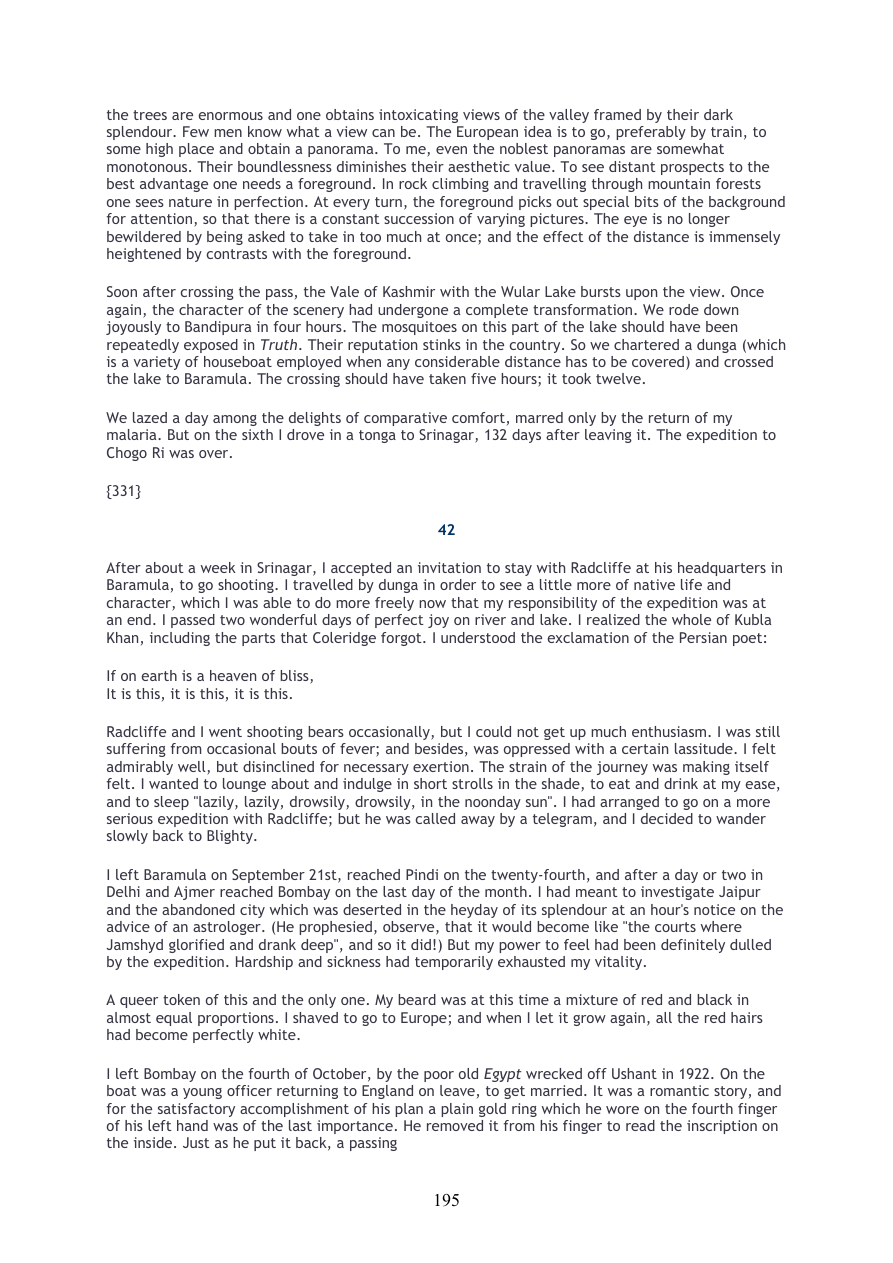
Highlights use the original PDF text layer. OCR-only matches may not be visible on the scan.
Transcription
Download text ↓raw extractionoriginal embedded textReview: unreviewed
195
the trees are enormous and one obtains intoxicating views of the valley framed by their dark
splendour. Few men know what a view can be. The European idea is to go, preferably by train, to
some high place and obtain a panorama. To me, even the noblest panoramas are somewhat
monotonous. Their boundlessness diminishes their aesthetic value. To see distant prospects to the
best advantage one needs a foreground. In rock climbing and travelling through mountain forests
one sees nature in perfection. At every turn, the foreground picks out special bits of the background
for attention, so that there is a constant succession of varying pictures. The eye is no longer
bewildered by being asked to take in too much at once; and the effect of the distance is immensely
heightened by contrasts with the foreground.
Soon after crossing the pass, the Vale of Kashmir with the Wular Lake bursts upon the view. Once
again, the character of the scenery had undergone a complete transformation. We rode down
joyously to Bandipura in four hours. The mosquitoes on this part of the lake should have been
repeatedly exposed in Truth. Their reputation stinks in the country. So we chartered a dunga (which
is a variety of houseboat employed when any considerable distance has to be covered) and crossed
the lake to Baramula. The crossing should have taken five hours; it took twelve.
We lazed a day among the delights of comparative comfort, marred only by the return of my
malaria. But on the sixth I drove in a tonga to Srinagar, 132 days after leaving it. The expedition to
Chogo Ri was over.
{331}
42
After about a week in Srinagar, I accepted an invitation to stay with Radcliffe at his headquarters in
Baramula, to go shooting. I travelled by dunga in order to see a little more of native life and
character, which I was able to do more freely now that my responsibility of the expedition was at
an end. I passed two wonderful days of perfect joy on river and lake. I realized the whole of Kubla
Khan, including the parts that Coleridge forgot. I understood the exclamation of the Persian poet:
If on earth is a heaven of bliss,
It is this, it is this, it is this.
Radcliffe and I went shooting bears occasionally, but I could not get up much enthusiasm. I was still
suffering from occasional bouts of fever; and besides, was oppressed with a certain lassitude. I felt
admirably well, but disinclined for necessary exertion. The strain of the journey was making itself
felt. I wanted to lounge about and indulge in short strolls in the shade, to eat and drink at my ease,
and to sleep "lazily, lazily, drowsily, drowsily, in the noonday sun". I had arranged to go on a more
serious expedition with Radcliffe; but he was called away by a telegram, and I decided to wander
slowly back to Blighty.
I left Baramula on September 21st, reached Pindi on the twenty-fourth, and after a day or two in
Delhi and Ajmer reached Bombay on the last day of the month. I had meant to investigate Jaipur
and the abandoned city which was deserted in the heyday of its splendour at an hour's notice on the
advice of an astrologer. (He prophesied, observe, that it would become like "the courts where
Jamshyd glorified and drank deep", and so it did!) But my power to feel had been definitely dulled
by the expedition. Hardship and sickness had temporarily exhausted my vitality.
A queer token of this and the only one. My beard was at this time a mixture of red and black in
almost equal proportions. I shaved to go to Europe; and when I let it grow again, all the red hairs
had become perfectly white.
I left Bombay on the fourth of October, by the poor old Egypt wrecked off Ushant in 1922. On the
boat was a young officer returning to England on leave, to get married. It was a romantic story, and
for the satisfactory accomplishment of his plan a plain gold ring which he wore on the fourth finger
of his left hand was of the last importance. He removed it from his finger to read the inscription on
the inside. Just as he put it back, a passing
Page provenance & review flags
Stable page ID: 5ef44b98d8f9c4af5f6f86e1:p00195
Line breaks are preserved. Reading order and OCR accuracy may need review.
Printed page label has not been verified.
- No automated review flags. This does not establish transcription accuracy.