1929 · CLOSE READING
Confessions of Aleister Crowley
Confessions of Aleister Crowley (1929), PDF p. 190
Original page
Enlarge ↗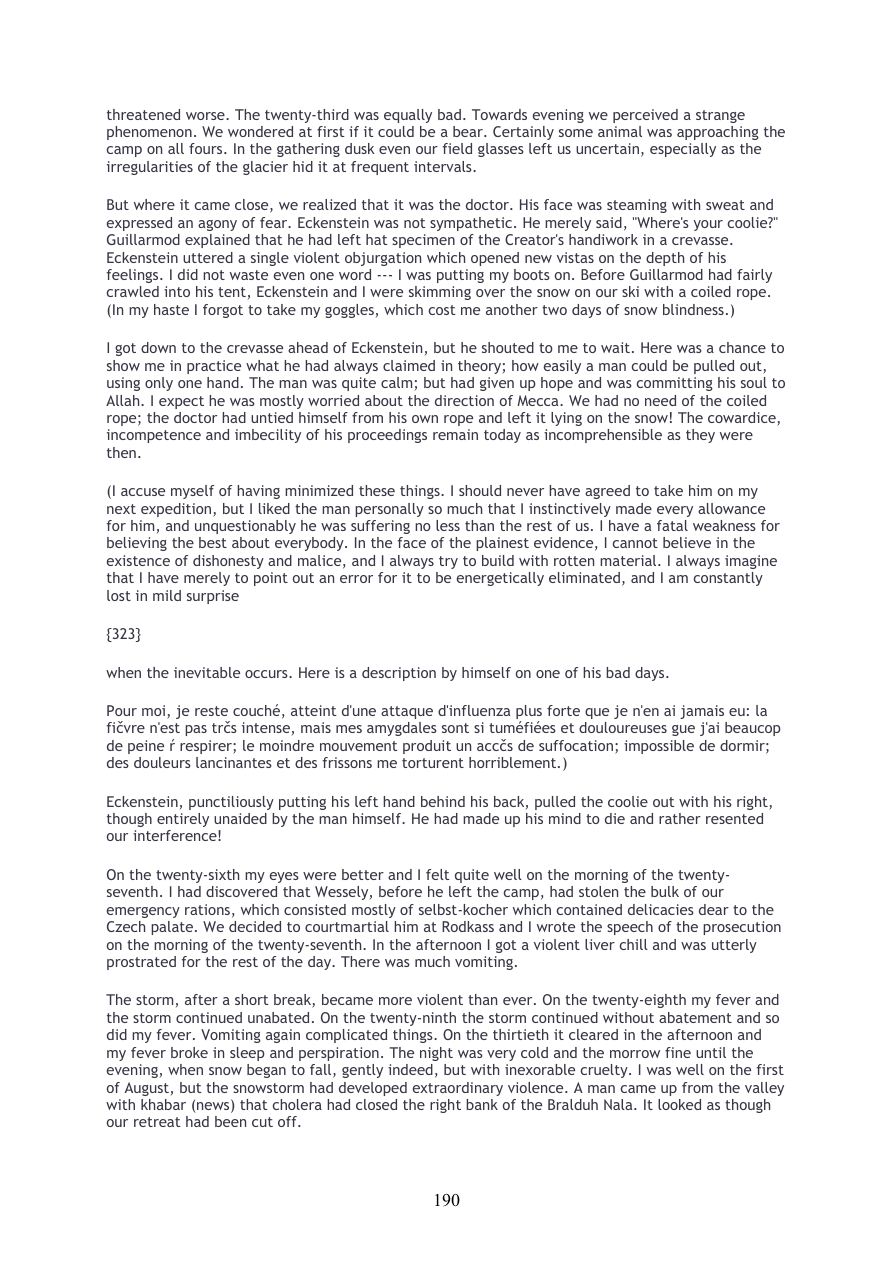
Highlights use the original PDF text layer. OCR-only matches may not be visible on the scan.
Transcription
Download text ↓raw extractionoriginal embedded textReview: unreviewed
190
threatened worse. The twenty-third was equally bad. Towards evening we perceived a strange
phenomenon. We wondered at first if it could be a bear. Certainly some animal was approaching the
camp on all fours. In the gathering dusk even our field glasses left us uncertain, especially as the
irregularities of the glacier hid it at frequent intervals.
But where it came close, we realized that it was the doctor. His face was steaming with sweat and
expressed an agony of fear. Eckenstein was not sympathetic. He merely said, "Where's your coolie?"
Guillarmod explained that he had left hat specimen of the Creator's handiwork in a crevasse.
Eckenstein uttered a single violent objurgation which opened new vistas on the depth of his
feelings. I did not waste even one word --- I was putting my boots on. Before Guillarmod had fairly
crawled into his tent, Eckenstein and I were skimming over the snow on our ski with a coiled rope.
(In my haste I forgot to take my goggles, which cost me another two days of snow blindness.)
I got down to the crevasse ahead of Eckenstein, but he shouted to me to wait. Here was a chance to
show me in practice what he had always claimed in theory; how easily a man could be pulled out,
using only one hand. The man was quite calm; but had given up hope and was committing his soul to
Allah. I expect he was mostly worried about the direction of Mecca. We had no need of the coiled
rope; the doctor had untied himself from his own rope and left it lying on the snow! The cowardice,
incompetence and imbecility of his proceedings remain today as incomprehensible as they were
then.
(I accuse myself of having minimized these things. I should never have agreed to take him on my
next expedition, but I liked the man personally so much that I instinctively made every allowance
for him, and unquestionably he was suffering no less than the rest of us. I have a fatal weakness for
believing the best about everybody. In the face of the plainest evidence, I cannot believe in the
existence of dishonesty and malice, and I always try to build with rotten material. I always imagine
that I have merely to point out an error for it to be energetically eliminated, and I am constantly
lost in mild surprise
{323}
when the inevitable occurs. Here is a description by himself on one of his bad days.
Pour moi, je reste couché, atteint d'une attaque d'influenza plus forte que je n'en ai jamais eu: la
fičvre n'est pas trčs intense, mais mes amygdales sont si tuméfiées et douloureuses gue j'ai beaucop
de peine ŕ respirer; le moindre mouvement produit un accčs de suffocation; impossible de dormir;
des douleurs lancinantes et des frissons me torturent horriblement.)
Eckenstein, punctiliously putting his left hand behind his back, pulled the coolie out with his right,
though entirely unaided by the man himself. He had made up his mind to die and rather resented
our interference!
On the twenty-sixth my eyes were better and I felt quite well on the morning of the twenty-
seventh. I had discovered that Wessely, before he left the camp, had stolen the bulk of our
emergency rations, which consisted mostly of selbst-kocher which contained delicacies dear to the
Czech palate. We decided to courtmartial him at Rodkass and I wrote the speech of the prosecution
on the morning of the twenty-seventh. In the afternoon I got a violent liver chill and was utterly
prostrated for the rest of the day. There was much vomiting.
The storm, after a short break, became more violent than ever. On the twenty-eighth my fever and
the storm continued unabated. On the twenty-ninth the storm continued without abatement and so
did my fever. Vomiting again complicated things. On the thirtieth it cleared in the afternoon and
my fever broke in sleep and perspiration. The night was very cold and the morrow fine until the
evening, when snow began to fall, gently indeed, but with inexorable cruelty. I was well on the first
of August, but the snowstorm had developed extraordinary violence. A man came up from the valley
with khabar (news) that cholera had closed the right bank of the Bralduh Nala. It looked as though
our retreat had been cut off.
Page provenance & review flags
Stable page ID: 5ef44b98d8f9c4af5f6f86e1:p00190
Line breaks are preserved. Reading order and OCR accuracy may need review.
Printed page label has not been verified.
- No automated review flags. This does not establish transcription accuracy.