1929 · CLOSE READING
Confessions of Aleister Crowley
Confessions of Aleister Crowley (1929), PDF p. 186
Original page
Enlarge ↗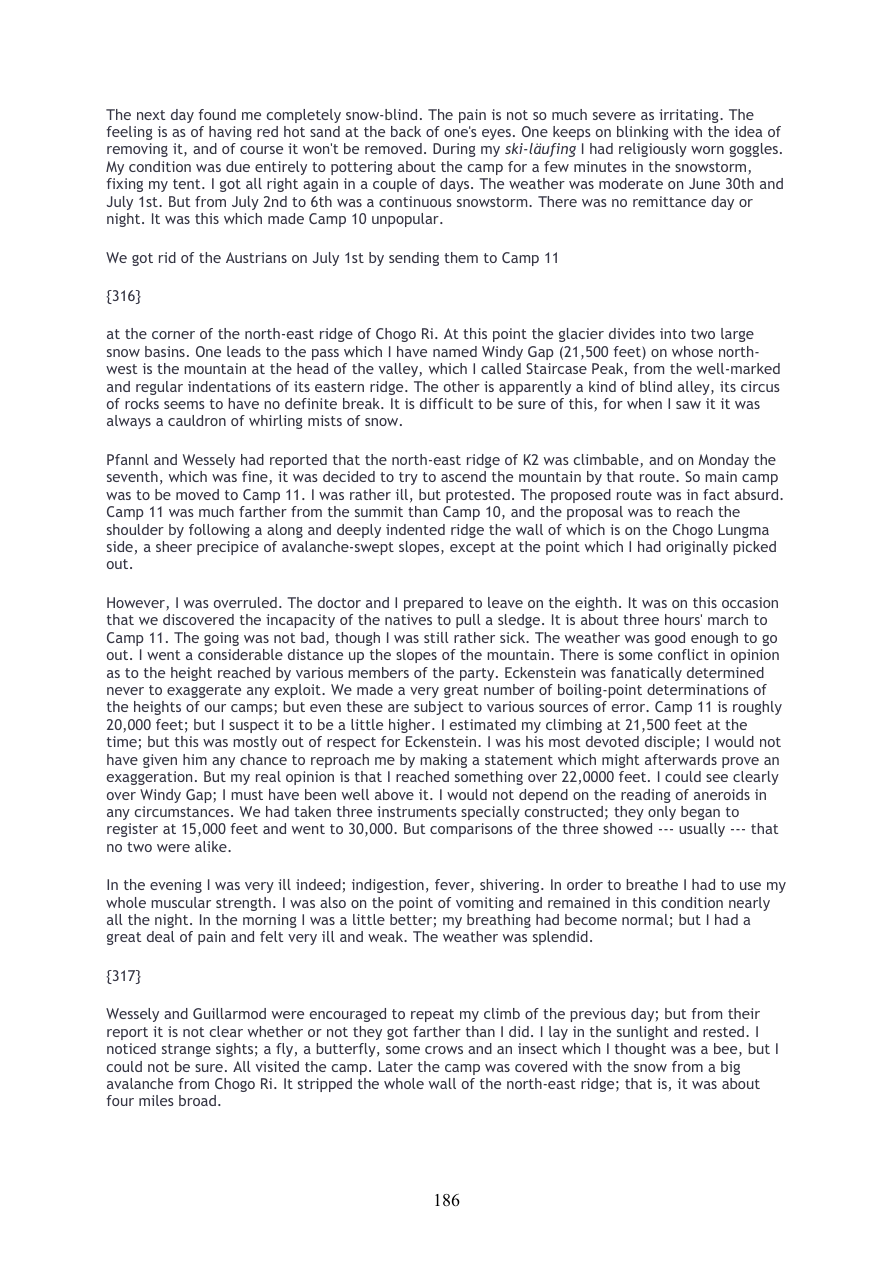
Highlights use the original PDF text layer. OCR-only matches may not be visible on the scan.
Transcription
Download text ↓raw extractionoriginal embedded textReview: unreviewed
186
The next day found me completely snow-blind. The pain is not so much severe as irritating. The
feeling is as of having red hot sand at the back of one's eyes. One keeps on blinking with the idea of
removing it, and of course it won't be removed. During my ski-läufing I had religiously worn goggles.
My condition was due entirely to pottering about the camp for a few minutes in the snowstorm,
fixing my tent. I got all right again in a couple of days. The weather was moderate on June 30th and
July 1st. But from July 2nd to 6th was a continuous snowstorm. There was no remittance day or
night. It was this which made Camp 10 unpopular.
We got rid of the Austrians on July 1st by sending them to Camp 11
{316}
at the corner of the north-east ridge of Chogo Ri. At this point the glacier divides into two large
snow basins. One leads to the pass which I have named Windy Gap (21,500 feet) on whose north-
west is the mountain at the head of the valley, which I called Staircase Peak, from the well-marked
and regular indentations of its eastern ridge. The other is apparently a kind of blind alley, its circus
of rocks seems to have no definite break. It is difficult to be sure of this, for when I saw it it was
always a cauldron of whirling mists of snow.
Pfannl and Wessely had reported that the north-east ridge of K2 was climbable, and on Monday the
seventh, which was fine, it was decided to try to ascend the mountain by that route. So main camp
was to be moved to Camp 11. I was rather ill, but protested. The proposed route was in fact absurd.
Camp 11 was much farther from the summit than Camp 10, and the proposal was to reach the
shoulder by following a along and deeply indented ridge the wall of which is on the Chogo Lungma
side, a sheer precipice of avalanche-swept slopes, except at the point which I had originally picked
out.
However, I was overruled. The doctor and I prepared to leave on the eighth. It was on this occasion
that we discovered the incapacity of the natives to pull a sledge. It is about three hours' march to
Camp 11. The going was not bad, though I was still rather sick. The weather was good enough to go
out. I went a considerable distance up the slopes of the mountain. There is some conflict in opinion
as to the height reached by various members of the party. Eckenstein was fanatically determined
never to exaggerate any exploit. We made a very great number of boiling-point determinations of
the heights of our camps; but even these are subject to various sources of error. Camp 11 is roughly
20,000 feet; but I suspect it to be a little higher. I estimated my climbing at 21,500 feet at the
time; but this was mostly out of respect for Eckenstein. I was his most devoted disciple; I would not
have given him any chance to reproach me by making a statement which might afterwards prove an
exaggeration. But my real opinion is that I reached something over 22,0000 feet. I could see clearly
over Windy Gap; I must have been well above it. I would not depend on the reading of aneroids in
any circumstances. We had taken three instruments specially constructed; they only began to
register at 15,000 feet and went to 30,000. But comparisons of the three showed --- usually --- that
no two were alike.
In the evening I was very ill indeed; indigestion, fever, shivering. In order to breathe I had to use my
whole muscular strength. I was also on the point of vomiting and remained in this condition nearly
all the night. In the morning I was a little better; my breathing had become normal; but I had a
great deal of pain and felt very ill and weak. The weather was splendid.
{317}
Wessely and Guillarmod were encouraged to repeat my climb of the previous day; but from their
report it is not clear whether or not they got farther than I did. I lay in the sunlight and rested. I
noticed strange sights; a fly, a butterfly, some crows and an insect which I thought was a bee, but I
could not be sure. All visited the camp. Later the camp was covered with the snow from a big
avalanche from Chogo Ri. It stripped the whole wall of the north-east ridge; that is, it was about
four miles broad.
Page provenance & review flags
Stable page ID: 5ef44b98d8f9c4af5f6f86e1:p00186
Line breaks are preserved. Reading order and OCR accuracy may need review.
Printed page label has not been verified.
- No automated review flags. This does not establish transcription accuracy.