1929 · CLOSE READING
Confessions of Aleister Crowley
Confessions of Aleister Crowley (1929), PDF p. 180
Original page
Enlarge ↗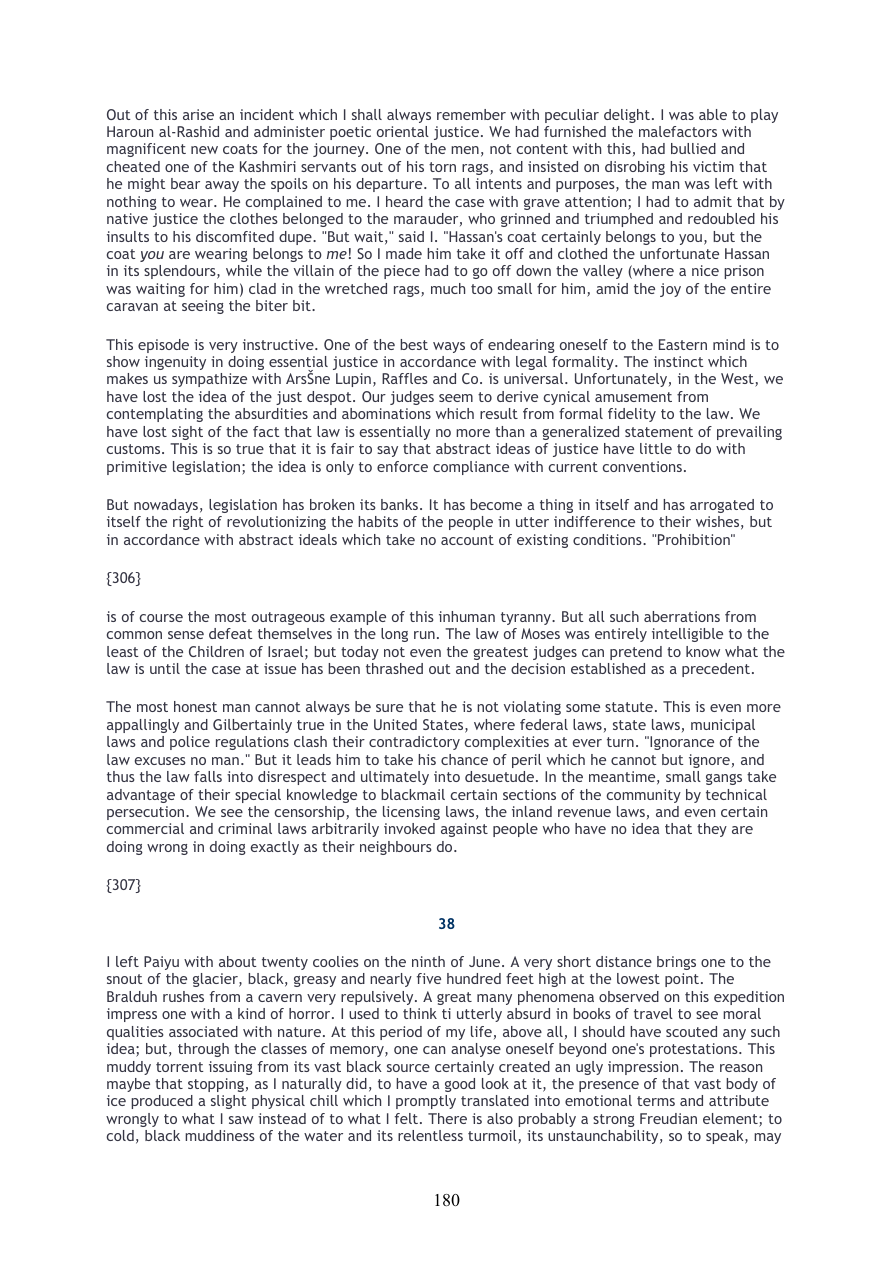
Highlights use the original PDF text layer. OCR-only matches may not be visible on the scan.
Transcription
Download text ↓raw extractionoriginal embedded textReview: unreviewed
180
Out of this arise an incident which I shall always remember with peculiar delight. I was able to play
Haroun al-Rashid and administer poetic oriental justice. We had furnished the malefactors with
magnificent new coats for the journey. One of the men, not content with this, had bullied and
cheated one of the Kashmiri servants out of his torn rags, and insisted on disrobing his victim that
he might bear away the spoils on his departure. To all intents and purposes, the man was left with
nothing to wear. He complained to me. I heard the case with grave attention; I had to admit that by
native justice the clothes belonged to the marauder, who grinned and triumphed and redoubled his
insults to his discomfited dupe. "But wait," said I. "Hassan's coat certainly belongs to you, but the
coat you are wearing belongs to me! So I made him take it off and clothed the unfortunate Hassan
in its splendours, while the villain of the piece had to go off down the valley (where a nice prison
was waiting for him) clad in the wretched rags, much too small for him, amid the joy of the entire
caravan at seeing the biter bit.
This episode is very instructive. One of the best ways of endearing oneself to the Eastern mind is to
show ingenuity in doing essential justice in accordance with legal formality. The instinct which
makes us sympathize with Arsne Lupin, Raffles and Co. is universal. Unfortunately, in the West, we
have lost the idea of the just despot. Our judges seem to derive cynical amusement from
contemplating the absurdities and abominations which result from formal fidelity to the law. We
have lost sight of the fact that law is essentially no more than a generalized statement of prevailing
customs. This is so true that it is fair to say that abstract ideas of justice have little to do with
primitive legislation; the idea is only to enforce compliance with current conventions.
But nowadays, legislation has broken its banks. It has become a thing in itself and has arrogated to
itself the right of revolutionizing the habits of the people in utter indifference to their wishes, but
in accordance with abstract ideals which take no account of existing conditions. "Prohibition"
{306}
is of course the most outrageous example of this inhuman tyranny. But all such aberrations from
common sense defeat themselves in the long run. The law of Moses was entirely intelligible to the
least of the Children of Israel; but today not even the greatest judges can pretend to know what the
law is until the case at issue has been thrashed out and the decision established as a precedent.
The most honest man cannot always be sure that he is not violating some statute. This is even more
appallingly and Gilbertainly true in the United States, where federal laws, state laws, municipal
laws and police regulations clash their contradictory complexities at ever turn. "Ignorance of the
law excuses no man." But it leads him to take his chance of peril which he cannot but ignore, and
thus the law falls into disrespect and ultimately into desuetude. In the meantime, small gangs take
advantage of their special knowledge to blackmail certain sections of the community by technical
persecution. We see the censorship, the licensing laws, the inland revenue laws, and even certain
commercial and criminal laws arbitrarily invoked against people who have no idea that they are
doing wrong in doing exactly as their neighbours do.
{307}
38
I left Paiyu with about twenty coolies on the ninth of June. A very short distance brings one to the
snout of the glacier, black, greasy and nearly five hundred feet high at the lowest point. The
Bralduh rushes from a cavern very repulsively. A great many phenomena observed on this expedition
impress one with a kind of horror. I used to think ti utterly absurd in books of travel to see moral
qualities associated with nature. At this period of my life, above all, I should have scouted any such
idea; but, through the classes of memory, one can analyse oneself beyond one's protestations. This
muddy torrent issuing from its vast black source certainly created an ugly impression. The reason
maybe that stopping, as I naturally did, to have a good look at it, the presence of that vast body of
ice produced a slight physical chill which I promptly translated into emotional terms and attribute
wrongly to what I saw instead of to what I felt. There is also probably a strong Freudian element; to
cold, black muddiness of the water and its relentless turmoil, its unstaunchability, so to speak, may
Page provenance & review flags
Stable page ID: 5ef44b98d8f9c4af5f6f86e1:p00180
Line breaks are preserved. Reading order and OCR accuracy may need review.
Printed page label has not been verified.
- No automated review flags. This does not establish transcription accuracy.