1929 · CLOSE READING
Confessions of Aleister Crowley
Confessions of Aleister Crowley (1929), PDF p. 177
Original page
Enlarge ↗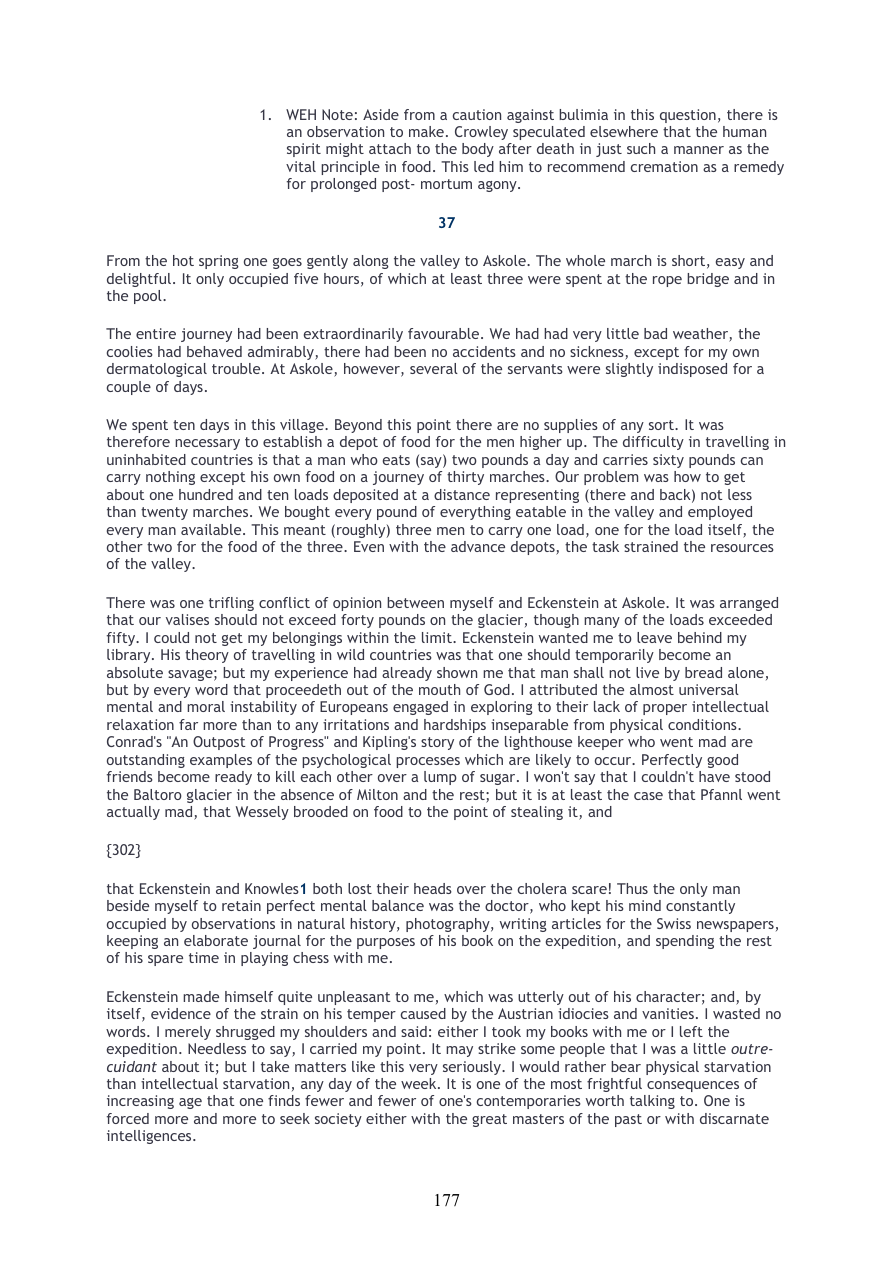
Highlights use the original PDF text layer. OCR-only matches may not be visible on the scan.
Transcription
Download text ↓raw extractionoriginal embedded textReview: unreviewed
177
1. WEH Note: Aside from a caution against bulimia in this question, there is
an observation to make. Crowley speculated elsewhere that the human
spirit might attach to the body after death in just such a manner as the
vital principle in food. This led him to recommend cremation as a remedy
for prolonged post- mortum agony.
37
From the hot spring one goes gently along the valley to Askole. The whole march is short, easy and
delightful. It only occupied five hours, of which at least three were spent at the rope bridge and in
the pool.
The entire journey had been extraordinarily favourable. We had had very little bad weather, the
coolies had behaved admirably, there had been no accidents and no sickness, except for my own
dermatological trouble. At Askole, however, several of the servants were slightly indisposed for a
couple of days.
We spent ten days in this village. Beyond this point there are no supplies of any sort. It was
therefore necessary to establish a depot of food for the men higher up. The difficulty in travelling in
uninhabited countries is that a man who eats (say) two pounds a day and carries sixty pounds can
carry nothing except his own food on a journey of thirty marches. Our problem was how to get
about one hundred and ten loads deposited at a distance representing (there and back) not less
than twenty marches. We bought every pound of everything eatable in the valley and employed
every man available. This meant (roughly) three men to carry one load, one for the load itself, the
other two for the food of the three. Even with the advance depots, the task strained the resources
of the valley.
There was one trifling conflict of opinion between myself and Eckenstein at Askole. It was arranged
that our valises should not exceed forty pounds on the glacier, though many of the loads exceeded
fifty. I could not get my belongings within the limit. Eckenstein wanted me to leave behind my
library. His theory of travelling in wild countries was that one should temporarily become an
absolute savage; but my experience had already shown me that man shall not live by bread alone,
but by every word that proceedeth out of the mouth of God. I attributed the almost universal
mental and moral instability of Europeans engaged in exploring to their lack of proper intellectual
relaxation far more than to any irritations and hardships inseparable from physical conditions.
Conrad's "An Outpost of Progress" and Kipling's story of the lighthouse keeper who went mad are
outstanding examples of the psychological processes which are likely to occur. Perfectly good
friends become ready to kill each other over a lump of sugar. I won't say that I couldn't have stood
the Baltoro glacier in the absence of Milton and the rest; but it is at least the case that Pfannl went
actually mad, that Wessely brooded on food to the point of stealing it, and
{302}
that Eckenstein and Knowles1 both lost their heads over the cholera scare! Thus the only man
beside myself to retain perfect mental balance was the doctor, who kept his mind constantly
occupied by observations in natural history, photography, writing articles for the Swiss newspapers,
keeping an elaborate journal for the purposes of his book on the expedition, and spending the rest
of his spare time in playing chess with me.
Eckenstein made himself quite unpleasant to me, which was utterly out of his character; and, by
itself, evidence of the strain on his temper caused by the Austrian idiocies and vanities. I wasted no
words. I merely shrugged my shoulders and said: either I took my books with me or I left the
expedition. Needless to say, I carried my point. It may strike some people that I was a little outre-
cuidant about it; but I take matters like this very seriously. I would rather bear physical starvation
than intellectual starvation, any day of the week. It is one of the most frightful consequences of
increasing age that one finds fewer and fewer of one's contemporaries worth talking to. One is
forced more and more to seek society either with the great masters of the past or with discarnate
intelligences.
Page provenance & review flags
Stable page ID: 5ef44b98d8f9c4af5f6f86e1:p00177
Line breaks are preserved. Reading order and OCR accuracy may need review.
Printed page label has not been verified.
- No automated review flags. This does not establish transcription accuracy.