1929 · CLOSE READING
Confessions of Aleister Crowley
Confessions of Aleister Crowley (1929), PDF p. 173
Original page
Enlarge ↗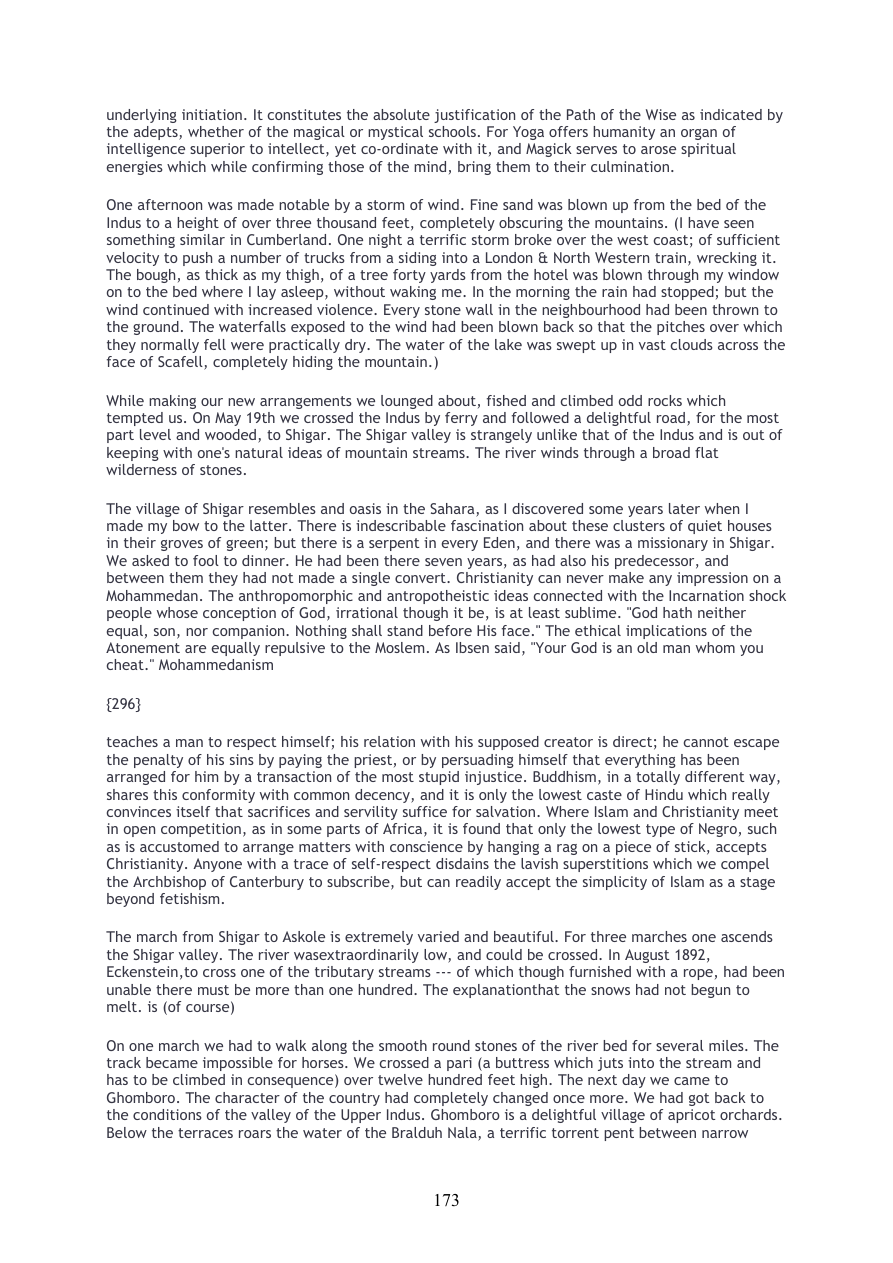
Highlights use the original PDF text layer. OCR-only matches may not be visible on the scan.
Transcription
Download text ↓raw extractionoriginal embedded textReview: unreviewed
173
underlying initiation. It constitutes the absolute justification of the Path of the Wise as indicated by
the adepts, whether of the magical or mystical schools. For Yoga offers humanity an organ of
intelligence superior to intellect, yet co-ordinate with it, and Magick serves to arose spiritual
energies which while confirming those of the mind, bring them to their culmination.
One afternoon was made notable by a storm of wind. Fine sand was blown up from the bed of the
Indus to a height of over three thousand feet, completely obscuring the mountains. (I have seen
something similar in Cumberland. One night a terrific storm broke over the west coast; of sufficient
velocity to push a number of trucks from a siding into a London & North Western train, wrecking it.
The bough, as thick as my thigh, of a tree forty yards from the hotel was blown through my window
on to the bed where I lay asleep, without waking me. In the morning the rain had stopped; but the
wind continued with increased violence. Every stone wall in the neighbourhood had been thrown to
the ground. The waterfalls exposed to the wind had been blown back so that the pitches over which
they normally fell were practically dry. The water of the lake was swept up in vast clouds across the
face of Scafell, completely hiding the mountain.)
While making our new arrangements we lounged about, fished and climbed odd rocks which
tempted us. On May 19th we crossed the Indus by ferry and followed a delightful road, for the most
part level and wooded, to Shigar. The Shigar valley is strangely unlike that of the Indus and is out of
keeping with one's natural ideas of mountain streams. The river winds through a broad flat
wilderness of stones.
The village of Shigar resembles and oasis in the Sahara, as I discovered some years later when I
made my bow to the latter. There is indescribable fascination about these clusters of quiet houses
in their groves of green; but there is a serpent in every Eden, and there was a missionary in Shigar.
We asked to fool to dinner. He had been there seven years, as had also his predecessor, and
between them they had not made a single convert. Christianity can never make any impression on a
Mohammedan. The anthropomorphic and antropotheistic ideas connected with the Incarnation shock
people whose conception of God, irrational though it be, is at least sublime. "God hath neither
equal, son, nor companion. Nothing shall stand before His face." The ethical implications of the
Atonement are equally repulsive to the Moslem. As Ibsen said, "Your God is an old man whom you
cheat." Mohammedanism
{296}
teaches a man to respect himself; his relation with his supposed creator is direct; he cannot escape
the penalty of his sins by paying the priest, or by persuading himself that everything has been
arranged for him by a transaction of the most stupid injustice. Buddhism, in a totally different way,
shares this conformity with common decency, and it is only the lowest caste of Hindu which really
convinces itself that sacrifices and servility suffice for salvation. Where Islam and Christianity meet
in open competition, as in some parts of Africa, it is found that only the lowest type of Negro, such
as is accustomed to arrange matters with conscience by hanging a rag on a piece of stick, accepts
Christianity. Anyone with a trace of self-respect disdains the lavish superstitions which we compel
the Archbishop of Canterbury to subscribe, but can readily accept the simplicity of Islam as a stage
beyond fetishism.
The march from Shigar to Askole is extremely varied and beautiful. For three marches one ascends
the Shigar valley. The river wasextraordinarily low, and could be crossed. In August 1892,
Eckenstein,to cross one of the tributary streams --- of which though furnished with a rope, had been
unable there must be more than one hundred. The explanationthat the snows had not begun to
melt. is (of course)
On one march we had to walk along the smooth round stones of the river bed for several miles. The
track became impossible for horses. We crossed a pari (a buttress which juts into the stream and
has to be climbed in consequence) over twelve hundred feet high. The next day we came to
Ghomboro. The character of the country had completely changed once more. We had got back to
the conditions of the valley of the Upper Indus. Ghomboro is a delightful village of apricot orchards.
Below the terraces roars the water of the Bralduh Nala, a terrific torrent pent between narrow
Page provenance & review flags
Stable page ID: 5ef44b98d8f9c4af5f6f86e1:p00173
Line breaks are preserved. Reading order and OCR accuracy may need review.
Printed page label has not been verified.
- No automated review flags. This does not establish transcription accuracy.