1929 · CLOSE READING
Confessions of Aleister Crowley
Confessions of Aleister Crowley (1929), PDF p. 169
Original page
Enlarge ↗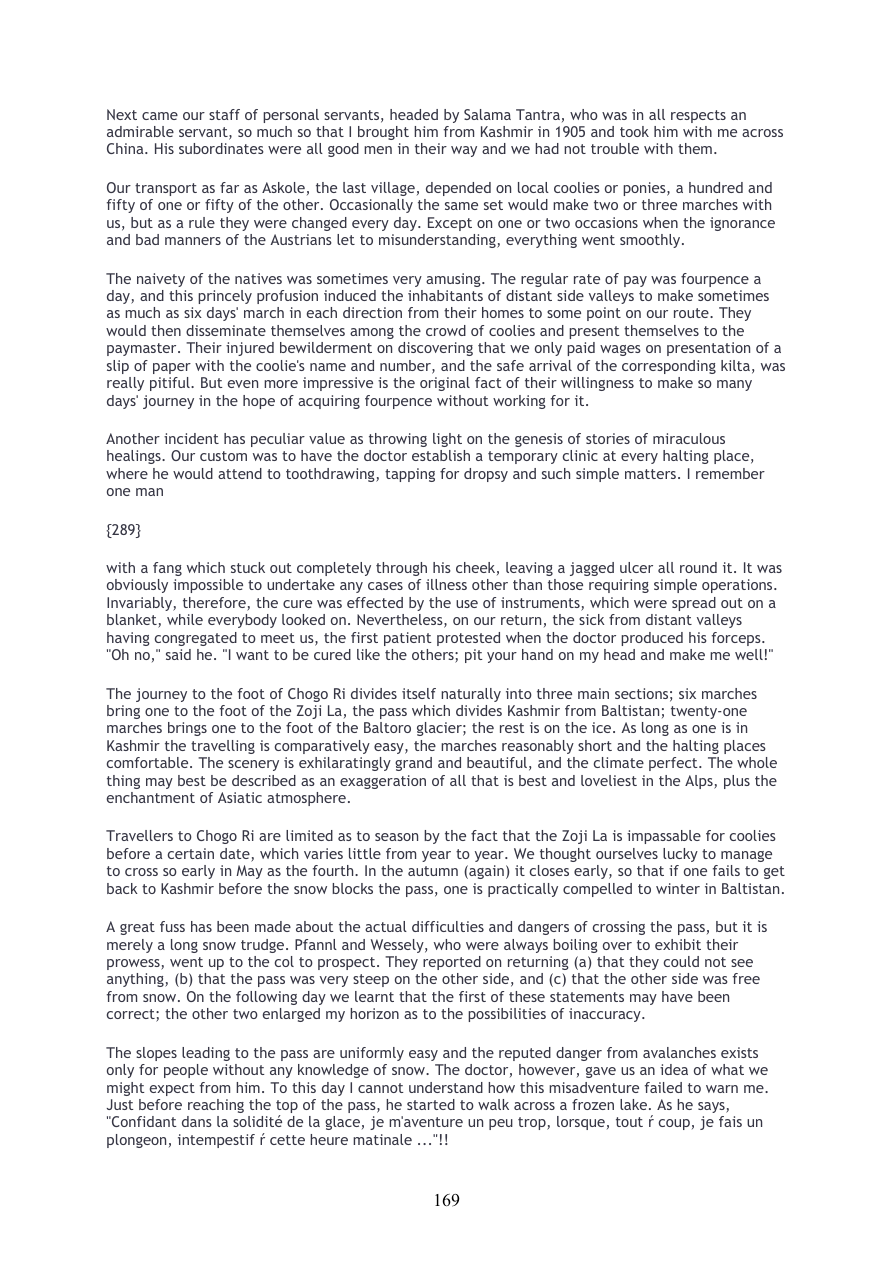
Highlights use the original PDF text layer. OCR-only matches may not be visible on the scan.
Transcription
Download text ↓raw extractionoriginal embedded textReview: unreviewed
169
Next came our staff of personal servants, headed by Salama Tantra, who was in all respects an
admirable servant, so much so that I brought him from Kashmir in 1905 and took him with me across
China. His subordinates were all good men in their way and we had not trouble with them.
Our transport as far as Askole, the last village, depended on local coolies or ponies, a hundred and
fifty of one or fifty of the other. Occasionally the same set would make two or three marches with
us, but as a rule they were changed every day. Except on one or two occasions when the ignorance
and bad manners of the Austrians let to misunderstanding, everything went smoothly.
The naivety of the natives was sometimes very amusing. The regular rate of pay was fourpence a
day, and this princely profusion induced the inhabitants of distant side valleys to make sometimes
as much as six days' march in each direction from their homes to some point on our route. They
would then disseminate themselves among the crowd of coolies and present themselves to the
paymaster. Their injured bewilderment on discovering that we only paid wages on presentation of a
slip of paper with the coolie's name and number, and the safe arrival of the corresponding kilta, was
really pitiful. But even more impressive is the original fact of their willingness to make so many
days' journey in the hope of acquiring fourpence without working for it.
Another incident has peculiar value as throwing light on the genesis of stories of miraculous
healings. Our custom was to have the doctor establish a temporary clinic at every halting place,
where he would attend to toothdrawing, tapping for dropsy and such simple matters. I remember
one man
{289}
with a fang which stuck out completely through his cheek, leaving a jagged ulcer all round it. It was
obviously impossible to undertake any cases of illness other than those requiring simple operations.
Invariably, therefore, the cure was effected by the use of instruments, which were spread out on a
blanket, while everybody looked on. Nevertheless, on our return, the sick from distant valleys
having congregated to meet us, the first patient protested when the doctor produced his forceps.
"Oh no," said he. "I want to be cured like the others; pit your hand on my head and make me well!"
The journey to the foot of Chogo Ri divides itself naturally into three main sections; six marches
bring one to the foot of the Zoji La, the pass which divides Kashmir from Baltistan; twenty-one
marches brings one to the foot of the Baltoro glacier; the rest is on the ice. As long as one is in
Kashmir the travelling is comparatively easy, the marches reasonably short and the halting places
comfortable. The scenery is exhilaratingly grand and beautiful, and the climate perfect. The whole
thing may best be described as an exaggeration of all that is best and loveliest in the Alps, plus the
enchantment of Asiatic atmosphere.
Travellers to Chogo Ri are limited as to season by the fact that the Zoji La is impassable for coolies
before a certain date, which varies little from year to year. We thought ourselves lucky to manage
to cross so early in May as the fourth. In the autumn (again) it closes early, so that if one fails to get
back to Kashmir before the snow blocks the pass, one is practically compelled to winter in Baltistan.
A great fuss has been made about the actual difficulties and dangers of crossing the pass, but it is
merely a long snow trudge. Pfannl and Wessely, who were always boiling over to exhibit their
prowess, went up to the col to prospect. They reported on returning (a) that they could not see
anything, (b) that the pass was very steep on the other side, and (c) that the other side was free
from snow. On the following day we learnt that the first of these statements may have been
correct; the other two enlarged my horizon as to the possibilities of inaccuracy.
The slopes leading to the pass are uniformly easy and the reputed danger from avalanches exists
only for people without any knowledge of snow. The doctor, however, gave us an idea of what we
might expect from him. To this day I cannot understand how this misadventure failed to warn me.
Just before reaching the top of the pass, he started to walk across a frozen lake. As he says,
"Confidant dans la solidité de la glace, je m'aventure un peu trop, lorsque, tout ŕ coup, je fais un
plongeon, intempestif ŕ cette heure matinale ..."!!
Page provenance & review flags
Stable page ID: 5ef44b98d8f9c4af5f6f86e1:p00169
Line breaks are preserved. Reading order and OCR accuracy may need review.
Printed page label has not been verified.
- No automated review flags. This does not establish transcription accuracy.