1929 · CLOSE READING
Confessions of Aleister Crowley
Confessions of Aleister Crowley (1929), PDF p. 168
Original page
Enlarge ↗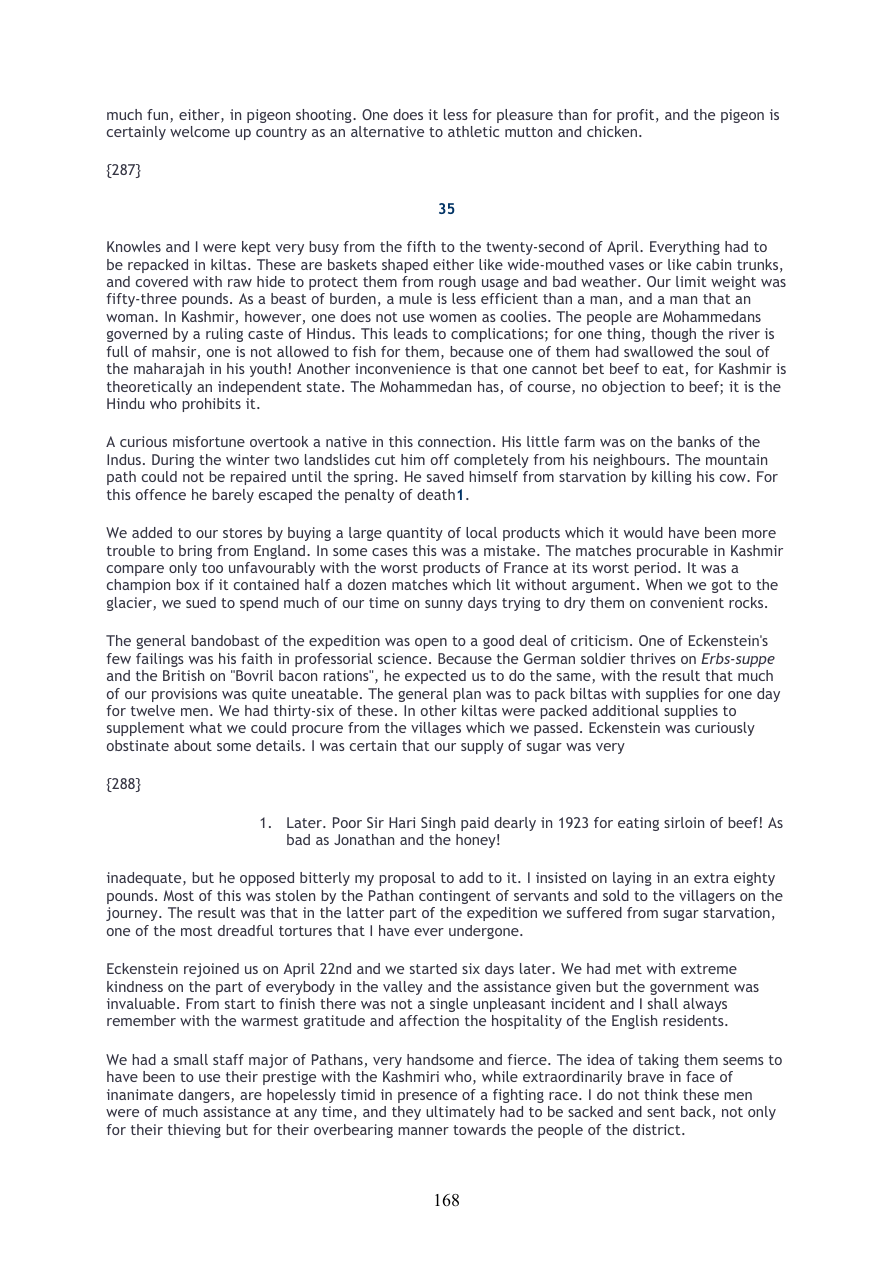
Highlights use the original PDF text layer. OCR-only matches may not be visible on the scan.
Transcription
Download text ↓raw extractionoriginal embedded textReview: unreviewed
168
much fun, either, in pigeon shooting. One does it less for pleasure than for profit, and the pigeon is
certainly welcome up country as an alternative to athletic mutton and chicken.
{287}
35
Knowles and I were kept very busy from the fifth to the twenty-second of April. Everything had to
be repacked in kiltas. These are baskets shaped either like wide-mouthed vases or like cabin trunks,
and covered with raw hide to protect them from rough usage and bad weather. Our limit weight was
fifty-three pounds. As a beast of burden, a mule is less efficient than a man, and a man that an
woman. In Kashmir, however, one does not use women as coolies. The people are Mohammedans
governed by a ruling caste of Hindus. This leads to complications; for one thing, though the river is
full of mahsir, one is not allowed to fish for them, because one of them had swallowed the soul of
the maharajah in his youth! Another inconvenience is that one cannot bet beef to eat, for Kashmir is
theoretically an independent state. The Mohammedan has, of course, no objection to beef; it is the
Hindu who prohibits it.
A curious misfortune overtook a native in this connection. His little farm was on the banks of the
Indus. During the winter two landslides cut him off completely from his neighbours. The mountain
path could not be repaired until the spring. He saved himself from starvation by killing his cow. For
this offence he barely escaped the penalty of death1.
We added to our stores by buying a large quantity of local products which it would have been more
trouble to bring from England. In some cases this was a mistake. The matches procurable in Kashmir
compare only too unfavourably with the worst products of France at its worst period. It was a
champion box if it contained half a dozen matches which lit without argument. When we got to the
glacier, we sued to spend much of our time on sunny days trying to dry them on convenient rocks.
The general bandobast of the expedition was open to a good deal of criticism. One of Eckenstein's
few failings was his faith in professorial science. Because the German soldier thrives on Erbs-suppe
and the British on "Bovril bacon rations", he expected us to do the same, with the result that much
of our provisions was quite uneatable. The general plan was to pack biltas with supplies for one day
for twelve men. We had thirty-six of these. In other kiltas were packed additional supplies to
supplement what we could procure from the villages which we passed. Eckenstein was curiously
obstinate about some details. I was certain that our supply of sugar was very
{288}
1. Later. Poor Sir Hari Singh paid dearly in 1923 for eating sirloin of beef! As
bad as Jonathan and the honey!
inadequate, but he opposed bitterly my proposal to add to it. I insisted on laying in an extra eighty
pounds. Most of this was stolen by the Pathan contingent of servants and sold to the villagers on the
journey. The result was that in the latter part of the expedition we suffered from sugar starvation,
one of the most dreadful tortures that I have ever undergone.
Eckenstein rejoined us on April 22nd and we started six days later. We had met with extreme
kindness on the part of everybody in the valley and the assistance given but the government was
invaluable. From start to finish there was not a single unpleasant incident and I shall always
remember with the warmest gratitude and affection the hospitality of the English residents.
We had a small staff major of Pathans, very handsome and fierce. The idea of taking them seems to
have been to use their prestige with the Kashmiri who, while extraordinarily brave in face of
inanimate dangers, are hopelessly timid in presence of a fighting race. I do not think these men
were of much assistance at any time, and they ultimately had to be sacked and sent back, not only
for their thieving but for their overbearing manner towards the people of the district.
Page provenance & review flags
Stable page ID: 5ef44b98d8f9c4af5f6f86e1:p00168
Line breaks are preserved. Reading order and OCR accuracy may need review.
Printed page label has not been verified.
- No automated review flags. This does not establish transcription accuracy.