1929 · CLOSE READING
Confessions of Aleister Crowley
Confessions of Aleister Crowley (1929), PDF p. 162
Original page
Enlarge ↗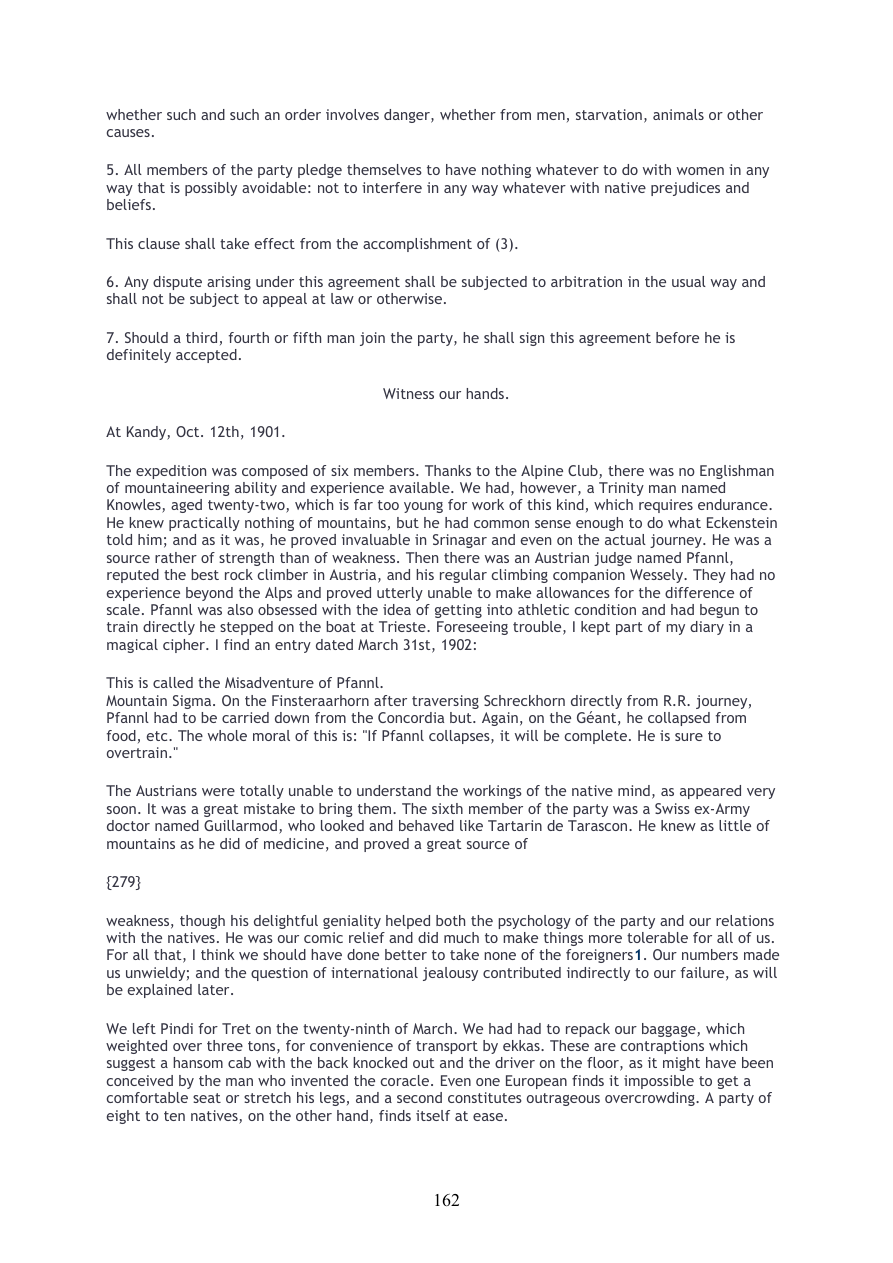
Highlights use the original PDF text layer. OCR-only matches may not be visible on the scan.
Transcription
Download text ↓raw extractionoriginal embedded textReview: unreviewed
162
whether such and such an order involves danger, whether from men, starvation, animals or other
causes.
5. All members of the party pledge themselves to have nothing whatever to do with women in any
way that is possibly avoidable: not to interfere in any way whatever with native prejudices and
beliefs.
This clause shall take effect from the accomplishment of (3).
6. Any dispute arising under this agreement shall be subjected to arbitration in the usual way and
shall not be subject to appeal at law or otherwise.
7. Should a third, fourth or fifth man join the party, he shall sign this agreement before he is
definitely accepted.
Witness our hands.
At Kandy, Oct. 12th, 1901.
The expedition was composed of six members. Thanks to the Alpine Club, there was no Englishman
of mountaineering ability and experience available. We had, however, a Trinity man named
Knowles, aged twenty-two, which is far too young for work of this kind, which requires endurance.
He knew practically nothing of mountains, but he had common sense enough to do what Eckenstein
told him; and as it was, he proved invaluable in Srinagar and even on the actual journey. He was a
source rather of strength than of weakness. Then there was an Austrian judge named Pfannl,
reputed the best rock climber in Austria, and his regular climbing companion Wessely. They had no
experience beyond the Alps and proved utterly unable to make allowances for the difference of
scale. Pfannl was also obsessed with the idea of getting into athletic condition and had begun to
train directly he stepped on the boat at Trieste. Foreseeing trouble, I kept part of my diary in a
magical cipher. I find an entry dated March 31st, 1902:
This is called the Misadventure of Pfannl.
Mountain Sigma. On the Finsteraarhorn after traversing Schreckhorn directly from R.R. journey,
Pfannl had to be carried down from the Concordia but. Again, on the Géant, he collapsed from
food, etc. The whole moral of this is: "If Pfannl collapses, it will be complete. He is sure to
overtrain."
The Austrians were totally unable to understand the workings of the native mind, as appeared very
soon. It was a great mistake to bring them. The sixth member of the party was a Swiss ex-Army
doctor named Guillarmod, who looked and behaved like Tartarin de Tarascon. He knew as little of
mountains as he did of medicine, and proved a great source of
{279}
weakness, though his delightful geniality helped both the psychology of the party and our relations
with the natives. He was our comic relief and did much to make things more tolerable for all of us.
For all that, I think we should have done better to take none of the foreigners1. Our numbers made
us unwieldy; and the question of international jealousy contributed indirectly to our failure, as will
be explained later.
We left Pindi for Tret on the twenty-ninth of March. We had had to repack our baggage, which
weighted over three tons, for convenience of transport by ekkas. These are contraptions which
suggest a hansom cab with the back knocked out and the driver on the floor, as it might have been
conceived by the man who invented the coracle. Even one European finds it impossible to get a
comfortable seat or stretch his legs, and a second constitutes outrageous overcrowding. A party of
eight to ten natives, on the other hand, finds itself at ease.
Page provenance & review flags
Stable page ID: 5ef44b98d8f9c4af5f6f86e1:p00162
Line breaks are preserved. Reading order and OCR accuracy may need review.
Printed page label has not been verified.
- No automated review flags. This does not establish transcription accuracy.