1929 · CLOSE READING
Confessions of Aleister Crowley
Confessions of Aleister Crowley (1929), PDF p. 158
Original page
Enlarge ↗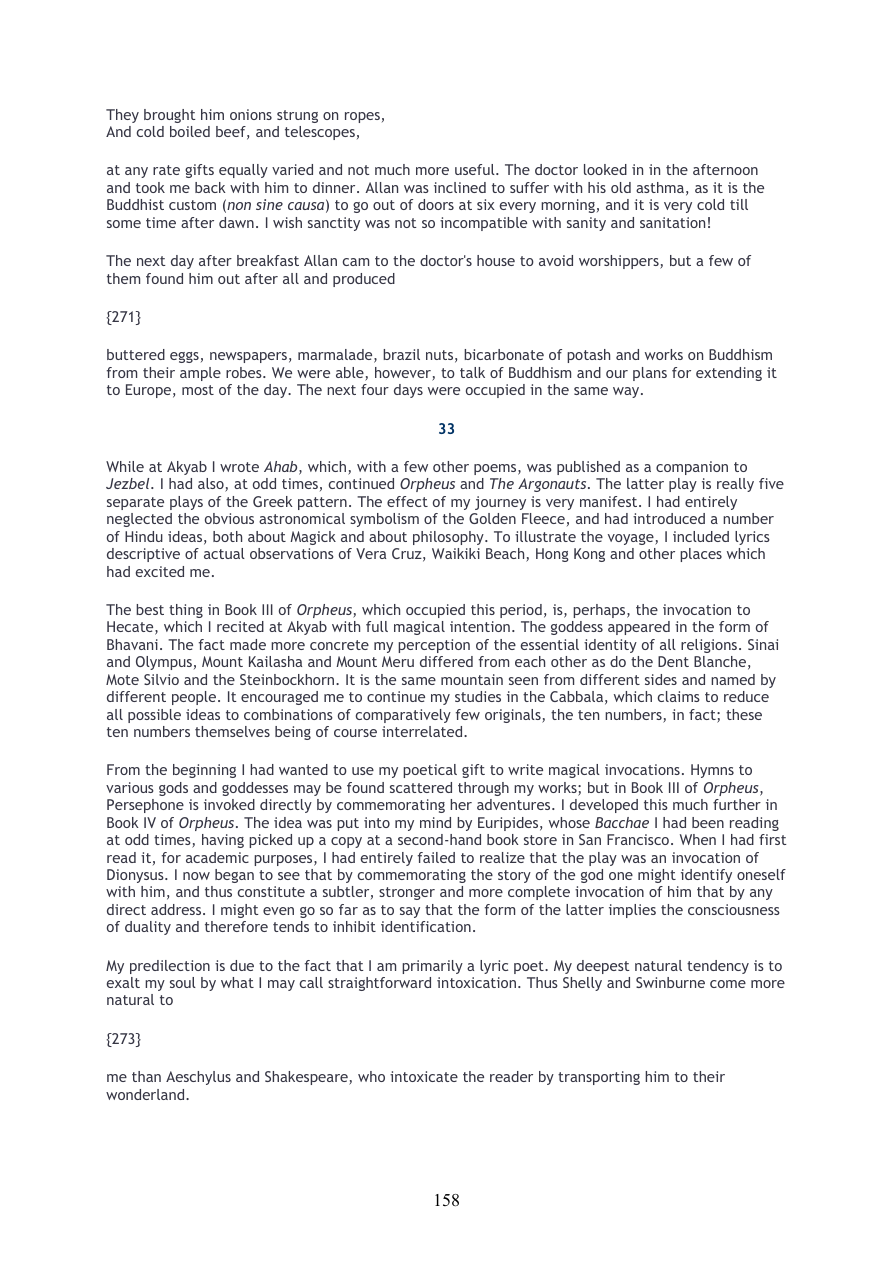
Highlights use the original PDF text layer. OCR-only matches may not be visible on the scan.
Transcription
Download text ↓raw extractionoriginal embedded textReview: unreviewed
158
They brought him onions strung on ropes,
And cold boiled beef, and telescopes,
at any rate gifts equally varied and not much more useful. The doctor looked in in the afternoon
and took me back with him to dinner. Allan was inclined to suffer with his old asthma, as it is the
Buddhist custom (non sine causa) to go out of doors at six every morning, and it is very cold till
some time after dawn. I wish sanctity was not so incompatible with sanity and sanitation!
The next day after breakfast Allan cam to the doctor's house to avoid worshippers, but a few of
them found him out after all and produced
{271}
buttered eggs, newspapers, marmalade, brazil nuts, bicarbonate of potash and works on Buddhism
from their ample robes. We were able, however, to talk of Buddhism and our plans for extending it
to Europe, most of the day. The next four days were occupied in the same way.
33
While at Akyab I wrote Ahab, which, with a few other poems, was published as a companion to
Jezbel. I had also, at odd times, continued Orpheus and The Argonauts. The latter play is really five
separate plays of the Greek pattern. The effect of my journey is very manifest. I had entirely
neglected the obvious astronomical symbolism of the Golden Fleece, and had introduced a number
of Hindu ideas, both about Magick and about philosophy. To illustrate the voyage, I included lyrics
descriptive of actual observations of Vera Cruz, Waikiki Beach, Hong Kong and other places which
had excited me.
The best thing in Book III of Orpheus, which occupied this period, is, perhaps, the invocation to
Hecate, which I recited at Akyab with full magical intention. The goddess appeared in the form of
Bhavani. The fact made more concrete my perception of the essential identity of all religions. Sinai
and Olympus, Mount Kailasha and Mount Meru differed from each other as do the Dent Blanche,
Mote Silvio and the Steinbockhorn. It is the same mountain seen from different sides and named by
different people. It encouraged me to continue my studies in the Cabbala, which claims to reduce
all possible ideas to combinations of comparatively few originals, the ten numbers, in fact; these
ten numbers themselves being of course interrelated.
From the beginning I had wanted to use my poetical gift to write magical invocations. Hymns to
various gods and goddesses may be found scattered through my works; but in Book III of Orpheus,
Persephone is invoked directly by commemorating her adventures. I developed this much further in
Book IV of Orpheus. The idea was put into my mind by Euripides, whose Bacchae I had been reading
at odd times, having picked up a copy at a second-hand book store in San Francisco. When I had first
read it, for academic purposes, I had entirely failed to realize that the play was an invocation of
Dionysus. I now began to see that by commemorating the story of the god one might identify oneself
with him, and thus constitute a subtler, stronger and more complete invocation of him that by any
direct address. I might even go so far as to say that the form of the latter implies the consciousness
of duality and therefore tends to inhibit identification.
My predilection is due to the fact that I am primarily a lyric poet. My deepest natural tendency is to
exalt my soul by what I may call straightforward intoxication. Thus Shelly and Swinburne come more
natural to
{273}
me than Aeschylus and Shakespeare, who intoxicate the reader by transporting him to their
wonderland.
Page provenance & review flags
Stable page ID: 5ef44b98d8f9c4af5f6f86e1:p00158
Line breaks are preserved. Reading order and OCR accuracy may need review.
Printed page label has not been verified.
- No automated review flags. This does not establish transcription accuracy.