1929 · CLOSE READING
Confessions of Aleister Crowley
Confessions of Aleister Crowley (1929), PDF p. 153
Original page
Enlarge ↗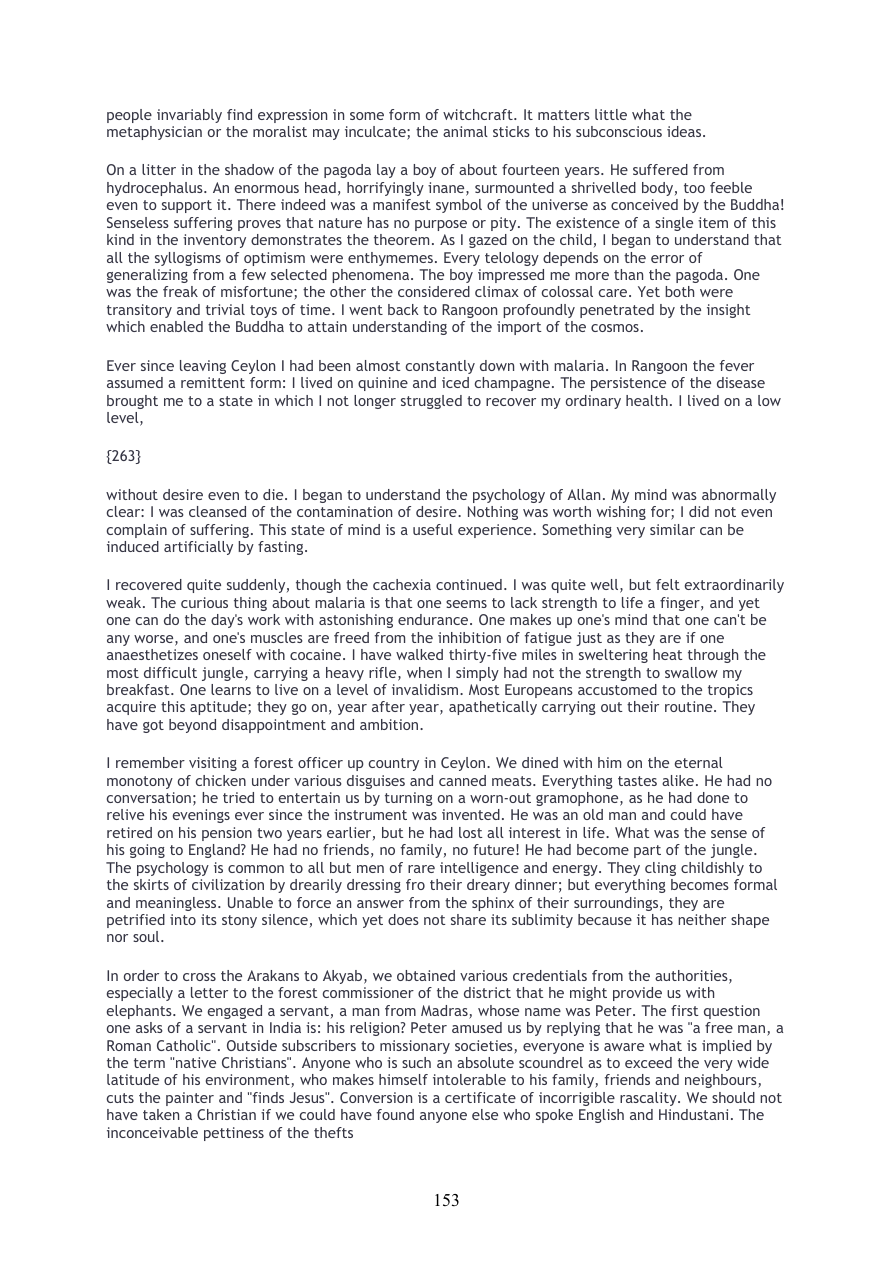
Highlights use the original PDF text layer. OCR-only matches may not be visible on the scan.
Transcription
Download text ↓raw extractionoriginal embedded textReview: unreviewed
153
people invariably find expression in some form of witchcraft. It matters little what the
metaphysician or the moralist may inculcate; the animal sticks to his subconscious ideas.
On a litter in the shadow of the pagoda lay a boy of about fourteen years. He suffered from
hydrocephalus. An enormous head, horrifyingly inane, surmounted a shrivelled body, too feeble
even to support it. There indeed was a manifest symbol of the universe as conceived by the Buddha!
Senseless suffering proves that nature has no purpose or pity. The existence of a single item of this
kind in the inventory demonstrates the theorem. As I gazed on the child, I began to understand that
all the syllogisms of optimism were enthymemes. Every telology depends on the error of
generalizing from a few selected phenomena. The boy impressed me more than the pagoda. One
was the freak of misfortune; the other the considered climax of colossal care. Yet both were
transitory and trivial toys of time. I went back to Rangoon profoundly penetrated by the insight
which enabled the Buddha to attain understanding of the import of the cosmos.
Ever since leaving Ceylon I had been almost constantly down with malaria. In Rangoon the fever
assumed a remittent form: I lived on quinine and iced champagne. The persistence of the disease
brought me to a state in which I not longer struggled to recover my ordinary health. I lived on a low
level,
{263}
without desire even to die. I began to understand the psychology of Allan. My mind was abnormally
clear: I was cleansed of the contamination of desire. Nothing was worth wishing for; I did not even
complain of suffering. This state of mind is a useful experience. Something very similar can be
induced artificially by fasting.
I recovered quite suddenly, though the cachexia continued. I was quite well, but felt extraordinarily
weak. The curious thing about malaria is that one seems to lack strength to life a finger, and yet
one can do the day's work with astonishing endurance. One makes up one's mind that one can't be
any worse, and one's muscles are freed from the inhibition of fatigue just as they are if one
anaesthetizes oneself with cocaine. I have walked thirty-five miles in sweltering heat through the
most difficult jungle, carrying a heavy rifle, when I simply had not the strength to swallow my
breakfast. One learns to live on a level of invalidism. Most Europeans accustomed to the tropics
acquire this aptitude; they go on, year after year, apathetically carrying out their routine. They
have got beyond disappointment and ambition.
I remember visiting a forest officer up country in Ceylon. We dined with him on the eternal
monotony of chicken under various disguises and canned meats. Everything tastes alike. He had no
conversation; he tried to entertain us by turning on a worn-out gramophone, as he had done to
relive his evenings ever since the instrument was invented. He was an old man and could have
retired on his pension two years earlier, but he had lost all interest in life. What was the sense of
his going to England? He had no friends, no family, no future! He had become part of the jungle.
The psychology is common to all but men of rare intelligence and energy. They cling childishly to
the skirts of civilization by drearily dressing fro their dreary dinner; but everything becomes formal
and meaningless. Unable to force an answer from the sphinx of their surroundings, they are
petrified into its stony silence, which yet does not share its sublimity because it has neither shape
nor soul.
In order to cross the Arakans to Akyab, we obtained various credentials from the authorities,
especially a letter to the forest commissioner of the district that he might provide us with
elephants. We engaged a servant, a man from Madras, whose name was Peter. The first question
one asks of a servant in India is: his religion? Peter amused us by replying that he was "a free man, a
Roman Catholic". Outside subscribers to missionary societies, everyone is aware what is implied by
the term "native Christians". Anyone who is such an absolute scoundrel as to exceed the very wide
latitude of his environment, who makes himself intolerable to his family, friends and neighbours,
cuts the painter and "finds Jesus". Conversion is a certificate of incorrigible rascality. We should not
have taken a Christian if we could have found anyone else who spoke English and Hindustani. The
inconceivable pettiness of the thefts
Page provenance & review flags
Stable page ID: 5ef44b98d8f9c4af5f6f86e1:p00153
Line breaks are preserved. Reading order and OCR accuracy may need review.
Printed page label has not been verified.
- No automated review flags. This does not establish transcription accuracy.