1929 · CLOSE READING
Confessions of Aleister Crowley
Confessions of Aleister Crowley (1929), PDF p. 13
Original page
Enlarge ↗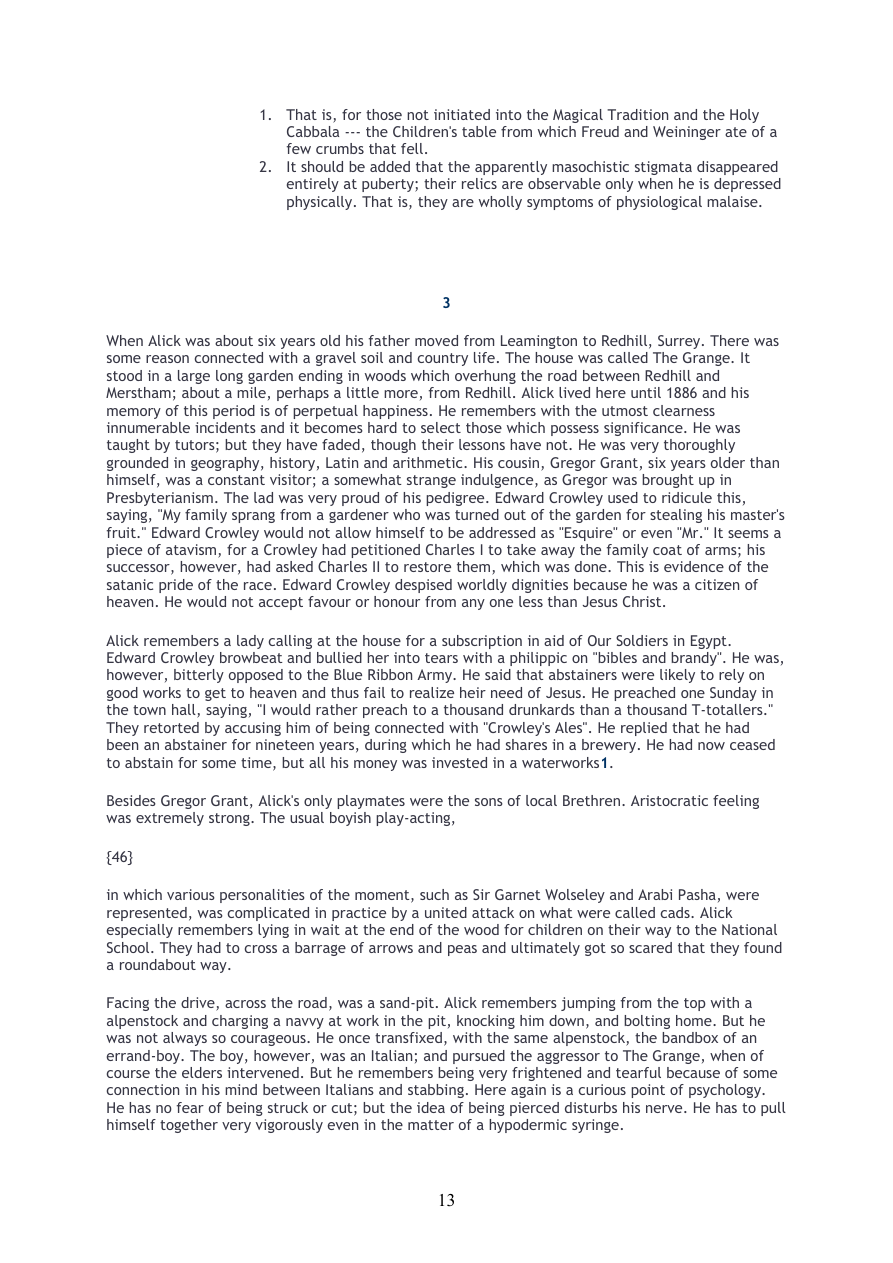
Highlights use the original PDF text layer. OCR-only matches may not be visible on the scan.
Transcription
Download text ↓raw extractionoriginal embedded textReview: unreviewed
13
1. That is, for those not initiated into the Magical Tradition and the Holy
Cabbala --- the Children's table from which Freud and Weininger ate of a
few crumbs that fell.
2. It should be added that the apparently masochistic stigmata disappeared
entirely at puberty; their relics are observable only when he is depressed
physically. That is, they are wholly symptoms of physiological malaise.
3
When Alick was about six years old his father moved from Leamington to Redhill, Surrey. There was
some reason connected with a gravel soil and country life. The house was called The Grange. It
stood in a large long garden ending in woods which overhung the road between Redhill and
Merstham; about a mile, perhaps a little more, from Redhill. Alick lived here until 1886 and his
memory of this period is of perpetual happiness. He remembers with the utmost clearness
innumerable incidents and it becomes hard to select those which possess significance. He was
taught by tutors; but they have faded, though their lessons have not. He was very thoroughly
grounded in geography, history, Latin and arithmetic. His cousin, Gregor Grant, six years older than
himself, was a constant visitor; a somewhat strange indulgence, as Gregor was brought up in
Presbyterianism. The lad was very proud of his pedigree. Edward Crowley used to ridicule this,
saying, "My family sprang from a gardener who was turned out of the garden for stealing his master's
fruit." Edward Crowley would not allow himself to be addressed as "Esquire" or even "Mr." It seems a
piece of atavism, for a Crowley had petitioned Charles I to take away the family coat of arms; his
successor, however, had asked Charles II to restore them, which was done. This is evidence of the
satanic pride of the race. Edward Crowley despised worldly dignities because he was a citizen of
heaven. He would not accept favour or honour from any one less than Jesus Christ.
Alick remembers a lady calling at the house for a subscription in aid of Our Soldiers in Egypt.
Edward Crowley browbeat and bullied her into tears with a philippic on "bibles and brandy". He was,
however, bitterly opposed to the Blue Ribbon Army. He said that abstainers were likely to rely on
good works to get to heaven and thus fail to realize heir need of Jesus. He preached one Sunday in
the town hall, saying, "I would rather preach to a thousand drunkards than a thousand T-totallers."
They retorted by accusing him of being connected with "Crowley's Ales". He replied that he had
been an abstainer for nineteen years, during which he had shares in a brewery. He had now ceased
to abstain for some time, but all his money was invested in a waterworks1.
Besides Gregor Grant, Alick's only playmates were the sons of local Brethren. Aristocratic feeling
was extremely strong. The usual boyish play-acting,
{46}
in which various personalities of the moment, such as Sir Garnet Wolseley and Arabi Pasha, were
represented, was complicated in practice by a united attack on what were called cads. Alick
especially remembers lying in wait at the end of the wood for children on their way to the National
School. They had to cross a barrage of arrows and peas and ultimately got so scared that they found
a roundabout way.
Facing the drive, across the road, was a sand-pit. Alick remembers jumping from the top with a
alpenstock and charging a navvy at work in the pit, knocking him down, and bolting home. But he
was not always so courageous. He once transfixed, with the same alpenstock, the bandbox of an
errand-boy. The boy, however, was an Italian; and pursued the aggressor to The Grange, when of
course the elders intervened. But he remembers being very frightened and tearful because of some
connection in his mind between Italians and stabbing. Here again is a curious point of psychology.
He has no fear of being struck or cut; but the idea of being pierced disturbs his nerve. He has to pull
himself together very vigorously even in the matter of a hypodermic syringe.
Page provenance & review flags
Stable page ID: 5ef44b98d8f9c4af5f6f86e1:p00013
Line breaks are preserved. Reading order and OCR accuracy may need review.
Printed page label has not been verified.
- No automated review flags. This does not establish transcription accuracy.