1929 · CLOSE READING
Confessions of Aleister Crowley
Confessions of Aleister Crowley (1929), PDF p. 113
Original page
Enlarge ↗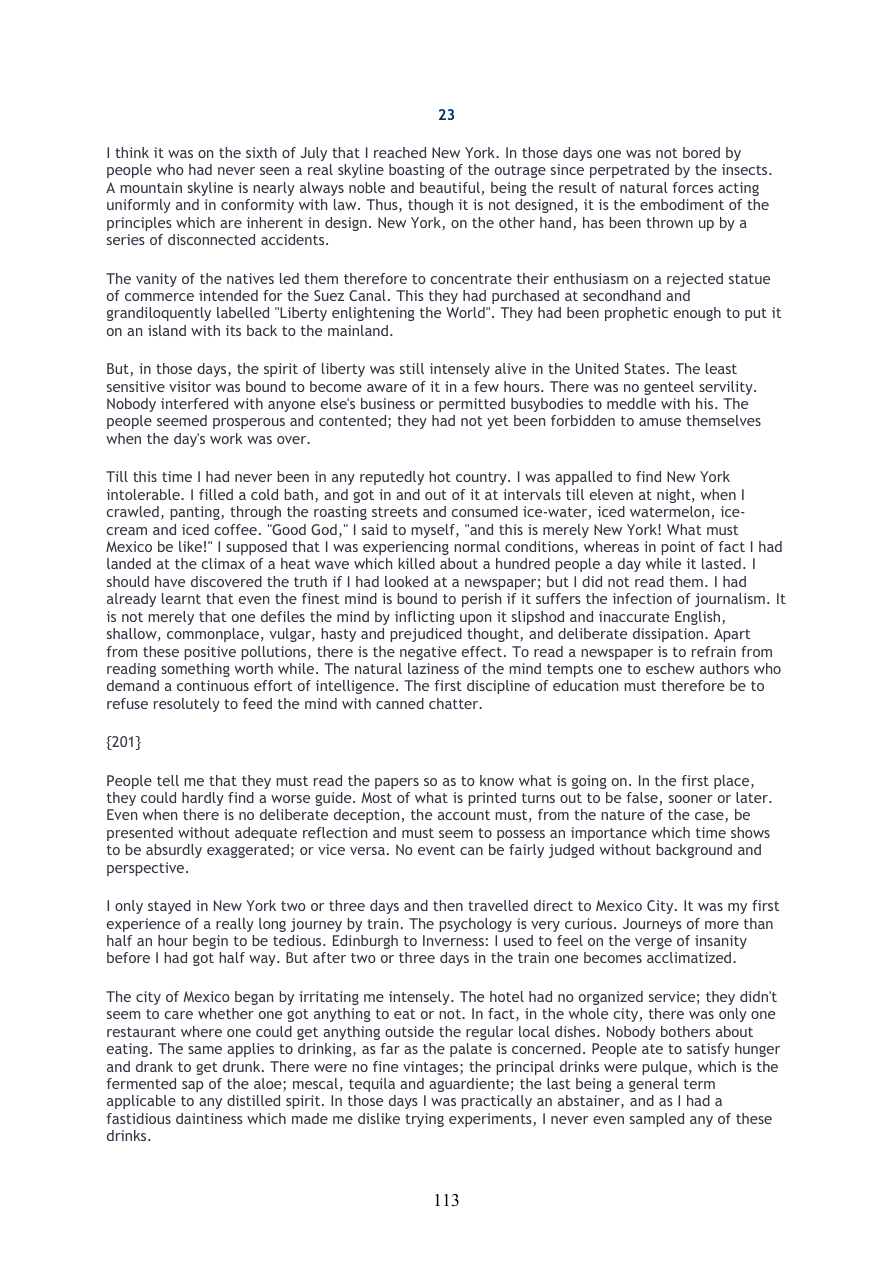
Highlights use the original PDF text layer. OCR-only matches may not be visible on the scan.
Transcription
Download text ↓raw extractionoriginal embedded textReview: unreviewed
113
23
I think it was on the sixth of July that I reached New York. In those days one was not bored by
people who had never seen a real skyline boasting of the outrage since perpetrated by the insects.
A mountain skyline is nearly always noble and beautiful, being the result of natural forces acting
uniformly and in conformity with law. Thus, though it is not designed, it is the embodiment of the
principles which are inherent in design. New York, on the other hand, has been thrown up by a
series of disconnected accidents.
The vanity of the natives led them therefore to concentrate their enthusiasm on a rejected statue
of commerce intended for the Suez Canal. This they had purchased at secondhand and
grandiloquently labelled "Liberty enlightening the World". They had been prophetic enough to put it
on an island with its back to the mainland.
But, in those days, the spirit of liberty was still intensely alive in the United States. The least
sensitive visitor was bound to become aware of it in a few hours. There was no genteel servility.
Nobody interfered with anyone else's business or permitted busybodies to meddle with his. The
people seemed prosperous and contented; they had not yet been forbidden to amuse themselves
when the day's work was over.
Till this time I had never been in any reputedly hot country. I was appalled to find New York
intolerable. I filled a cold bath, and got in and out of it at intervals till eleven at night, when I
crawled, panting, through the roasting streets and consumed ice-water, iced watermelon, ice-
cream and iced coffee. "Good God," I said to myself, "and this is merely New York! What must
Mexico be like!" I supposed that I was experiencing normal conditions, whereas in point of fact I had
landed at the climax of a heat wave which killed about a hundred people a day while it lasted. I
should have discovered the truth if I had looked at a newspaper; but I did not read them. I had
already learnt that even the finest mind is bound to perish if it suffers the infection of journalism. It
is not merely that one defiles the mind by inflicting upon it slipshod and inaccurate English,
shallow, commonplace, vulgar, hasty and prejudiced thought, and deliberate dissipation. Apart
from these positive pollutions, there is the negative effect. To read a newspaper is to refrain from
reading something worth while. The natural laziness of the mind tempts one to eschew authors who
demand a continuous effort of intelligence. The first discipline of education must therefore be to
refuse resolutely to feed the mind with canned chatter.
{201}
People tell me that they must read the papers so as to know what is going on. In the first place,
they could hardly find a worse guide. Most of what is printed turns out to be false, sooner or later.
Even when there is no deliberate deception, the account must, from the nature of the case, be
presented without adequate reflection and must seem to possess an importance which time shows
to be absurdly exaggerated; or vice versa. No event can be fairly judged without background and
perspective.
I only stayed in New York two or three days and then travelled direct to Mexico City. It was my first
experience of a really long journey by train. The psychology is very curious. Journeys of more than
half an hour begin to be tedious. Edinburgh to Inverness: I used to feel on the verge of insanity
before I had got half way. But after two or three days in the train one becomes acclimatized.
The city of Mexico began by irritating me intensely. The hotel had no organized service; they didn't
seem to care whether one got anything to eat or not. In fact, in the whole city, there was only one
restaurant where one could get anything outside the regular local dishes. Nobody bothers about
eating. The same applies to drinking, as far as the palate is concerned. People ate to satisfy hunger
and drank to get drunk. There were no fine vintages; the principal drinks were pulque, which is the
fermented sap of the aloe; mescal, tequila and aguardiente; the last being a general term
applicable to any distilled spirit. In those days I was practically an abstainer, and as I had a
fastidious daintiness which made me dislike trying experiments, I never even sampled any of these
drinks.
Page provenance & review flags
Stable page ID: 5ef44b98d8f9c4af5f6f86e1:p00113
Line breaks are preserved. Reading order and OCR accuracy may need review.
Printed page label has not been verified.
- No automated review flags. This does not establish transcription accuracy.