1929 · CLOSE READING
Confessions of Aleister Crowley
Confessions of Aleister Crowley (1929), PDF p. 106
Original page
Enlarge ↗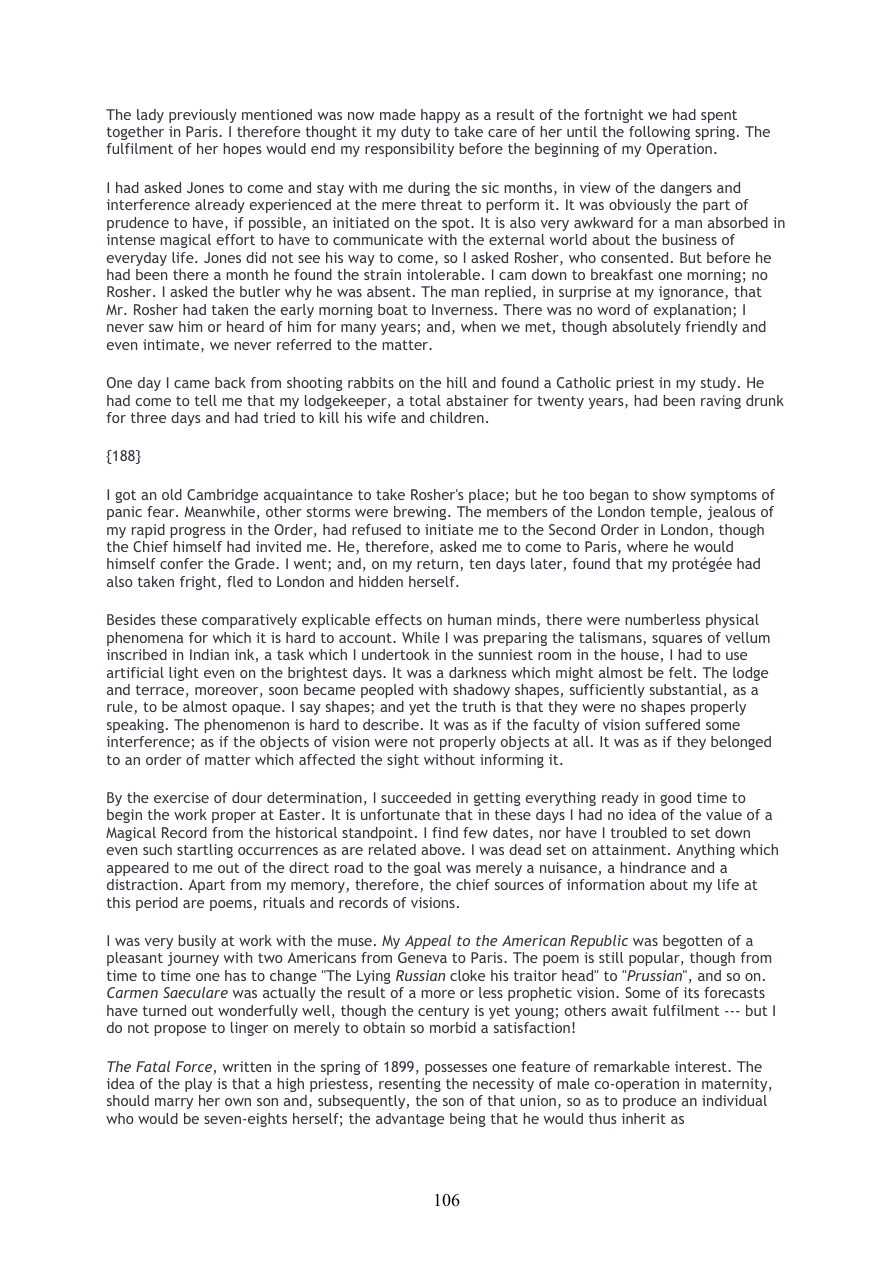
Highlights use the original PDF text layer. OCR-only matches may not be visible on the scan.
Transcription
Download text ↓raw extractionoriginal embedded textReview: unreviewed
106
The lady previously mentioned was now made happy as a result of the fortnight we had spent
together in Paris. I therefore thought it my duty to take care of her until the following spring. The
fulfilment of her hopes would end my responsibility before the beginning of my Operation.
I had asked Jones to come and stay with me during the sic months, in view of the dangers and
interference already experienced at the mere threat to perform it. It was obviously the part of
prudence to have, if possible, an initiated on the spot. It is also very awkward for a man absorbed in
intense magical effort to have to communicate with the external world about the business of
everyday life. Jones did not see his way to come, so I asked Rosher, who consented. But before he
had been there a month he found the strain intolerable. I cam down to breakfast one morning; no
Rosher. I asked the butler why he was absent. The man replied, in surprise at my ignorance, that
Mr. Rosher had taken the early morning boat to Inverness. There was no word of explanation; I
never saw him or heard of him for many years; and, when we met, though absolutely friendly and
even intimate, we never referred to the matter.
One day I came back from shooting rabbits on the hill and found a Catholic priest in my study. He
had come to tell me that my lodgekeeper, a total abstainer for twenty years, had been raving drunk
for three days and had tried to kill his wife and children.
{188}
I got an old Cambridge acquaintance to take Rosher's place; but he too began to show symptoms of
panic fear. Meanwhile, other storms were brewing. The members of the London temple, jealous of
my rapid progress in the Order, had refused to initiate me to the Second Order in London, though
the Chief himself had invited me. He, therefore, asked me to come to Paris, where he would
himself confer the Grade. I went; and, on my return, ten days later, found that my protégée had
also taken fright, fled to London and hidden herself.
Besides these comparatively explicable effects on human minds, there were numberless physical
phenomena for which it is hard to account. While I was preparing the talismans, squares of vellum
inscribed in Indian ink, a task which I undertook in the sunniest room in the house, I had to use
artificial light even on the brightest days. It was a darkness which might almost be felt. The lodge
and terrace, moreover, soon became peopled with shadowy shapes, sufficiently substantial, as a
rule, to be almost opaque. I say shapes; and yet the truth is that they were no shapes properly
speaking. The phenomenon is hard to describe. It was as if the faculty of vision suffered some
interference; as if the objects of vision were not properly objects at all. It was as if they belonged
to an order of matter which affected the sight without informing it.
By the exercise of dour determination, I succeeded in getting everything ready in good time to
begin the work proper at Easter. It is unfortunate that in these days I had no idea of the value of a
Magical Record from the historical standpoint. I find few dates, nor have I troubled to set down
even such startling occurrences as are related above. I was dead set on attainment. Anything which
appeared to me out of the direct road to the goal was merely a nuisance, a hindrance and a
distraction. Apart from my memory, therefore, the chief sources of information about my life at
this period are poems, rituals and records of visions.
I was very busily at work with the muse. My Appeal to the American Republic was begotten of a
pleasant journey with two Americans from Geneva to Paris. The poem is still popular, though from
time to time one has to change "The Lying Russian cloke his traitor head" to "Prussian", and so on.
Carmen Saeculare was actually the result of a more or less prophetic vision. Some of its forecasts
have turned out wonderfully well, though the century is yet young; others await fulfilment --- but I
do not propose to linger on merely to obtain so morbid a satisfaction!
The Fatal Force, written in the spring of 1899, possesses one feature of remarkable interest. The
idea of the play is that a high priestess, resenting the necessity of male co-operation in maternity,
should marry her own son and, subsequently, the son of that union, so as to produce an individual
who would be seven-eights herself; the advantage being that he would thus inherit as
Page provenance & review flags
Stable page ID: 5ef44b98d8f9c4af5f6f86e1:p00106
Line breaks are preserved. Reading order and OCR accuracy may need review.
Printed page label has not been verified.
- No automated review flags. This does not establish transcription accuracy.