1929 · CLOSE READING
Confessions of Aleister Crowley
Confessions of Aleister Crowley (1929), PDF p. 104
Original page
Enlarge ↗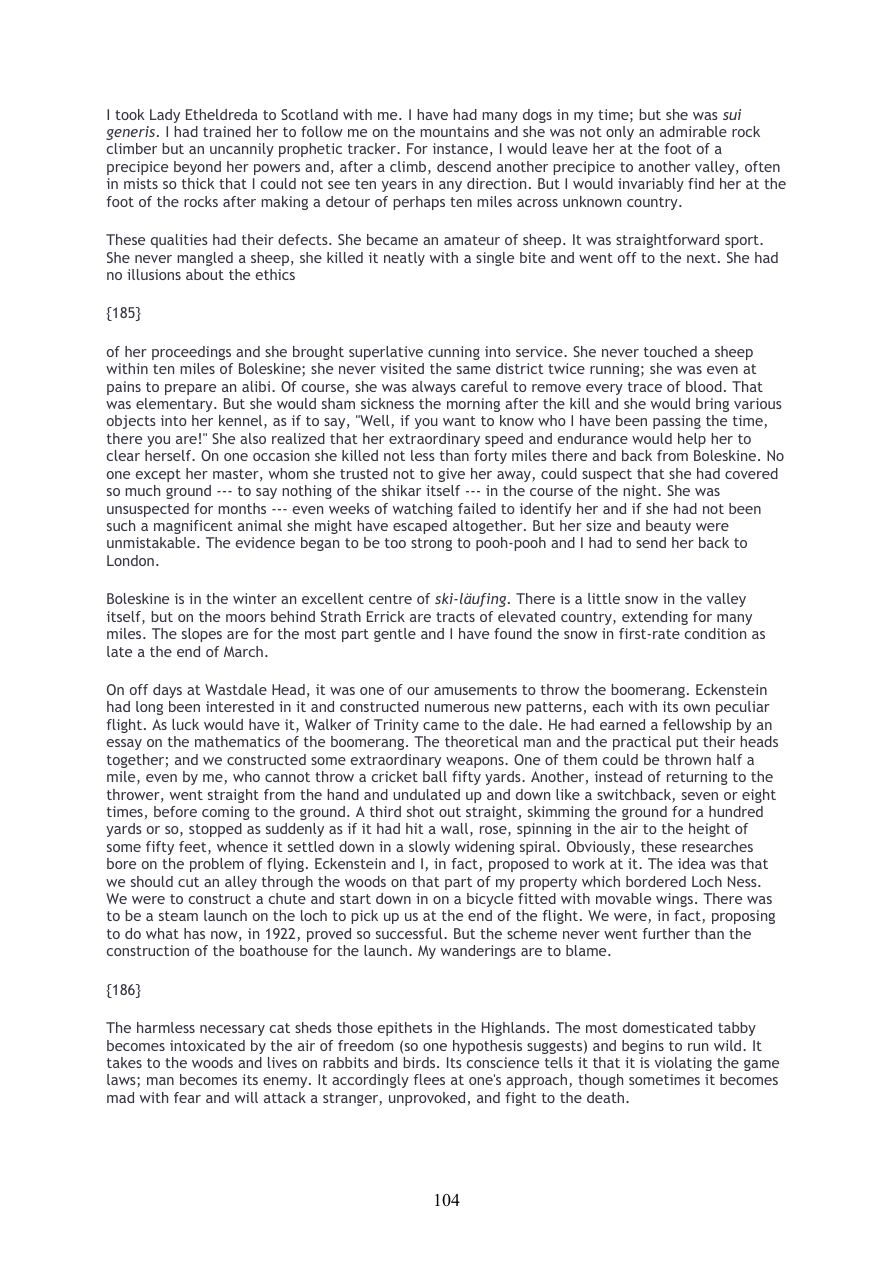
Highlights use the original PDF text layer. OCR-only matches may not be visible on the scan.
Transcription
Download text ↓raw extractionoriginal embedded textReview: unreviewed
104
I took Lady Etheldreda to Scotland with me. I have had many dogs in my time; but she was sui
generis. I had trained her to follow me on the mountains and she was not only an admirable rock
climber but an uncannily prophetic tracker. For instance, I would leave her at the foot of a
precipice beyond her powers and, after a climb, descend another precipice to another valley, often
in mists so thick that I could not see ten years in any direction. But I would invariably find her at the
foot of the rocks after making a detour of perhaps ten miles across unknown country.
These qualities had their defects. She became an amateur of sheep. It was straightforward sport.
She never mangled a sheep, she killed it neatly with a single bite and went off to the next. She had
no illusions about the ethics
{185}
of her proceedings and she brought superlative cunning into service. She never touched a sheep
within ten miles of Boleskine; she never visited the same district twice running; she was even at
pains to prepare an alibi. Of course, she was always careful to remove every trace of blood. That
was elementary. But she would sham sickness the morning after the kill and she would bring various
objects into her kennel, as if to say, "Well, if you want to know who I have been passing the time,
there you are!" She also realized that her extraordinary speed and endurance would help her to
clear herself. On one occasion she killed not less than forty miles there and back from Boleskine. No
one except her master, whom she trusted not to give her away, could suspect that she had covered
so much ground --- to say nothing of the shikar itself --- in the course of the night. She was
unsuspected for months --- even weeks of watching failed to identify her and if she had not been
such a magnificent animal she might have escaped altogether. But her size and beauty were
unmistakable. The evidence began to be too strong to pooh-pooh and I had to send her back to
London.
Boleskine is in the winter an excellent centre of ski-läufing. There is a little snow in the valley
itself, but on the moors behind Strath Errick are tracts of elevated country, extending for many
miles. The slopes are for the most part gentle and I have found the snow in first-rate condition as
late a the end of March.
On off days at Wastdale Head, it was one of our amusements to throw the boomerang. Eckenstein
had long been interested in it and constructed numerous new patterns, each with its own peculiar
flight. As luck would have it, Walker of Trinity came to the dale. He had earned a fellowship by an
essay on the mathematics of the boomerang. The theoretical man and the practical put their heads
together; and we constructed some extraordinary weapons. One of them could be thrown half a
mile, even by me, who cannot throw a cricket ball fifty yards. Another, instead of returning to the
thrower, went straight from the hand and undulated up and down like a switchback, seven or eight
times, before coming to the ground. A third shot out straight, skimming the ground for a hundred
yards or so, stopped as suddenly as if it had hit a wall, rose, spinning in the air to the height of
some fifty feet, whence it settled down in a slowly widening spiral. Obviously, these researches
bore on the problem of flying. Eckenstein and I, in fact, proposed to work at it. The idea was that
we should cut an alley through the woods on that part of my property which bordered Loch Ness.
We were to construct a chute and start down in on a bicycle fitted with movable wings. There was
to be a steam launch on the loch to pick up us at the end of the flight. We were, in fact, proposing
to do what has now, in 1922, proved so successful. But the scheme never went further than the
construction of the boathouse for the launch. My wanderings are to blame.
{186}
The harmless necessary cat sheds those epithets in the Highlands. The most domesticated tabby
becomes intoxicated by the air of freedom (so one hypothesis suggests) and begins to run wild. It
takes to the woods and lives on rabbits and birds. Its conscience tells it that it is violating the game
laws; man becomes its enemy. It accordingly flees at one's approach, though sometimes it becomes
mad with fear and will attack a stranger, unprovoked, and fight to the death.
Page provenance & review flags
Stable page ID: 5ef44b98d8f9c4af5f6f86e1:p00104
Line breaks are preserved. Reading order and OCR accuracy may need review.
Printed page label has not been verified.
- No automated review flags. This does not establish transcription accuracy.