1929 · CLOSE READING
Confessions of Aleister Crowley
Confessions of Aleister Crowley (1929), PDF p. 103
Original page
Enlarge ↗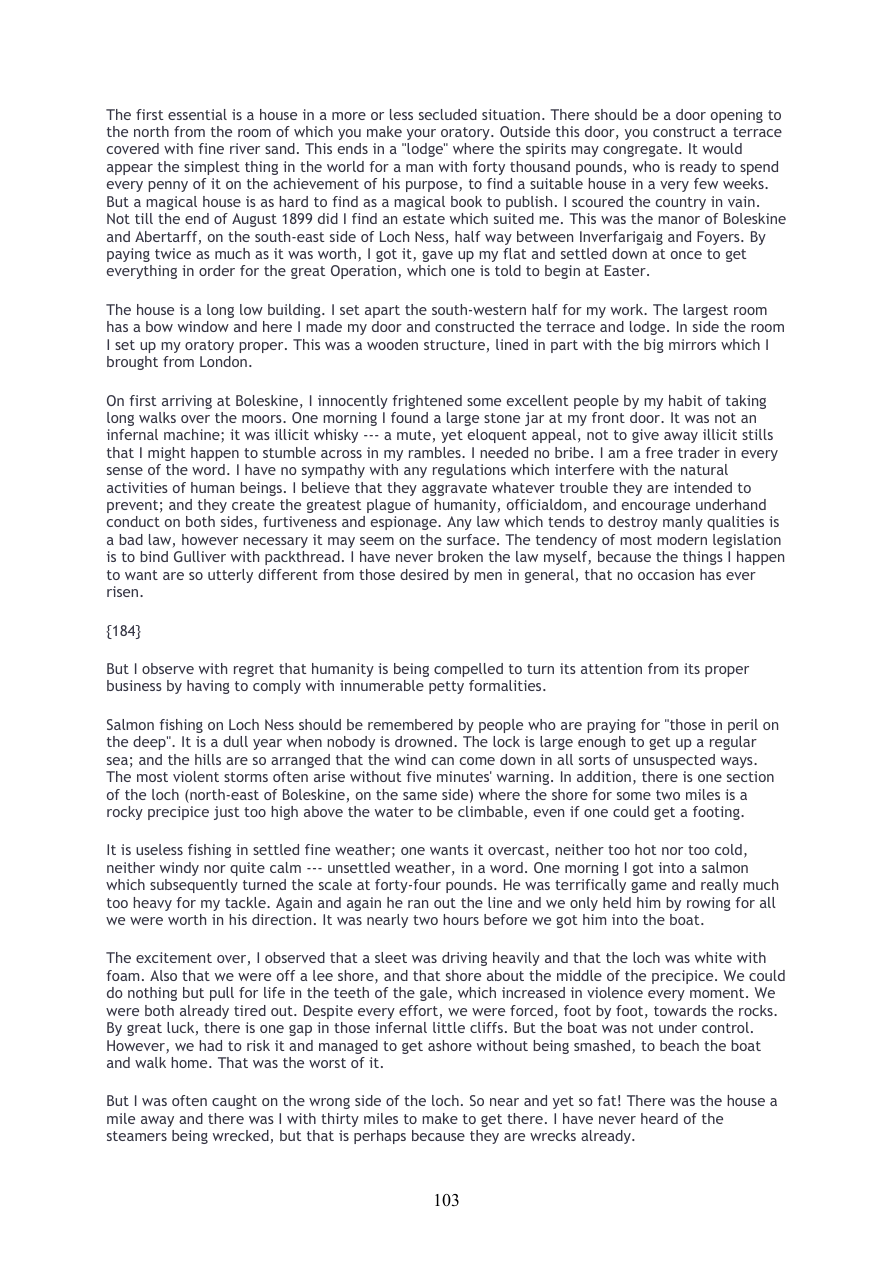
Highlights use the original PDF text layer. OCR-only matches may not be visible on the scan.
Transcription
Download text ↓raw extractionoriginal embedded textReview: unreviewed
103
The first essential is a house in a more or less secluded situation. There should be a door opening to
the north from the room of which you make your oratory. Outside this door, you construct a terrace
covered with fine river sand. This ends in a "lodge" where the spirits may congregate. It would
appear the simplest thing in the world for a man with forty thousand pounds, who is ready to spend
every penny of it on the achievement of his purpose, to find a suitable house in a very few weeks.
But a magical house is as hard to find as a magical book to publish. I scoured the country in vain.
Not till the end of August 1899 did I find an estate which suited me. This was the manor of Boleskine
and Abertarff, on the south-east side of Loch Ness, half way between Inverfarigaig and Foyers. By
paying twice as much as it was worth, I got it, gave up my flat and settled down at once to get
everything in order for the great Operation, which one is told to begin at Easter.
The house is a long low building. I set apart the south-western half for my work. The largest room
has a bow window and here I made my door and constructed the terrace and lodge. In side the room
I set up my oratory proper. This was a wooden structure, lined in part with the big mirrors which I
brought from London.
On first arriving at Boleskine, I innocently frightened some excellent people by my habit of taking
long walks over the moors. One morning I found a large stone jar at my front door. It was not an
infernal machine; it was illicit whisky --- a mute, yet eloquent appeal, not to give away illicit stills
that I might happen to stumble across in my rambles. I needed no bribe. I am a free trader in every
sense of the word. I have no sympathy with any regulations which interfere with the natural
activities of human beings. I believe that they aggravate whatever trouble they are intended to
prevent; and they create the greatest plague of humanity, officialdom, and encourage underhand
conduct on both sides, furtiveness and espionage. Any law which tends to destroy manly qualities is
a bad law, however necessary it may seem on the surface. The tendency of most modern legislation
is to bind Gulliver with packthread. I have never broken the law myself, because the things I happen
to want are so utterly different from those desired by men in general, that no occasion has ever
risen.
{184}
But I observe with regret that humanity is being compelled to turn its attention from its proper
business by having to comply with innumerable petty formalities.
Salmon fishing on Loch Ness should be remembered by people who are praying for "those in peril on
the deep". It is a dull year when nobody is drowned. The lock is large enough to get up a regular
sea; and the hills are so arranged that the wind can come down in all sorts of unsuspected ways.
The most violent storms often arise without five minutes' warning. In addition, there is one section
of the loch (north-east of Boleskine, on the same side) where the shore for some two miles is a
rocky precipice just too high above the water to be climbable, even if one could get a footing.
It is useless fishing in settled fine weather; one wants it overcast, neither too hot nor too cold,
neither windy nor quite calm --- unsettled weather, in a word. One morning I got into a salmon
which subsequently turned the scale at forty-four pounds. He was terrifically game and really much
too heavy for my tackle. Again and again he ran out the line and we only held him by rowing for all
we were worth in his direction. It was nearly two hours before we got him into the boat.
The excitement over, I observed that a sleet was driving heavily and that the loch was white with
foam. Also that we were off a lee shore, and that shore about the middle of the precipice. We could
do nothing but pull for life in the teeth of the gale, which increased in violence every moment. We
were both already tired out. Despite every effort, we were forced, foot by foot, towards the rocks.
By great luck, there is one gap in those infernal little cliffs. But the boat was not under control.
However, we had to risk it and managed to get ashore without being smashed, to beach the boat
and walk home. That was the worst of it.
But I was often caught on the wrong side of the loch. So near and yet so fat! There was the house a
mile away and there was I with thirty miles to make to get there. I have never heard of the
steamers being wrecked, but that is perhaps because they are wrecks already.
Page provenance & review flags
Stable page ID: 5ef44b98d8f9c4af5f6f86e1:p00103
Line breaks are preserved. Reading order and OCR accuracy may need review.
Printed page label has not been verified.
- No automated review flags. This does not establish transcription accuracy.