1906 · CLOSE READING
Collected Works (Vol. II)
Collected Works (Vol. II) (1906), PDF p. 92
Original page
Enlarge ↗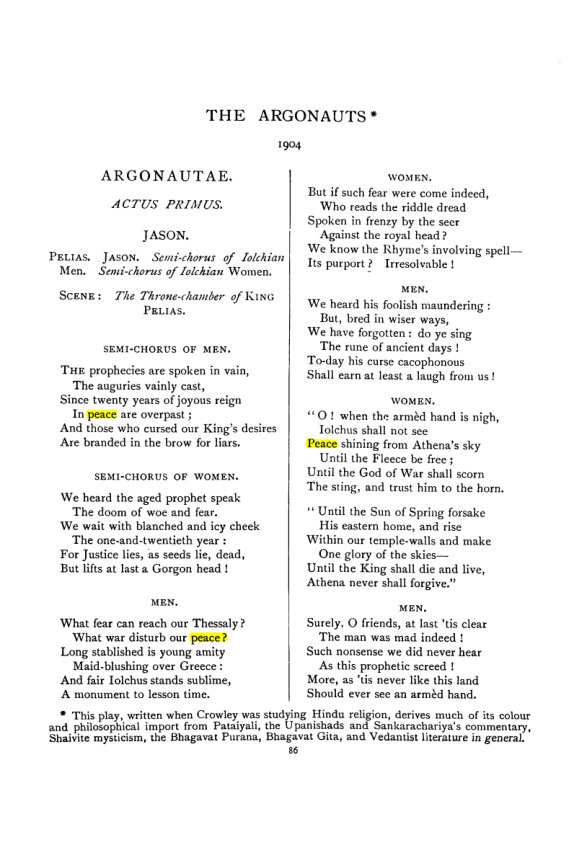
Highlights use the original PDF text layer. OCR-only matches may not be visible on the scan.
Transcription
Download text ↓raw extractionoriginal embedded textReview: unreviewed
THE ARGONAUTS*
1904
ARGONAUTAE.
ACTUS PRIMUS.
JASON.
PELIAS, JASON. Semz-chorus of Lolchian
Men. Sewmz-chorus of Lolchian Women.
SCENE: The Throne-chamber of KING
PELIAS.
SEMI-CHORUS OF MEN.
THE prophecies are spoken in vain,
The auguries vainly cast,
Since twenty years of joyous reign
In peace are overpast ;
And those who cursed our King’s desires
Are branded in the brow for liars.
SEMI-CHORUS OF WOMEN.
We heard the aged prophet speak
The doom of woe and fear.
We wait with blanched and icy cheek
The one-and-twentieth year :
For Justice lies, as seeds lie, dead,
But lifts at last a Gorgon head !
MEN.
What fear can reach our Thessaly?
What war disturb our peace?
Long stablished is young amity
Maid-blushing over Greece :
And fair Iolchus stands sublime,
A monument to lesson time.
WOMEN.
But if such fear were come indeed,
Who reads the riddle dread
Spoken in frenzy by the seer
Against the royal head?
We know the Rhyme’s involving spell—
Its purport? Irresolvable !
MEN.
We heard his foolish maundering :
But, bred in wiser ways,
We have forgotten: do ye sing
The rune of ancient days !
To-day his curse cacophonous
Shall earn at least a laugh from us!
WOMEN.
‘*O! when the arméd hand is nigh,
Tolchus shall not see
Peace shining from Athena’s sky
Until the Fleece be free;
Until the God of War shall scorn
The sting, and trust him to the horn.
‘Until the Sun of Spring forsake
His eastern home, and rise
Within our temple-walls and make
One glory of the skies—
Until the King shall die and live,
Athena never shall forgive.”
MEN,
Surely, O friends, at last ’tis clear
The man was mad indeed !
Such nonsense we did never hear
As this prophetic screed !
More, as ’tis never like this land
Should ever see an arméd hand.
* This play, written when Crowley was studying Hindu religion, derives much of its colour
and philosophical import from Pataiyali, the Upanishads and Sankarachariya’s commentary,
Shaivite mysticism, the Bhagavat Purana, Bhagavat Gita, and Vedantist literature in general.
Page provenance & review flags
Stable page ID: 59a930c2e614ddb0b1a2a000:p00092
Line breaks are preserved. Reading order and OCR accuracy may need review.
Printed page label has not been verified.
- No automated review flags. This does not establish transcription accuracy.