1906 · CLOSE READING
Collected Works (Vol. II)
Collected Works (Vol. II) (1906), PDF p. 60
Original page
Enlarge ↗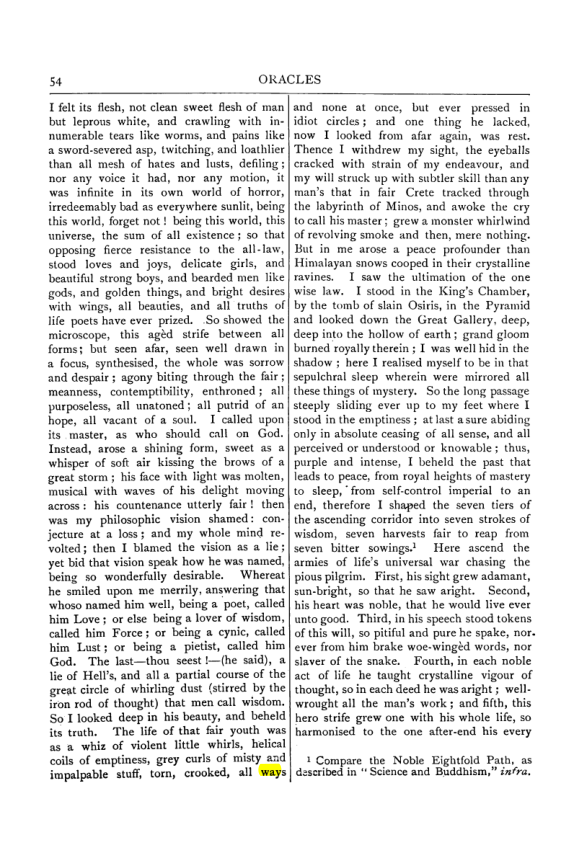
Highlights use the original PDF text layer. OCR-only matches may not be visible on the scan.
Transcription
Download text ↓raw extractionoriginal embedded textReview: unreviewed
54
ORACLES
I felt its flesh, not clean sweet flesh of man
but leprous white, and crawling with in-
numerable tears like worms, and pains like
a sword-severed asp, twitching, and loathlier
than all mesh of hates and lusts, defiling;
nor any voice it had, nor any motion, it
was infinite in its own world of horror,
irredeemably bad as everywhere sunlit, being
this world, forget not ! being this world, this
universe, the sum of all existence; so that
opposing fierce resistance to the all-law,
stood loves and joys, delicate girls, and
beautiful strong boys, and bearded men like
gods, and golden things, and bright desires
with wings, all beauties, and all truths of
life poets have ever prized. .So showed the
microscope, this agéd strife between all
forms: but seen afar, seen well drawn in
a focus, synthesised, the whole was sorrow
and despair; agony biting through the fair;
meanness, contemptibility, enthroned; all
purposeless, all unatoned; all putrid of an
hope, all vacant of a soul. I called upon
its master, as who should call on God.
Instead, arose a shining form, sweet as a
whisper of soft air kissing the brows of a
great storm; his face with light was molten,
musical with waves of his delight moving
across: his countenance utterly fair! then
was my philosophic vision shamed: con-
jecture at a loss; and my whole mind re-
volted; then I blamed the vision as a lie;
yet bid that vision speak how he was named,
being so wonderfully desirable. Whereat
he smiled upon me merrily, answering that
whoso named him well, being a poet, called
him Love; or else being a lover of wisdom,
called him Force; or being a cynic, called
him Lust; or being a pietist, called him
God. The last—thou seest !—(he said), a
lie of Hell’s, and alla partial course of the
great circle of whirling dust (stirred by the
iron rod of thought) that men call wisdom.
So I looked deepin his beauty, and beheld
its truth. The life of that fair youth was
as a whiz of violent little whirls, helical
coils of emptiness, grey curls of misty and
impalpable stuff, torn, crooked, all ways
and none at once, but ever pressed in
idiot circles; and one thing he lacked,
now I looked from afar again, was rest.
Thence I withdrew my sight, the eyeballs
cracked with strain of my endeavour, and
my will struck up with subtler skill than any
man’s that in fair Crete tracked through
the labyrinth of Minos, and awoke the cry
to call his master; grew a monster whirlwind
of revolving smoke and then, mere nothing.
But in me arose a peace profounder than
Himalayan snows cooped in their crystalline
ravines. I saw the ultimation of the one
wise law. I stood in the King’s Chamber,
by the tomb of slain Osiris, in the Pyramid
and looked down the Great Gallery, deep,
deep into the hollow of earth; grand gloom
burned royally therein ; I was well hid in the
shadow ; here I realised myself to be in that
sepulchral sleep wherein were mirrored all
these things of mystery. So the long passage
steeply sliding ever up to my feet where I
stood in the emptiness ; at last asure abiding
only in absolute ceasing of all sense, and all
perceived or understood or knowable; thus,
purple and intense, I beheld the past that
leads to peace, from royal heights of mastery
to sleep, from self-control imperial to an
end, therefore I shaped the seven tiers of
the ascending corridor into seven strokes of
wisdom, seven harvests fair to reap from
seven bitter sowings. Here ascend the
armies of life’s universal war chasing the
pious pilgrim. First, his sight grew adamant,
sun-bright, so that he saw aright. Second,
his heart was noble, that he would live ever
unto good. Third, in his speech stood tokens
of this will, so pitiful and pure he spake, nor.
ever from him brake woe-winged words, nor
slaver of the snake. Fourth, in each noble
act of life he taught crystalline vigour of
thought, so in each deed he was aright ; well-
wrought all the man’s work; and fifth, this
hero strife grew one with his whole life, so
harmonised to the one after-end his every
1 Compare the Noble Eightfold Path, as
described in ‘‘ Science and Buddhism,” zzfra.
Page provenance & review flags
Stable page ID: 59a930c2e614ddb0b1a2a000:p00060
Line breaks are preserved. Reading order and OCR accuracy may need review.
Printed page label has not been verified.
- No automated review flags. This does not establish transcription accuracy.