1906 · CLOSE READING
Collected Works (Vol. II)
Collected Works (Vol. II) (1906), PDF p. 50
Original page
Enlarge ↗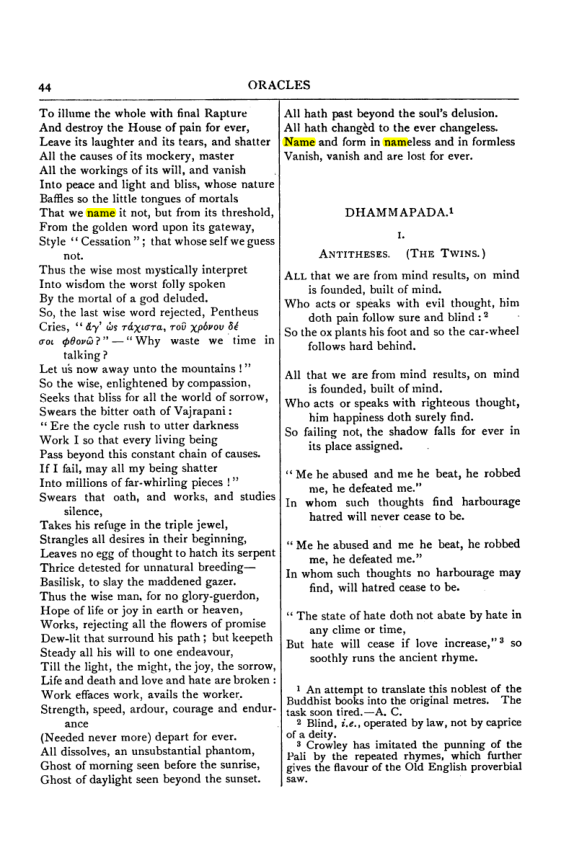
Highlights use the original PDF text layer. OCR-only matches may not be visible on the scan.
Transcription
Download text ↓raw extractionoriginal embedded textReview: unreviewed
44
ORACLES
To illume the whole with final Rapture
And destroy the House of pain for ever,
Leave its laughter and its tears, and shatter
All the causes of its mockery, master
All the workings of its will, and vanish
Into peace and light and bliss, whose nature
Baffles so the little tongues of mortals
That we name it not, but from its threshold,
From the golden word upon its gateway,
Style ‘‘ Cessation”; that whose self we guess
not.
Thus the wise most mystically interpret
Into wisdom the worst folly spoken
By the mortal of a god deluded.
So, the last wise word rejected, Pentheus
Cries, ‘‘ dy’ ws rdxuora, To0 xpbvov dé
co. POovar’”
—“ Why waste we time in
talking ?
Let us now away unto the mountains !”
So the wise, enlightened by compassion,
Seeks that bliss for all the world of sorrow,
Swears the bitter oath of Vajrapani:
‘‘ Ere the cycle rush to utter darkness
Work I so that every living being
Pass beyond this constant chain of causes.
If I fail, may all my being shatter
Into millions of far-whirling pieces !”
Swears that oath, and works, and studies
silence,
Takes his refuge in the triple jewel,
Strangles all desires in their beginning,
Leaves no egg of thought to hatch its serpent
Thrice detested for unnatural breeding—
Basilisk, to slay the maddened gazer.
Thus the wise man, for no glory-guerdon,
Hope of life or joy in earth or heaven,
Works, rejecting all the flowers of promise
Dew-lit that surround his path; but keepeth
Steady all his will to one endeavour,
Till the light, the might, the joy, the sorrow,
Life and death and love and hate are broken :
Work effaces work, avails the worker.
Strength, speed, ardour, courage and endur-
ance
(Needed never more) depart for ever.
All dissolves, an unsubstantial phantom,
Ghost of morning seen before the sunrise,
Ghost of daylight seen beyond the sunset.
All hath past beyond the soul’s delusion.
All hath changéd to the ever changeless.
Name and form in nameless and in formless
Vanish, vanish and are lost for ever.
DHAMMAPADA.!
I.
ANTITHESES. (THE TWINS.)
ALL that we are from mind results, on mind
is founded, built of mind.
Who acts or speaks with evil thought, him
doth pain follow sure and blind :?
So the ox plants his foot and so the car-wheel
follows hard behind.
All that we are from mind results, on mind
is founded, built of mind.
Who acts or speaks with righteous thought,
him happiness doth surely find.
So failing not, the shadow falls for ever in
its place assigned.
‘“Me he abused and me he beat, he robbed
me, he defeated me.”
In whom such thoughts find harbourage
hatred will never cease to be.
‘‘Me he abused and me he beat, he robbed
me, he defeated me.”
In whom such thoughts no harbourage may
find, will hatred cease to be.
‘‘ The state of hate doth not abate by hate in
any clime or time,
But hate will cease if love increase,’’? so
soothly runs the ancient rhyme.
1 An attempt to translate this noblest of the
Buddhist books into the original metres. The
task soon tired.—A, C.
2 Blind, z.e., operated by law, not by caprice
of a deity.
3 Crowley has imitated the punning of the
Pali by the repeated rhymes, which further
gives the flavour of the Old English proverbial
saw.
Page provenance & review flags
Stable page ID: 59a930c2e614ddb0b1a2a000:p00050
Line breaks are preserved. Reading order and OCR accuracy may need review.
Printed page label has not been verified.
- No automated review flags. This does not establish transcription accuracy.