1906 · CLOSE READING
Collected Works (Vol. II)
Collected Works (Vol. II) (1906), PDF p. 287
Original page
Enlarge ↗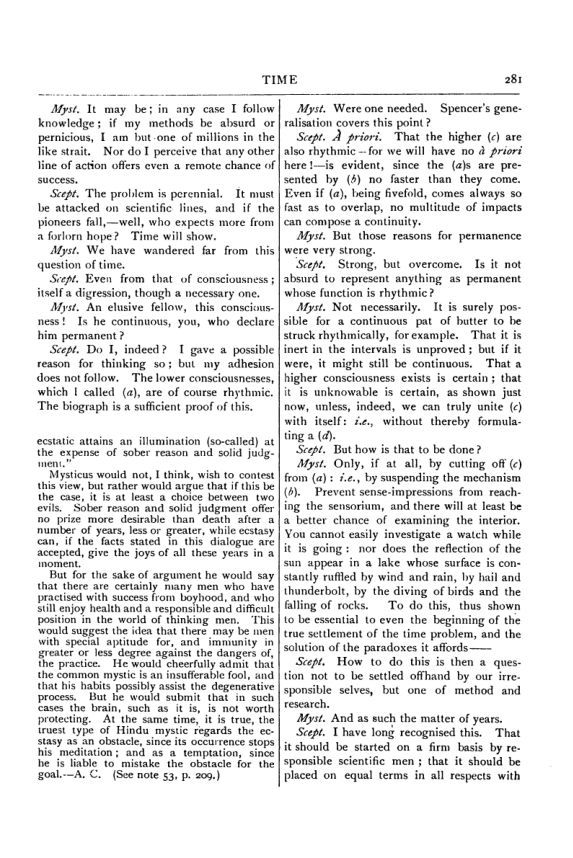
Highlights use the original PDF text layer. OCR-only matches may not be visible on the scan.
Transcription
Download text ↓raw extractionoriginal embedded textReview: unreviewed
TIME
281
Myst. It may be; in any case I follow
knowledge; if my methods be absurd or
pernicious, I am but-one of millions in the
like strait. Nor dol perceive that any other
line of action offers even a remote chance of
success.
Scept. The problem is perennial. It must
be attacked on scientific: lines, and if the
pioneers fall,—well, who expects more from
a forlorn hope? Time will show.
Myst. We have wandered far from this
question of time.
Scept. Even from that of consciousness;
itselfa digression, though a necessary one.
Myst. An elusive fellow, this conscious-
ness! Is he continuous, you, who declare
him permanent?
Scept. Do I, indeed? I gave a possible
reason for thinking so; but my adhesion
does not follow. The lower consciousnesses,
which I called (a), are of course rhythmic.
The biograph is a sufficient proof of this.
ecstatic attains an illumination (so-called) at
the expense of sober reason and solid judg-
ment.”
Mysticus would not, I think, wish to contest
this view, but rather would argue that if this be
the case, it is at least a choice between two
evils. Sober reason and solid judgment offer
no prize more desirable than death after a
number of years, less or greater, while ecstasy
can, if the facts stated in this dialogue are
accepted, give the joys of all these years in a
moment.
But for the sake of argument he would say
that there are certainly many men who have
practised with success from boyhood, and who
still enjoy health and a responsible and difficult
position in the world of thinking men. This
would suggest the idea that there may be men
with special aptitude for, and immunity in
greater or less degree against the dangers of,
the practice. He would cheerfully admit that
the common mystic is an insufferable fool, and
that his habits possibly assist the degenerative
process. But he would submit that in such
cases the brain, such as it is, is not worth
protecting. At the same time, it is true, the
truest type of Hindu mystic regards the ec-
stasy as an obstacle, since its occurrence stops
his meditation; and as a temptation, since
he is liable to mistake the obstacle for the
goal.-—A. C. (See note 53, p. 209.)
Myst. Were one needed. Spencer’s gene-
ralisation covers this point?
Scept. A priori. That the higher (c) are
also rhythmic
-- for we will have no @ prior
here !-—is evident, since the (a@)s are pre-
sented by (4) no faster than they come.
Even if (a), being fivefold, comes always so
fast as to overlap, no multitude of impacts
can compose a continuity.
Myst. But those reasons for permanence
were very strong.
Scept. Strong, but overcome. Is it not
absurd to represent anything as permanent
whose function is rhythmic?
Myst. Not necessarily. It is surely pos-
sible for a continuous pat of butter to be
struck rhythmically, forexample. That it is
inert in the intervals is unproved; but if it
were, it might still be continuous. That a
higher consciousness exists is certain; that
it is unknowable is certain, as shown just
now, unless, indeed, we can truly unite (c)
with itself: z.e., without thereby formula-
ting a (a).
Scept. But how is that to be done?
Myst. Only, if at all, by cutting off (c)
from (a): 7.e., by suspending the mechanism
(4). Prevent sense-impressions from reach-
ing the sensorium, and there will at least be
a better chance of examining the interior.
You cannot easily investigate a watch while
it is going: nor does the reflection of the
sun appear in a lake whose surface is con-
stantly ruffled by wind and rain, by hail and
thunderbolt, by the diving of birds and the
falling of rocks. To do this, thus shown
to be essential to even the beginning of the
true settlement of the time problem, and the
solution of the paradoxes it affords
——
Scept. How to do this is then a ques-
tion not to be settled offhand by our irre-
sponsible selves, but one of method and
research.
Myst. And as such the matter of years.
Scept. have long recognised this. That
it should be started on a firm basis by re-
sponsible scientific men; that it should be
placed on equal terms in all respects with
Page provenance & review flags
Stable page ID: 59a930c2e614ddb0b1a2a000:p00287
Line breaks are preserved. Reading order and OCR accuracy may need review.
Printed page label has not been verified.
- No automated review flags. This does not establish transcription accuracy.